Answering a few questions about last week’s superstorm, and assessing how hot it will get this week

In brief: Houston will remain warm and humid through next weekend, with partly to mostly sunny days and highs generally in the low 90s. Rain chances are low throughout the period. Today’s post also addresses some lingering questions from last week’s storms, including why the event was not particularly well predicted.

Over the weekend, the greater Houston region continued to recover from damaging winds last Thursday. On Sunday evening, CenterPoint said that it had restored electricity to more than 700,000 people who lost power, with about 240,000 customers still without. The transmission company said it remains on track to be “substantially complete” with power restoration by Wednesday evening. Before jumping into the forecast here are some additional thoughts about the very strong storms that arrived last week.

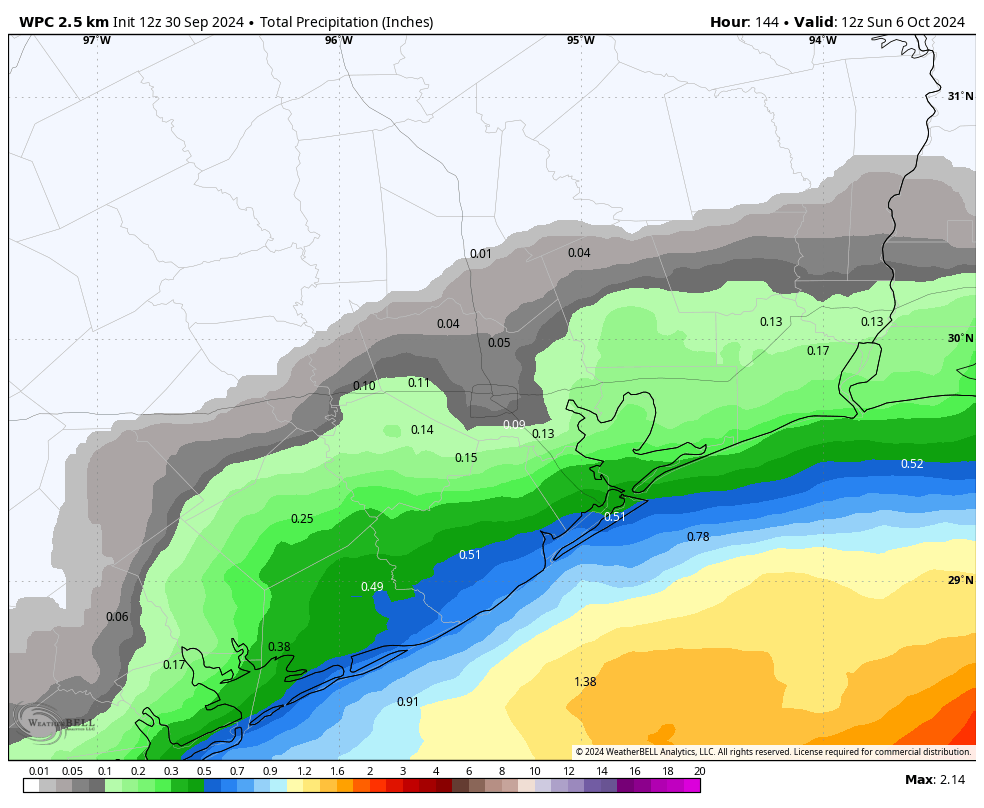
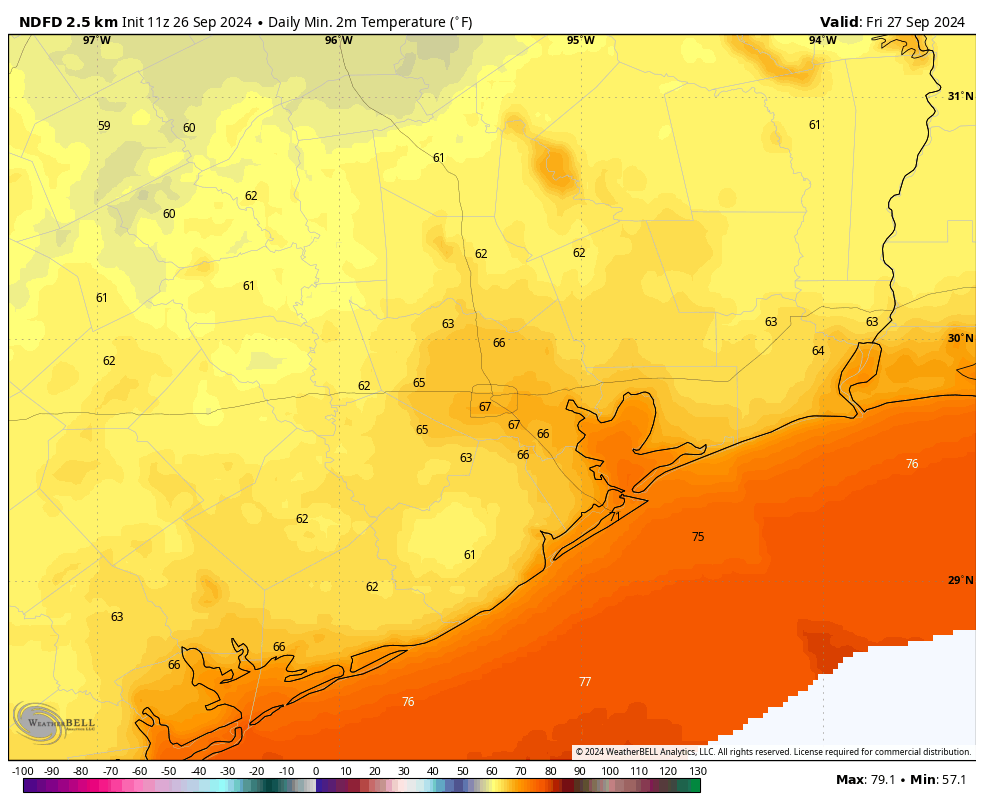
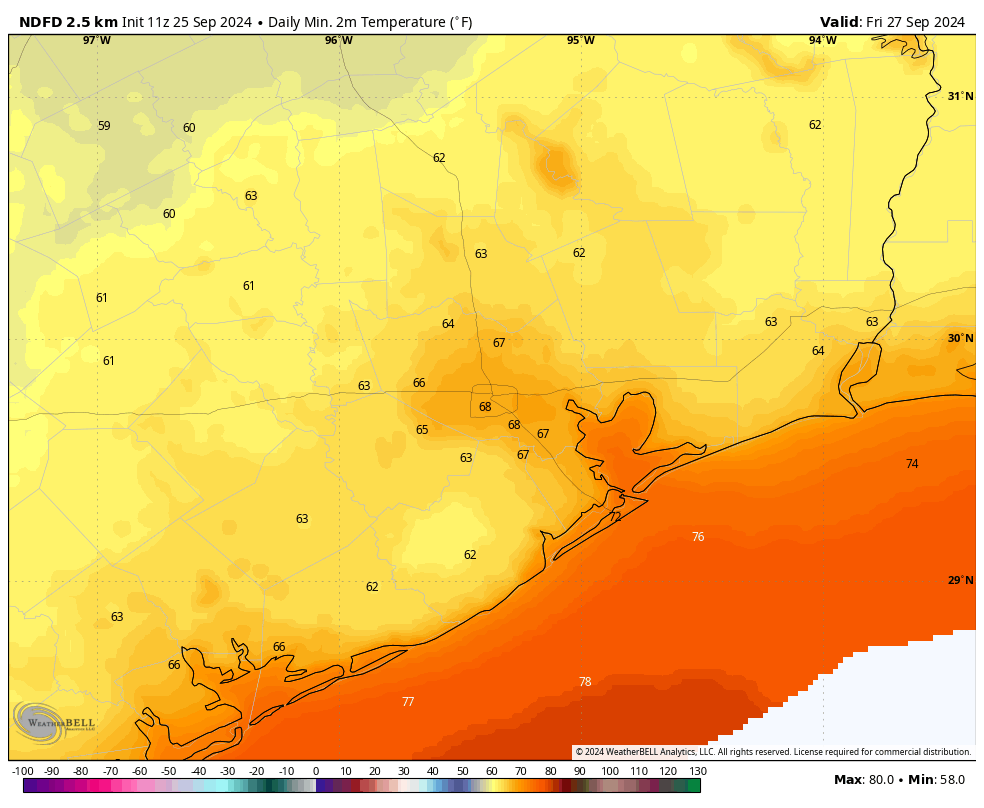
Outside of north Texas, it won’t rain much this week. This will help recovery activities from last week’s storms proceed. (Weather Bell)

Why wasn’t this well predicted?

This is a great question. The answer is that we have seen these kinds of setups before in which there is an atmosphere primed with moisture and instability, and with a potential trigger for supercell storms to form many times before. However, even hours before their development just west of Houston on Thursday, there was no ready data to indicate the true severity of the blow-the-doors-off storm that was coming.

It’s the kind of thing where there maybe is a 1-in-50 or a 1-in-100 chance that something so severe, a supercell event with very strong straight-line winds directly over the city’s urban core, could develop. If we had messaged that an “extremely dangerous and destructive event” was coming the previous 10 times there was such an atmospheric setup, and nothing of any real significance happened, who would believe us on the 11th time? There is a boy-who-cried-wolf problem here. The only real solution here is that we try harder to find that bit of data that gives us more confidence in a rare event like this one. I’m confident that Thursday’s storms will be studied in depth to identify such clues.

I was lying in bed on Sunday morning thinking about all of this—yes, I lose sleep worrying about this kind of stuff—and of all things a 2002 Houston Texans football game popped into mind. It was December 8, the team’s first season, and being an expansion franchise the Texans were not great. That week the Texans had to go to Pittsburgh and play the Steelers in near-freezing temperatures for a meaningless game. The Steelers were a decent football team, nothing fantastic, but were expected to blow the Texans out. The line was Steelers -14. The Steelers outgained the Texans 442 yards to 47. They won the time of possession with 40 minutes to 20 minutes. Texans quarterback David Carr was 3-of-10 passing, for 33 yards. That was in line with expectations.

But the Texans won 24 to 6. They returned three turnovers for touchdowns, and kicked a field goal after a short drive. The Steelers had many more penalties. Their two long drives ended in field goals rather than touchdowns. It was just an odd day. While the final score was within the bound of possibilities, on any given Sunday anything can happen when two teams meet, it was the lowest probability event. That’s kind of like what happened Thursday. A super-storm was within the realms of possibility, but was like an expansion team playing terribly, but still blowing out the Pittsburgh Steelers on the road in very cold conditions.

Why weren’t there more real-time warnings?

This is something Matt and I are taking away from the storms. I feel like we do a good job of forecasting the weather here, but where we struggle is in real-time coverage. Some readers have asked why we did not send out warnings for tornadoes on Thursday. That is because this is the express function of the National Weather Service, which has a large staff and the technology to send out real time warnings for tornadoes and other life-threatening weather events. Here’s more information about the agency’s wireless emergency alerts program. They are the experts at that, and we defer to them.

Matt and I were both tracking Thursday’s storm in real time. We were on top of things. And there was perhaps a 30 to 60-minute window between 5:30 and 6:30 p.m. when we could have provided some actionable information. However, in the time it would take to write and disseminate a post about that in real-time, the dynamic event might have already passed for most people. One possible solution is that we are likely to start sending (albeit very rarely) “urgent notifications” through our app. It is available for free here for Apple ioS, and here for Android. Regardless, we recognize this as a weakness and will address it here at Space City Weather. For one thing, we are changing the frequency of updates on days when severe weather is possible.

Monday

Our overall warm, but not extremely hot pattern will continue as we inch toward the end of May. With high pressure largely in control we’ll see this pattern largely persist through the holiday weekend, with the only really noticeable change in the strength of southerly winds, or a few more clouds on some days. For today, we’ll see highs generally in the low 90s, with only coastal areas unlikely to reach 90 degrees. Skies will be mostly sunny. Winds will blow from the southeast at 5 to 10 mph. Overnight lows will be warmer than we’ve seen, dropping only into the upper 70s.

Our weather will be nothing if not consistent this week. (Weather Bell)

Tuesday and Wednesday

In response to low pressure over the central United States, we’ll see an uptick in southerly winds with gusts up to 25 mph. Both days will see partly to sunny skies, with highs around 90 degrees. Nights remain quite warm.

Thursday and Friday

These will be partly to mostly sunny days, with winds perhaps slackening a bit. Highs in the low 90s. There is perhaps a 10 percent chance of rain showers each afternoon.

Saturday, Sunday, and Monday

Memorial Day weekend looks warm and sunny. Expect highs in the low 90s, with warm nights. Rain chances remain near nil. Plan your outdoor activities with confidence.

Next week

There are some hints of a pattern change by Tuesday or Wednesday of next week, with possibly a weak front sneaking into the area at the end of the month, and bringing with it a smattering of rain chances. This is far enough into the forecast, however, that my overall confidence is quite low. We shall see.

Power remains out for a quarter of Houston as we begin to assess carnage from Thursday’s storms

In brief: Ironically, Thursday was “National Love a Tree Day.” Instead of loving trees, however, a line of storms ripped through the heart of Houston and tore many thousands of them down, killing a handful of people, damaging homes and vehicles, and bringing down power lines. In this post we’ll provide some meteorological data about what happened Thursday, and a forecast looking ahead to calmer weather.

Tornadoes

The National Weather Service has completed a survey of damage from two confirmed tornadoes that struck Houston on Thursday evening, one at 5:44 pm near Pine Island in Waller County, and the second at 6:08 pm near Jersey Village in Harris County. Here is the summary of those investigations:

Waller County tornado

  • Rated EF1
  • Peak winds: 100 mph
  • Path length: 0.71 miles
  • Path width: 100 yards
  • No fatalities or injuries
  • Duration: 5:44 to 5:45 pm CT
  • Significant tree damage, large metal barn destroyed, metal debris thrown up to 1,000 yards away.
Radar signature of the Cypress tornado. (National Weather Service)

Cypress tornado

  • Rated EF1
  • Peak winds: 110 mph
  • Path length: 0.77 miles
  • Path width: 100 yards
  • No fatalities or injuries
  • Duration: 6:08 to 6:09 pm CT
  • Numerous single family homes had roof damage and broken windows. Damage path well defined.

This is a preliminary report that may be adjusted in the future.

Straight-line wind damage

As Matt noted yesterday, most of the damage in the region was caused by straight-line winds, and what appeared to be something of a mini-derecho. The National Weather Service has also collected maximum wind reports from around the area on Thursday afternoon and evening. Some of the highest values were recorded at Texas A&M University, 71 mph, and the Houston Ship Channel, 74 mph.

Very strong winds just above the surface were able to break through, and get down to the ground. These winds a few hundred feet above the ground were even stronger than what was observed at ground level. This is likely the reason why some skyscrapers in downtown Houston observed significant damage at their upper levels.

Power outages

About one-quarter of customers in Harris County are still without electricity this morning. In an update to the media on Friday evening, CenterPoint Energy said restoration could take “several days or longer” for the hardest hit areas.

“As crews continue to uncover damage and encounter new challenges while making repairs, restoration may take more time than customers typically experience following a routine storm event,” the company said. “CenterPoint Energy appreciates customers’ patience, and the company will work around-the-clock until the last customer is restored.”

We genuinely appreciate the hard work by all of the lineman working to restore power. It is a hard and hot business to rapidly repair storm damage, I know first-hand how hard the men and women are working out there.

Flooding

The heaviest rainfall on Thursday occurred north of the area, in locations such as College Station and Livingston, which have already been inundated over the last 30 days. Significant river flooding is likely along the East Fork of the San Jacinto River later this weekend, whereas the Trinity River is already cresting today before a slow fall next week.

The East Fork of the San Jacinto River will make a steep rise on Saturday. (National Weather Service)

Fortunately the entire southeast Texas region will now get a chance to dry out. Our weather is about to get boring.

Forecast

After the fog lifts this morning we’ll see sunny and hot conditions today, with highs likely in the low 90s. And that’s pretty much your forecast for the next week, at least. The only change will be gradually warming nights. Lows this morning got to below 70 degrees for most locations. It was, almost, nice? Well, except for the mosquitoes. By Wednesday or Thursday morning, our lows are likely to only dip into the upper 70s. Rain chances are nil for the foreseeable future.

We wish everyone the best this weekend as you recover from Thursday’s storms, and thank everyone who is out there helping to pick up the pieces. This community is at its best in moments like these, when we’re all working together.

Spring just ended with a bang in Houston

In brief: A line of severe storms moved through Houston on Thursday evening bringing heavy rainfall, and instances of damaging winds and tornadoes. We’ll have a full rundown tomorrow, but it has been a wild few hours. The point of this post is to let you know that that’s it for the night. And after some residual showers tomorrow, that’s it for spring storm season in Houston.

Wow, that was strong

Yes it was. We expected some severe weather this afternoon and evening, and forecasted as much this morning. But it’s fair to see we did not quite anticipate the severity of what developed. There are widespread reports of trees downed, damaged fences, and other significant problems associated with straight-line winds and a couple of tornadoes that developed this evening. On the excitable dogs scale from 1 to 10, this was an 11.5.

Damage near Cypress this evening. (Harris County Fire Marshal’s Office)

Electricity remains a significant casualty. In Harris County, as of 7:30 pm CT, 40 percent of customers are without power. These storms actually weakened as they tracked across the region, so the outages are even worse just to the west of Houston, where power is out to 75 percent of customers in Waller County. It is beyond the scope of what we can forecast to predict when the power will come back on, but the storms are clearing the area relatively quickly. Crews should be able to respond to outages beginning this evening, and work overnight.

So what happened? Some of the parameters we look at to gauge severe weather, including instability, convective available potential energy, shear, and helicity all came in at or above expected levels as the storms approached the Houston metro area late this afternoon. This allowed them to bloom and produce destructive storms.

What comes next

The major line of storms has already moved through central Houston, and it is steadily weakening as it as moves toward the coast. If it has stopped raining at your location, that is basically it. We may see a few trailing showers in the next couple of hours, but nothing serious. Tonight looks quiet.

Tomorrow a final low pressure system will pass Houston, and may bring some additional showers to locations along and south of Interstate 10. I don’t expect these to be particularly severe, and they should develop mostly south of where the strong storms were today.

And then? That’s it. Spring is over. High pressure begins building over the area this weekend and we’re unlikely to see significant rain for days, if not weeks. Spring storm season ended with a fiery finale today.

Storms likely later today, with especially heavy rain possible north of the metro area

In brief: Houston faces the threat of heavy rainfall, and possibly severe storms, on Thursday afternoon and evening. Beginning shortly after noon we’ll see stronger storms building north of Interstate 10. Eventually a (probably weaker) system will migrate toward the coast late this evening. Some additional rain is possible Friday before a prolonged period of hotter and sunnier weather.

The big picture

It may feel like déjà vu to be staring down yet another threat for storms and heavy rainfall, as it has been a truly wet spring for the Houston region. During the last 30 days, the majority of our area north of Interstate 10 has received at least 10 inches of rain, and locations further north, particularly in the Huntsville and Lake Livingston areas, have received in excess of 20 inches. This has led to significant river flooding, and we’re likely to see more of that in the coming days after storms this evening and overnight.

Observed rainfall over the last 30 days. (NOAA)

If you’re tired of it all, I don’t blame you. But I would also note, with some caution, that we’re about to experience a significant pattern change. High pressure will settle in, and after Friday the remainder of May looks very dry. Maybe not completely dry, but quite possibly so. This could set us up for another scorching June, not dissimilar to last year. So while significant flood relief is coming, we may begin to miss some rain in a few weeks. We’ll see.

Thursday

I’m not concerned about conditions on Thursday morning, which should bring cloudy skies and temperatures in the low-80s. However, beginning later this afternoon, perhaps around 1 to 3 pm, we’re likely to see the development of showers and thunderstorms to the north of Houston, in areas such as College Station and Huntsville. Conditions are ripe for heavy rainfall, as an upper-level system brings lift into an atmosphere filled with moisture.

This map indicates where the risk of heaviest rainfall lies today and tonight. (NOAA)

Some of these storms may well be severe. There is enough instability to support the threat of damaging winds and possibly a few tornadoes. (Hail, at this point, looks like a lesser threat). However, my biggest concern lies with the potential for heavy rainfall. Most areas north of Interstate 10 are likely to see 1 to 4 inches, but with these kinds of storms bullseyes of 6 or more inches are possible this afternoon and evening. By or before midnight, the worst should be over for inland areas. Long-term, we’ll need to monitor ongoing flooding of the Trinity, San Jacinto, and Brazos river basins.

After battering inland areas, the system is likely to migrate southward later this evening, and push closer to the coast near midnight. Heavy rain remains possible south of Interstate 10, but the overall threat is less.

Severe storms are also in play this afternoon and evening. (NOAA)

Friday

An additional, final round of showers and thunderstorms is possible on Friday morning. This activity should be clustered closer to the coast, where the boundary will get hung up. Expect highs in the mid-80s, with possibly some partially clearing skies by Friday afternoon or evening. Lows on Friday night will drop to around 70 degrees.

Saturday and Sunday

The weekend looks sunny. I’d expect highs to slot somewhere into the low-90s on both days, with nights in the low 70s. Southerly winds look light, so plan your outdoor activities with confidence (and sunscreen).

Next week

More sunshine is on the way. Generally we should see mostly sunny afternoons next week, with highs likely pushing into the low 90s for areas of Houston closer to the coast. Inland areas may get a few degrees warmer. It won’t be full-on summer, but it will be rather warm. Rain chances are not zero, but they’re close for most if not all of next week.