Time for yet another Q&A post, in which we answer your questions about area weather and Space City Weather itself. If you missed past Q&As, we keep an archive of them here. Submit your own questions via the Contact link on the blog’s home page, or post it to our Weather Talk topic on our Discourse forum.
Q. Every year for the past 20 odd years I’ve been raking leaves on my property in North Houston and this would normally stop by mid January. It’s mid February and maples and water oaks are shedding like crazy, not to mention that it seems like the drought made pines start dropping their needles like a month earlier. What is going on!?
A. First of all, I’ve noticed this phenomenon as well this winter, and have wondered the same thing. Second, I am not an arborist (although I do love trees). However, I do think the weather is involved here, and probably explains what has happened.
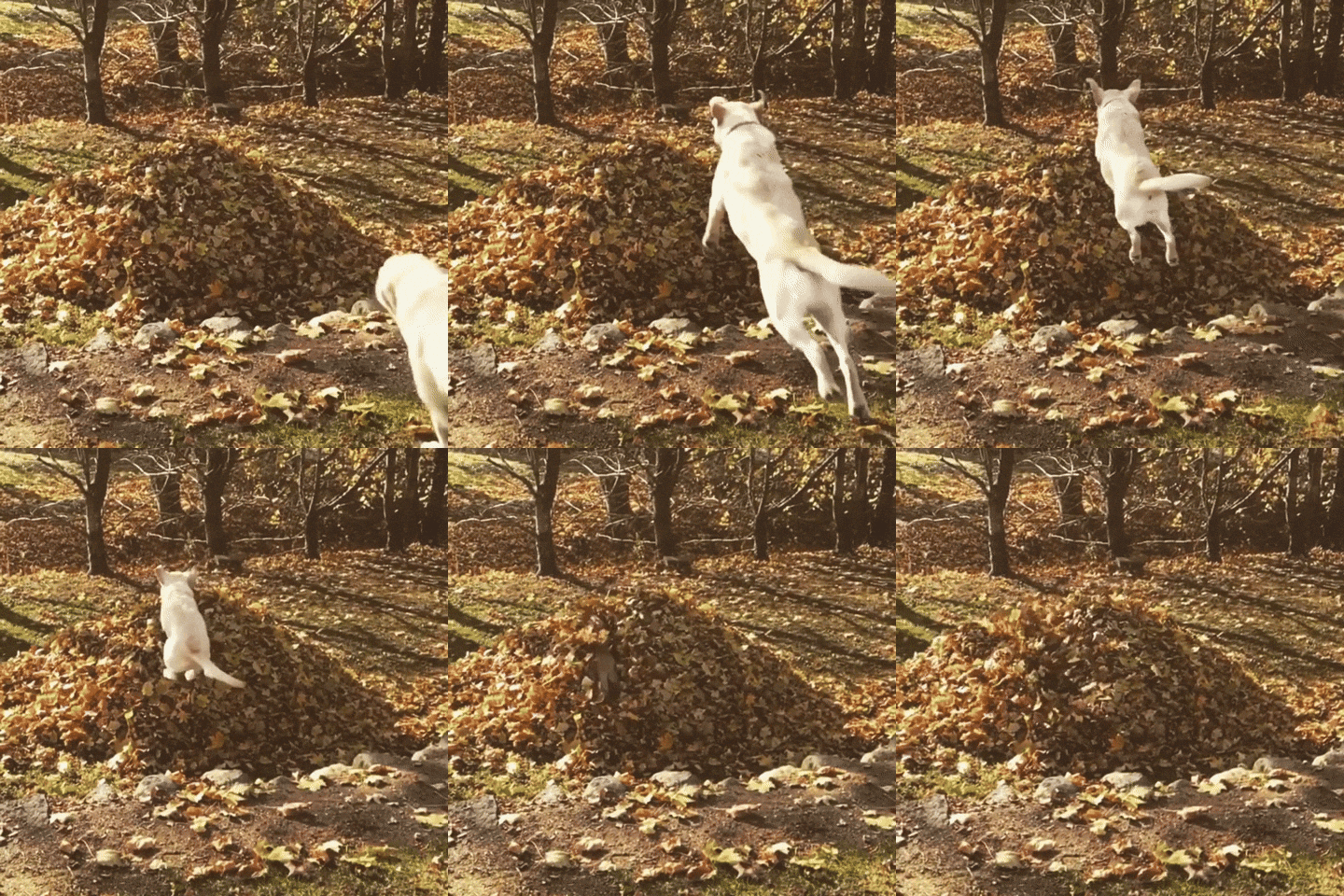
Live oaks typically keep their leaves well into winter, as you note. Then, they finally drop their leaves just as new ones are ready to emerge. So why is it happening later this year?
I would go back to our very warm weather in December (especially the second half of the month), followed by similar conditions through the first three weeks of January. This led to a delayed drop. Then, I suspect the Arctic fronts in late January and early February were a shock, causing most of our trees to lose all of their leaves at once. Our region’s lingering drought may well have also played a role. When you’re done raking at your house, would you care to come to mine?
– Eric
Q. We appreciate and rely upon your succinct forecasting and reporting our weather. However, we are frustrated by your haphazard timing each morning. We need to have your forecast by 7 a.m. and some mornings we have it, but often we miss it.
A. The only thing a lot of people really need before 7 a.m. in the morning is coffee, but I take your point.
Over the years the time I’ve posted on Space City Weather has varied based on the time I needed to get up and write a forecast before dropping one or both of my girls at school. That generally was before 7 a.m. However they’ve both graduated now, so there’s no forcing factor. Sometimes I “sleep in” until 6:30 a.m. or so, and this causes the post to be published later in the morning. There are also some days when the forecast is really complex, and I spend a lot of time trying to really understand things before writing a word.
But these are excuses, and in reality you are not the only person who has asked for this. So dear reader, I will commit to trying very hard to get the daily posts out by 7 a.m. There may be some mornings when I’m traveling for my day job, or when life happens. And I am not going to commit Matt to this deadline because he still has young kids.
But most days we’ll hit ‘publish’ by or before 7 a.m.
– Eric
Q. As a meteorologist, the usage of AI to make slop art is pretty disappointing. I think the comments on your posts about it tell you everything.
A. Wait, did we receive some negative feedback for the use of this image? I’m kidding. There were lots of comments and concerns, so I want to explain why we did so, how we use AI, and to try and allay reader concerns.
We have used AI-created images (always clearly labeled as such) only seven times in the history of Space City Weather, but most recent time we did so came on February 5th, here. This was, by far, the most controversial time. I used the image that morning because it was a humorous post, and I wanted a similarly “fun” image. I thought the AI-created image really fit the tone of the post, so I ran with it. It was a spur of the moment decision. This did not put a graphic artist out of business. Had I not used the AI-generated image, I would have just used a standard weather map or something.
I feel very conflicted about artificial intelligence, and its increasing prominence in our lives. A line in a recent op-ed in the New York Times really resonated with me: “”All of the people I love hate this stuff, and all the people I hate love it.” Basically, some of the most powerful business leaders in the world are aggressively pushing this stuff on us, and I don’t think they have our best interests at heart. I worry about the environmental implications. And I worry about the disruption to society a lot, and what the future is going to look like for my kids. So one one level, yes, I’m definitely uncomfortable with AI.
However, like it or not, this stuff is coming. And it behooves me—a perpetually online writer, forecaster, and journalist—to understand the technology and its implications. So yes, I experiment with AI tools and have found some utility in them. For forecasting, some of the AI-based weather models are quite good and Matt and I use them daily alongside traditional, physics-based models.
About one year ago we published an article outlining how Space City Weather will, and will not use AI. In that article, I wrote, “We have not, nor will we use any AI-based service for the writing of our forecasts. Very occasionally we may use an AI-based illustration, but if we do it will be clearly labeled as such.” That is the commitment we made to readers at the time, and we stuck with that, including our controversial use of an AI image a couple of weeks ago. However, I do want to reiterate that every word printed on this site in the past, today, and in perpetuity will be written by a human hand.
– Eric
Q. Houston’s such a big place, the weather is all over the place and yes, that pun was intended! Why do you only have 12 cities to pick from on your app? Why isn’t my city/town/neighborhood included?
A. Did you know that the city of Houston covers more than 600 square miles? It’s true! And that one of my favorite jokes about living here is that “Houston is an hour away from Houston”? “A big place” is something of an understatement …
This is one of our most-asked questions. When we first set out to build and release a mobile app for the site, we had to make some hard choices about which locations to include in the city picker (tap the 3-line menu on the upper left corner of the app’s home screen to see it). Eric and Matt tried to ensure that the region got wide-ranging coverage, but we only had five slots in the initial design. We were able to expand to a dozen in later updates, where we remain today.
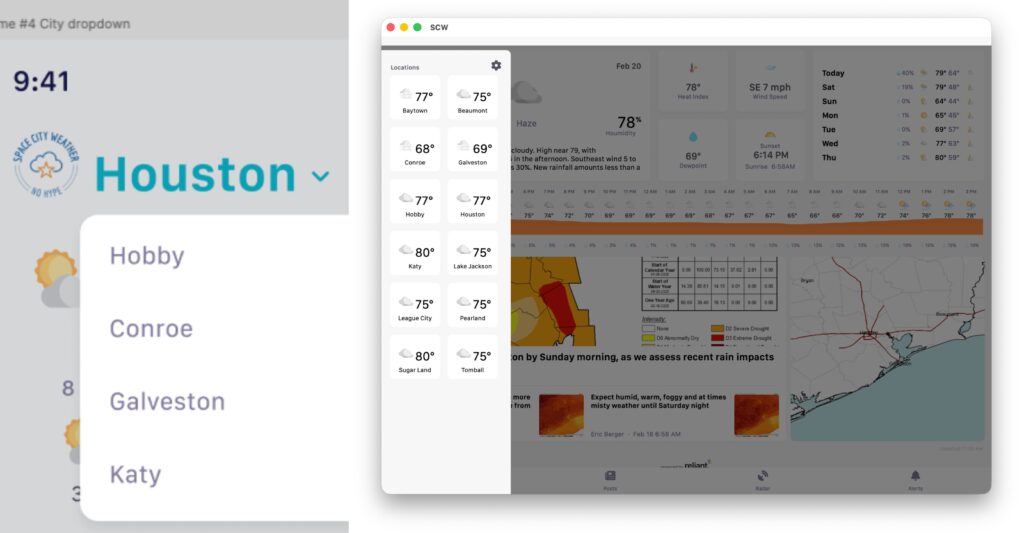
Besides Eric’s & Matt’s judgement calls, there are some technical and design limitations. On most phones and tablets, we didn’t want to force users to scroll through a bunch of city names (though on smaller devices there may be a bit of a scroll), and we wanted to keep the app “lite.”
In addition, we use location-based conditions and forecast feeds from the National Weather Service, and if there is not a feed for a particular city, we can’t provide that data.
Your best bet if you don’t see your exact location in the picker is to choose the city closest to you. Yes, Houston’s spread out, but the weather source nearest you is very likely to have the conditions and forecasting info you need. For example, I live in the Montrose/River Oaks area, so I choose Hobby as my location. That works out pretty well.
And here’s a tip: The Houston item on the app’s list is Bush Intercontinental Airport (IAH), so if you live around there you can choose it. (IAH is also Houston’s “official” weather station.)
One of the other reasons for our current approach is that we don’t track anything you do in the app, and that includes location. But we are considering changing that – location tracking may be added to a future version of the app as an opt-in feature. If you wanted to know the conditions and forecast at your current location, this feature would do that. But again, it would be off by default.
Also, we are looking at the feasibility of adding cities for every available NWS feed and letting users pick their 12 cities – or letting the app choose for you based on location, if you opt-in. A big under-the-hood change planned for this year could enable that. These are all proposals, nothing yet set in stone; let’s just say it’s … aspirational!
As always, thank you for using the Space City Weather app on your iPhone/iPad/Mac or Android devices. And don’t forget we have a dedicated topic on our Discourse forum for talking about the app!
–Dwight
Q. I’ve been dealing with some serious allergies. Have you noticed any data showing a surge in allergens like pollen or cedar? Does this seem earlier than usual for the season, or could it be tied to that big temperature swing from the hard freeze to the 80s this week?
A. This question tends to come up each spring, or late winter as it is in Houston. Is allergy season starting earlier than it has? There’s some evidence in research that says this is occurring as the climate warms. But looking practically at recent data specifically in Houston, it’s a little more mixed. Tree pollen is considered high once levels hit about 80 or so. But the first really, really bad day of spring typically hits when we get to around a level of 500. If you’re curious, the worst day we’ve had since we’ve tracked this back to 2017 was April 7, 2022 when pollen levels exceeded 12,000!
So when has Houston hit that first “500” of the season?
2017: January 4 and again February 9
2018: January 12, 23, and February 2
2019: January 24, 29, and February 5
2020: January 27 and February 4
2021: January 7, several more times through Feb 1, then not again til mid-March
2022: February 18
2023: January 6, 13, 24, and February 7
2024: January 2 and February 1
2025: January 31 and February 10
2026: February 12
What can we make of this? Well, for one it seems like we almost always get 1 to 3 bad allergy days before February. Usually that’ll be a bunch of cedar blowing in behind a cold front with strong winds. But we don’t really see our true “season” establish until around the first week or two of February. From that point of view, this year seems to be right on time, if not perhaps a little late.
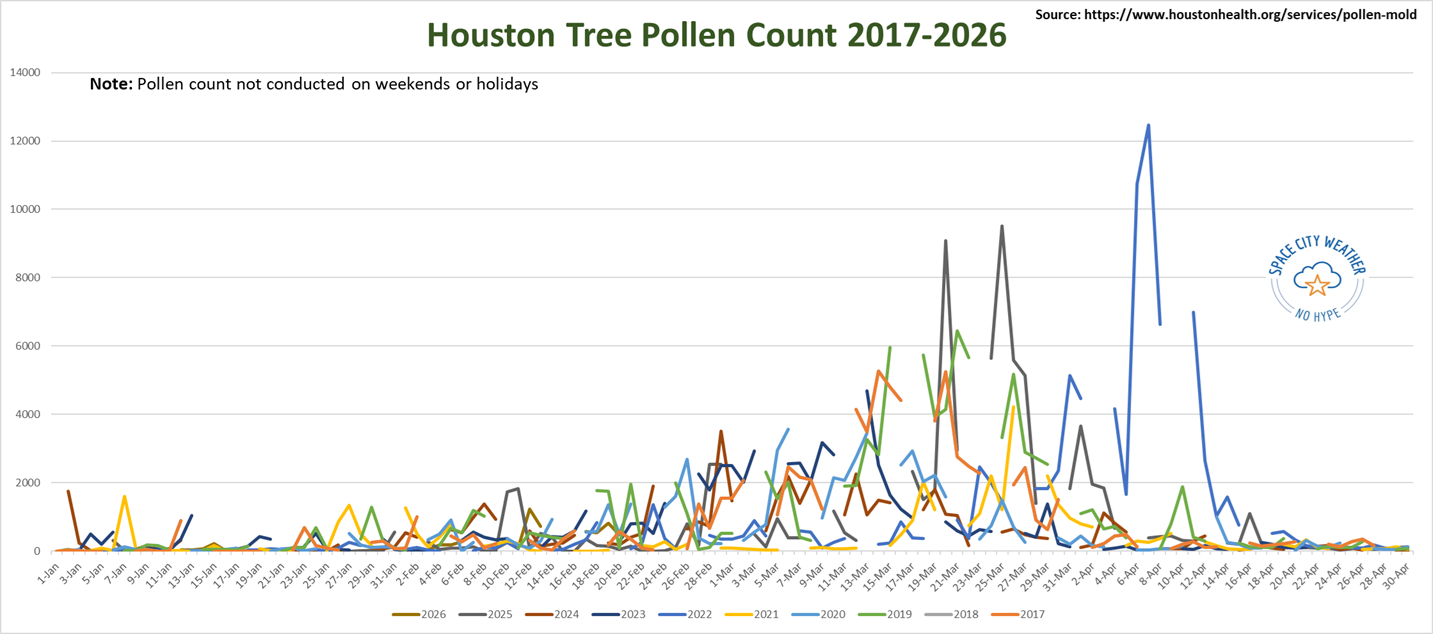
The glaring outlier is 2021, when the mid-February freeze likely caused enough damage to trees to keep pollen from becoming an issue again til March and April. But as you can see from the chart, we are quite early in the game. We haven’t seen anything yet, and it’s likely the next 2-6 weeks will be rough for seasonal allergy sufferers.
– Matt
Q. For a while there, it seemed like Houston had a flood every year, sometimes more than one. That seems to have faded in the past few years. Is there a bigger-picture thing happening, or is it just the roll of the weather dice?
A. If you look at the history of Houston flood events, you’ll find a mix of all sorts of years and event types that triggered them. In some ways 2015 (Memorial Day) and 2016 (Tax Day) were just dumb luck thunderstorm events. Neither were “freak,” per se, but they had a sense of randomness to them.
Then, in 2017 Harvey was caused by a remnant hurricane and 2019 was a stalled out tropical storm (Imelda). You are correct that since then, things have tended to be a little calmer. Since 2019, Houston has only had one year of above average rainfall (2024), and of course that was tied heavily to one event (Beryl) and an active spring thunderstorm season. So just generally speaking, we’ve been drier than usual, reducing the overall odds of rain events.
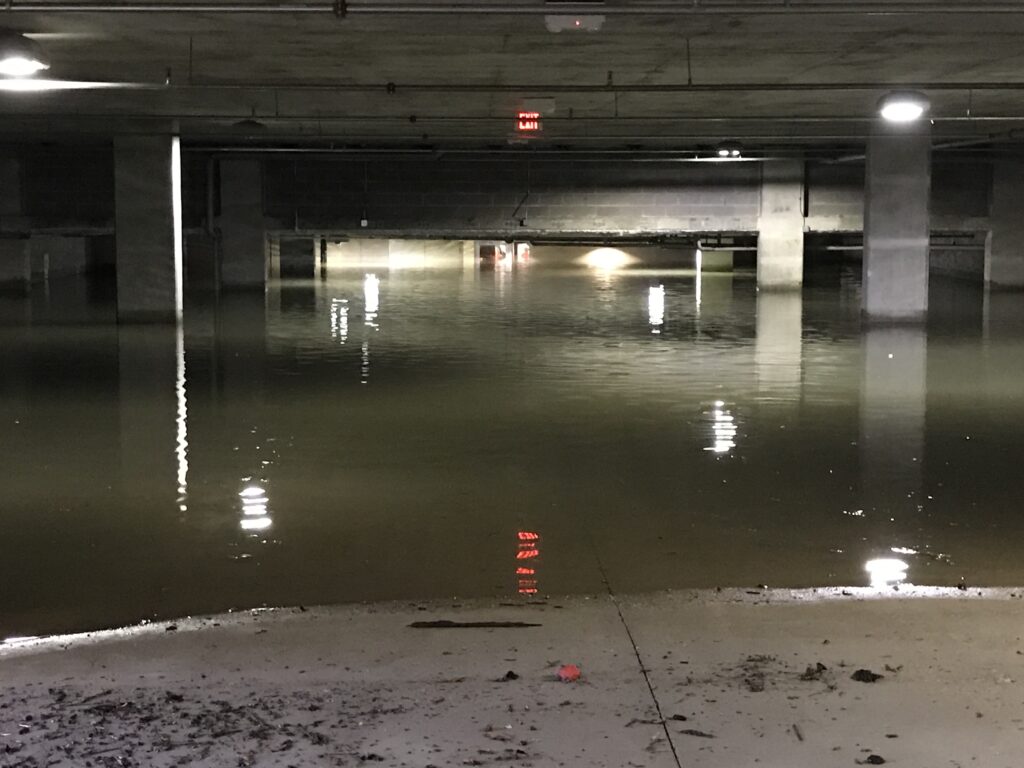
Also, keep in mind that Houston is merely a dot on a map. Regionally, there have been some bad flooding events since our bad luck finally eased up. News of the recent massive expansion in floodplain coverage across Harris County, however, should give us all pause that while we’ve been more than deserving of a few years of calm, the pendulum will one day swing back again.
– Matt
