A review of the 2020 Atlantic hurricane season and Houston, Part I

Today and tomorrow, Matt and I will be publishing two posts to summarize the 2020 Atlantic hurricane season, its effects on Houston, and implications for the future. In Part I, today, I will discuss the overall activity this season, and share some thoughts about Hurricane Laura. Part II, tomorrow, will focus on Tropical Storm Beta and what we can learn from this season about future hurricane activity.

2020 season

The numbers for the 2020 season are sobering. Across the Atlantic basin—which includes the Atlantic Ocean, Caribbean Sea, and Gulf of Mexico—there were a total of 30 tropical storms and hurricanes. This surpassed the previous record of 28 set in the year 2005, the historic year of Katrina, Rita, and Wilma. For only the second time, this year, forecasters at the National Hurricane Center in Miami ran out of names and had to resort to using the Greek alphabet.
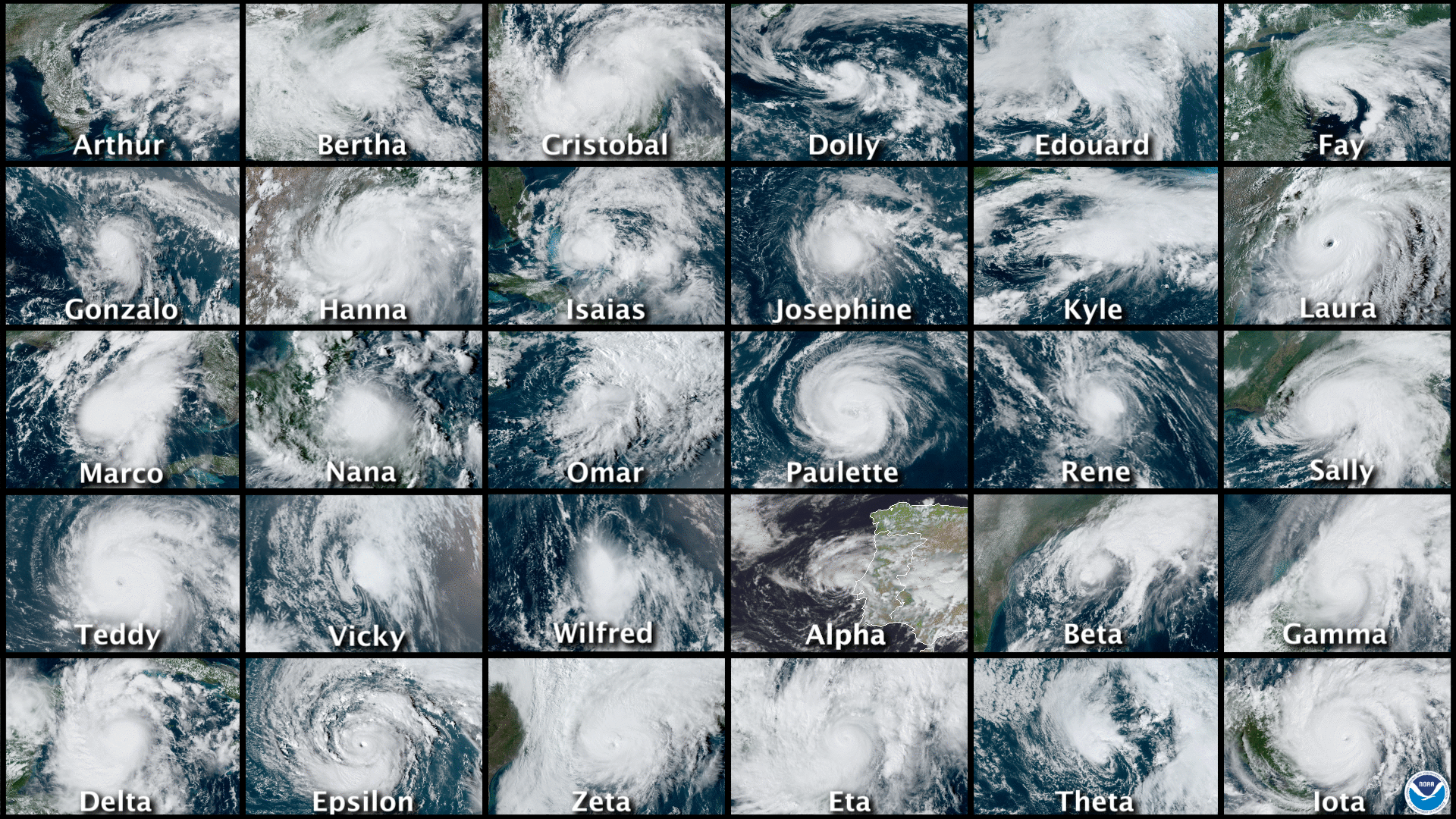
From Arthur to Iota, what a year it was. (NOAA)

Notably, a dozen of these tropical storms and hurricanes made landfall in the United States, crushing the previous record of nine landfalling tropical storms or hurricanes set in 1916. The state of Louisiana alone experienced five landfalls. (Thanks to the tremendous results of our 2020 fundraiser, Space City Weather will donate $5,000 to SBP, to assist with that state’s recovery efforts). At least one part of Louisiana fell under coastal watches or warnings for tropical activity for a total of 474 hours this summer and fall. And Hurricane Laura, discussed below, became the strongest hurricane to make landfall in Louisiana since 1856.

Harris County’s Jeff Lindner has catalogued some of this year’s other superlatives:

  • On September 14, five tropical cyclones were ongoing at the same time in the Atlantic basin (Sally, Paulette, Rene, Teddy, and Vicky). This ties September 1971 for the most number of tropical cyclones at the same time in the basin.
  • On September 18, three tropical cyclones formed within in six-hour window (Wilfred, Alpha, and Beta). This is only the second time in recorded history that three tropical cyclones have formed in such a short time period (1893).
  • Ten tropical storms formed in the month of September, the most for any month on record
  • A total of 10 systems experienced rapid intensification (35 mph increase in wind speed in 24 hours), Hanna, Laura, Sally, Teddy, Gamma, Delta, Epsilon, Zeta, Eta, and Iot).
  • Hurricanes Delta, Iota, and Eta experienced winds speed increases over 100 mph in 36 hours or less.
  • Of the 6 major hurricanes in 2020, four were in October and November, and bore Greek alphabet names (Delta, Epsilon, Eta, and Iota).
  • Hurricanes Eta and Iota both made landfall only 15 miles apart along the Nicaragua coast both as category 4 hurricanes.
  • Hurricane Iota (160 mph) became the latest category 5 hurricane on record in the Atlantic basin, and the second strongest November hurricane on record only behind the 1932 Cuba hurricane (175mph)
  • NOAA hurricane hunters flew a total of 86 missions for 678 flight hours and 102 eyewall passages. A total of 1,772 dropsondes were deployed.

Despite all of this, however, the 2020 Atlantic season was not all that extraordinary by some important measurements. Perhaps our best tool for determining a season’s overall activity is “accumulated cyclone energy,” or ACE, which sums up the intensity and duration of storms. For example, a weak, short-lived tropical storm counts for almost nothing, whereas a major, long-lived hurricane will quickly rack up dozens of points. The ACE value for the 2020 Atlantic season was 179.8. This significantly higher than the climatological norm for ACE values (about 104), but does not quite make the top 10 busiest Atlantic seasons on record, which is paced by the 1933 and 2005 seasons.

The bottom line is that the 2020 hurricane season was in line with our expectations for 2020 to produce a total cluster of a year. Fortunately, we survived. In Matt’s post on Thursday, he’ll discuss what this may mean for the 2021 season.

Hurricane Laura

It’s also worth reflecting for a moment on what I consider to be the most threatening storm of the year for Houston. There was a time in late August when it appeared that Hurricane Laura might strike Houston as a major hurricane. Personally, it was rather unsettling.

I first began writing extensively about hurricanes back in 2005. This was before I had become a meteorologist, and just after I started a blog for the Houston Chronicle. First, I tracked Hurricane Katrina and then, much closer to home, there was Rita. You may not remember the storm, or it may not have formed much of an impression on you. But it certainly did on me. I distinctly recall the evening of September 21, 2005—a Wednesday. Rita had intensified to 175 mph over the central Gulf of Mexico, and it was forecast to make landfall a little more than two days later just below Houston on the Texas coast. This was the worst-case scenario for our region. I’d bought a home in the Clear Lake area a couple of years earlier. Not going to lie, this one scared me. Eventually, Rita weakened some, and turned, making landfall near the Texas-Louisiana border.
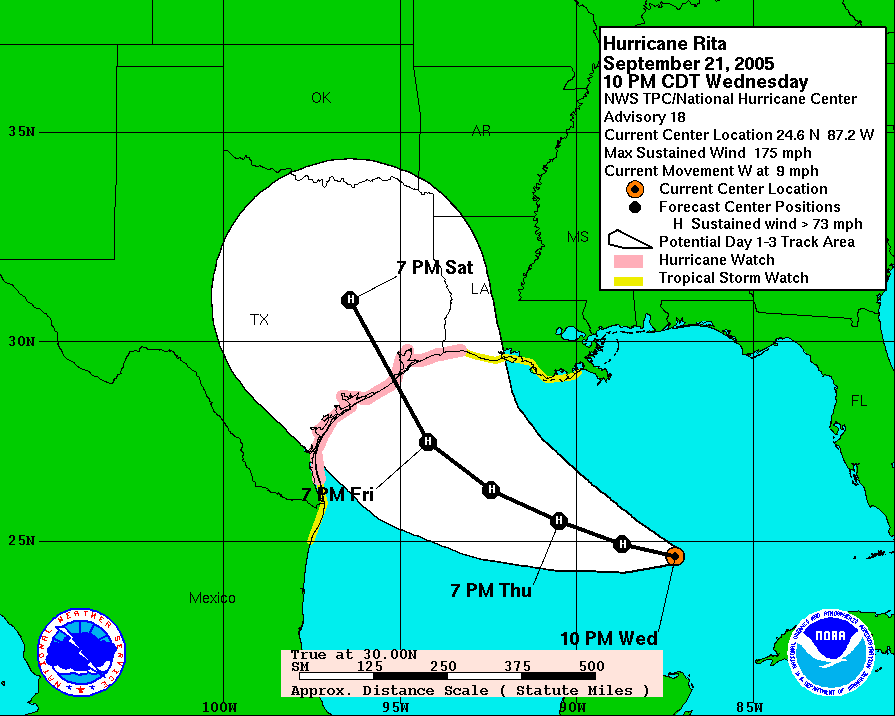
Hurricane Rita forecast for Sept 21, 2005, about 30 hours before landfall. (National Hurricane Center)

Since then, Rita has been the measuring stick for me in terms of dreading a hurricane landfall. And in those 15 years, no storm has ranked so highly as Laura did in late August. Why? Because although Houston has been battered by a strong storm surge (Hurricane Ike) and massive floodstorm (Harvey) in the last dozen years, it has not seen a major wind storm in nearly six decades. That was the potential Laura had with a track that could have come to Texas, across a very warm Gulf of Mexico. Ultimately, that didn’t happen, Laura turned away from Houston and made a devastating landfall in Louisiana.

Thanks to fine forecasting and smart calls by local officials, the greater Houston area was spared a major evacuation. But Laura was a close call in many ways for the nation’s fourth largest city. And I won’t soon forget it.

Sponsor Note from Reliant

A big thank you goes to the Space City Weather team for keeping Houstonians informed during the 2020 hurricane season. Just as Eric and Matt provide hype-free forecasts to ensure readers are prepared for a storm, Reliant keeps Houston powered with personalized electricity plans and back-up power solutions. Reliant is also here to help before, during and after the storm with helpful guides, tips and information on reliantstormcenter.com. We all hope for a quiet hurricane season in 2021, but know we’ll be informed and in good hands with Eric and Matt should any storms develop. Thanks for all you do, SCW!
Stormy end of 2020 on tap for Houston, followed by sunny start to 2021

The big picture for our weather during the last two days of 2020 remains the same: A slow-moving front will approach Houston, but likely stall west of the metro area. This will make for a stormy period from Wednesday afternoon into Thursday afternoon before conditions clear up heading into the new year. The first few days of 2021 should be clear and cool for the Houston area.

Wednesday

It’s mostly cloudy and humid this morning, with temperatures only falling into the low- to mid-60s for much of the region. For today, southerly winds will be gusty, perhaps as high as 20 mph. High temperatures later today will climb into the mid-70s, and we’ll start to see some scattered showers later this morning. The approaching front will be a larger driver of storms, and where it stalls will determine which areas see the heaviest rainfall during the overnight hours. For now, it seems the front will stall just west of Harris and Montgomery counties. Rain chances will increase during the afternoon and especially overnight hours.

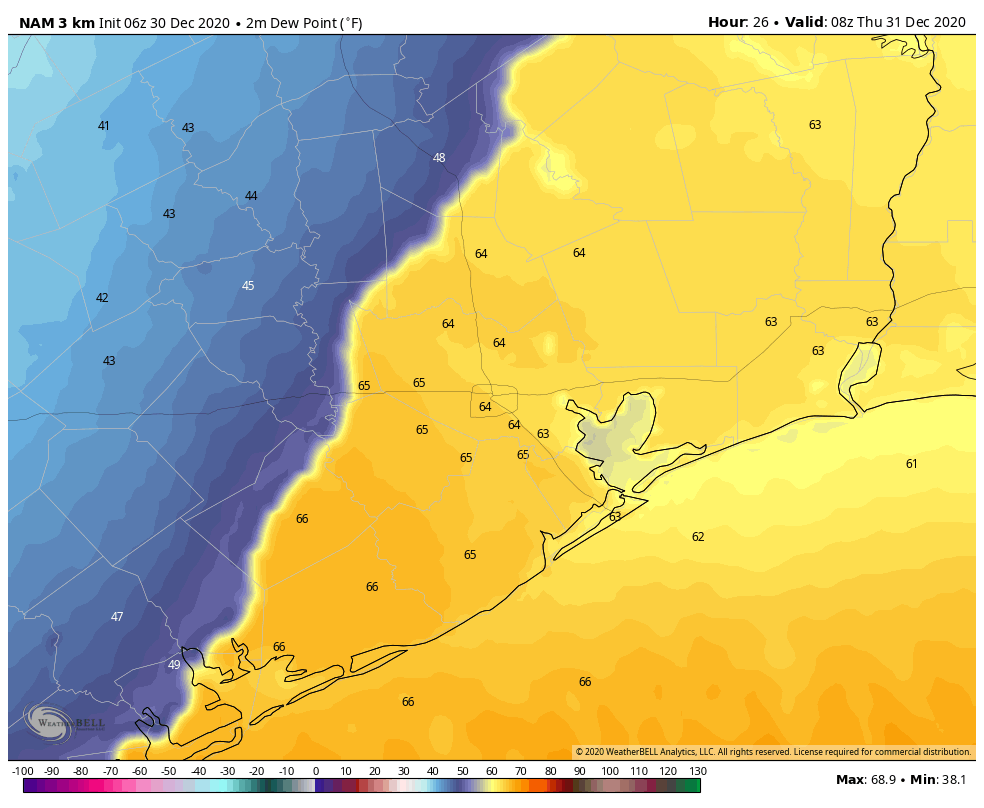
NAM model forecast for location of stalled front in the wee hours of Thursday. (Weather Bell)

Thursday

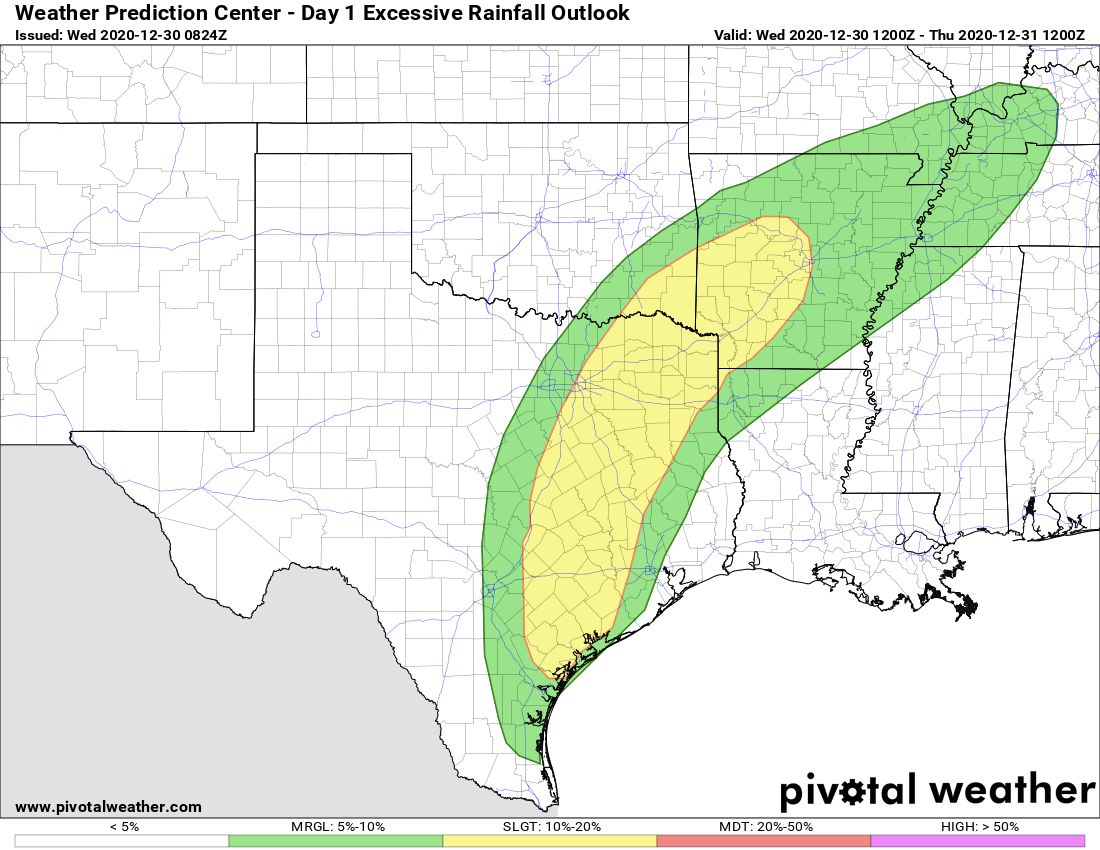
With the front stalling just west of Houston, our region is likely looking at another warm night, in the 60s, and a humid day. With the perturbed and moist atmosphere, rain chances will persist through much of Thursday afternoon, with widespread totals of 2-3 inches west of Interstate 45, and 1-2 inches for areas east of Interstate 45 between now and then. Finally, the front will shove through the area on Thursday afternoon, and this should bring an end to precipitation by sunset, or shortly before. Dry, westerly winds will follow the front’s passage, with temperatures dropping into the 40s as midnight approaches.

Areas in yellow have a “slight” chance of seeing excessive rainfall. (Pivotal Weather)

New Year’s Day

We’re expecting a cool and clear day, with highs in the upper 50s, and westerly winds at 5 to 10 mph. Lows will drop to around 40 degrees on Friday night.

Saturday and Sunday

The weekend looks sunny and fine, with highs in the upper 50s on Saturday, and lower 60s on Sunday.

Next week

We should see a warming trend next week, with highs perhaps reaching the 70s by Tuesday or so. Another front may be in the cards by around next Thursday, although overall confidence in the models is low. Regardless, rain chances after New Years’ Eve will remain low until that time.


Moderate to heavy rain possible before the end of 2020

The greater Houston region is still looking at a wet period on Wednesday and Thursday before clear and colder weather arrives in time for the new year. The first three or four days of 2021 should yield sunny, winter-like weather.

Tuesday

Temperatures have fallen to around 60 degrees for much of the area this morning, and winds are noticeable, out of the east at about 15 mph. They will gust above 20 mph later today as the onshore flow continues, pumping up moisture levels in the atmosphere. This should, in turn, increase cloud cover and limit high temperatures to around 70. Rain chances are probably about 10 percent. Low temperatures will drop into the low 60s, for most.

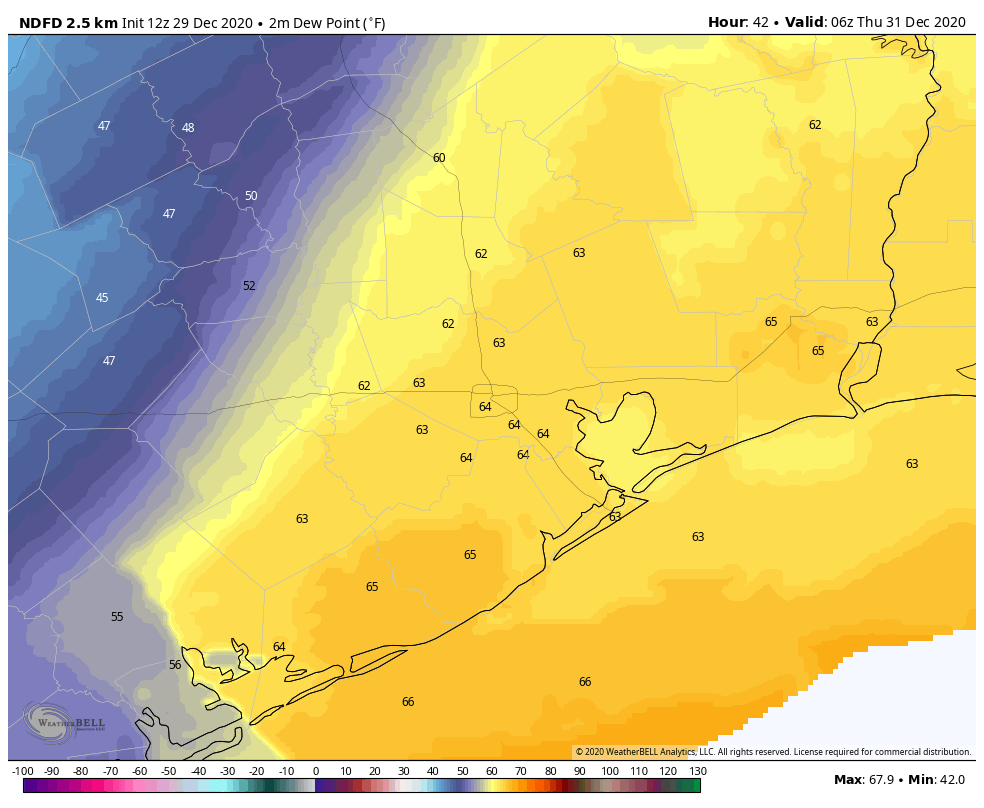
This dewpoint forecast shows the approximate position of the front on Wednesday night, at midnight. (Weather Bell)

Wednesday and Thursday

These two days will see inclement weather as an upper-level low pressure system approaches the area, and slowly drives a cold front into the region. This front will make it into the western periphery of the area—probably within a few dozen miles of Katy—late on Wednesday. It will then more or less stall for half a day before shoving through the region later on Thursday. The proximity of this front, and the ample moisture in our atmosphere, will drive healthy rain chances from Wednesday afternoon through the middle of Thursday.

Much of the area is likely to see 2 to 3 inches of rain, with localized amounts of 5 inches possible. The best chances for heavy rainfall will come west and north of the metro area. Wednesday and Wednesday night will be warm, with temperatures falling quickly on Thursday when the front finally passes. (It looks like precipitation will exit before the atmosphere gets cold enough to produce anything more than rain.) We should see clearing skies on Thursday afternoon or evening, with temperatures falling into the 40s on New Year’s Eve, heading into New Year’s Day.

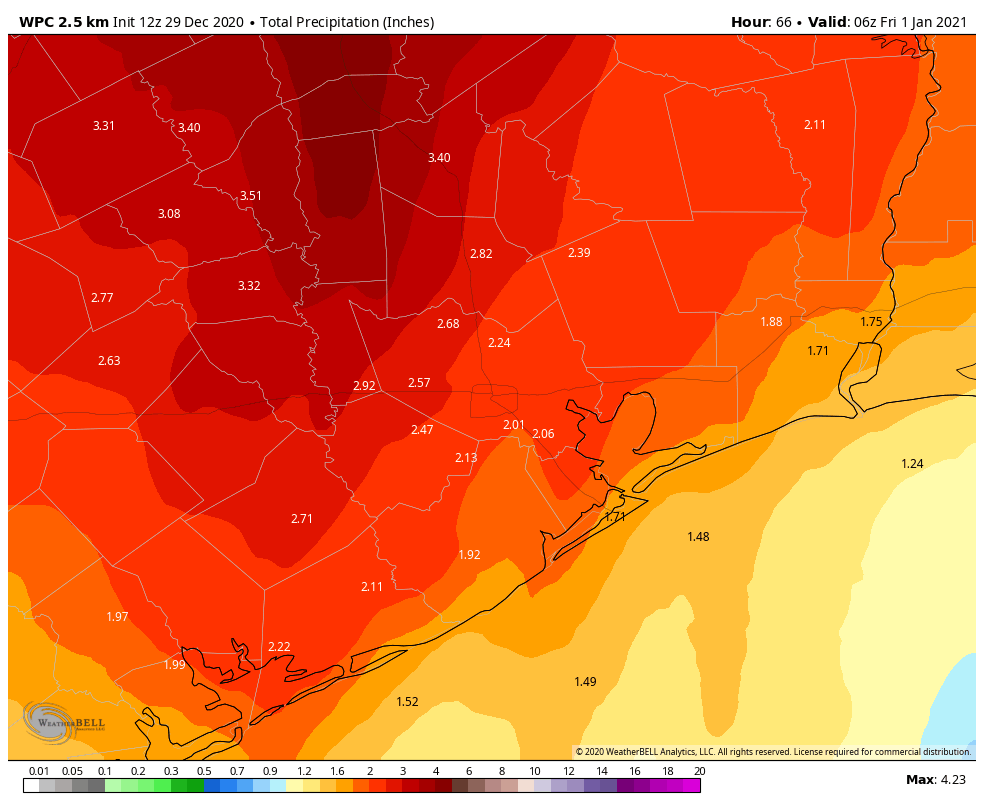
NOAA rainfall forecast for now through Thursday. (Weather Bell)

New Year’s Day

Expect a sunny day, with highs in the upper 50s.

Saturday and Sunday

The weekend should bring more fine weather into the area, with highs in the 50s to low 60s, lows in the 40s, and lots of sunshine.

Next week

Most of next week should bring highs in the 70s with lows in the 50s. For now we don’t see anything too exciting in terms of cold weather or precipitation.

After a tempestuous end to 2020, the New Year will dawn clear and cold

Good morning. Houston will see three warm days before a front arrives on Wednesday to usher in clear and cool conditions for the New Year. Perhaps the most noteworthy feature this week will be the potential for heavy rain and storms on Wednesday and Wednesday night along with the slow-moving front, with much of the area receiving 2 to 3 inches of rainfall. We cannot entirely rule out this precipitation turning into a wintry mix north of Houston later on Thursday.

Low temperatures this morning are quite a bit warmer. (Weather Bell)

Monday

As winds continue to blow from the southeast, our atmosphere will continue to moisten today. This will result in increasing cloud cover, and highs generally in the low 70s. A cold front will approach our area tonight, but stall out well north of the metro area. As a result, temperatures should again fall to around 60 degrees in Houston—warmer near the coast, and cooler inland.

Tuesday

Another warm day, for December, a lot like Monday. Expect mostly cloudy skies, with highs in the low 70s. Winds will be fairly gusty, out of the southeast at 10 to 15 mph, with higher gusts. Lows Tuesday night will again be fairly sticky.

Wednesday and Thursday

Wednesday will start out with partly cloudy skies and another warm morning, as the front approaches. During the morning and early afternoon we likely will see light, scattered showers. Rain chances will increase during the afternoon, evening and overnight hours as the front slowly moves from west to east. This is where the forecast breaks down some, as the feature approaching the Houston area will be cutoff from the main atmosphere circulation, and thus will probably move more slowly.

As this system approaches our warm and moist atmosphere, it will create conditions where some strong storms will be possible on Wednesday night into Thursday. Most of the area should see a solid 2 to 3 inches of rain during this period, but we can’t rule out a few isolated areas with 5 inches. Details on this forecast will improve by Tuesday, as higher-resolution models come into play.

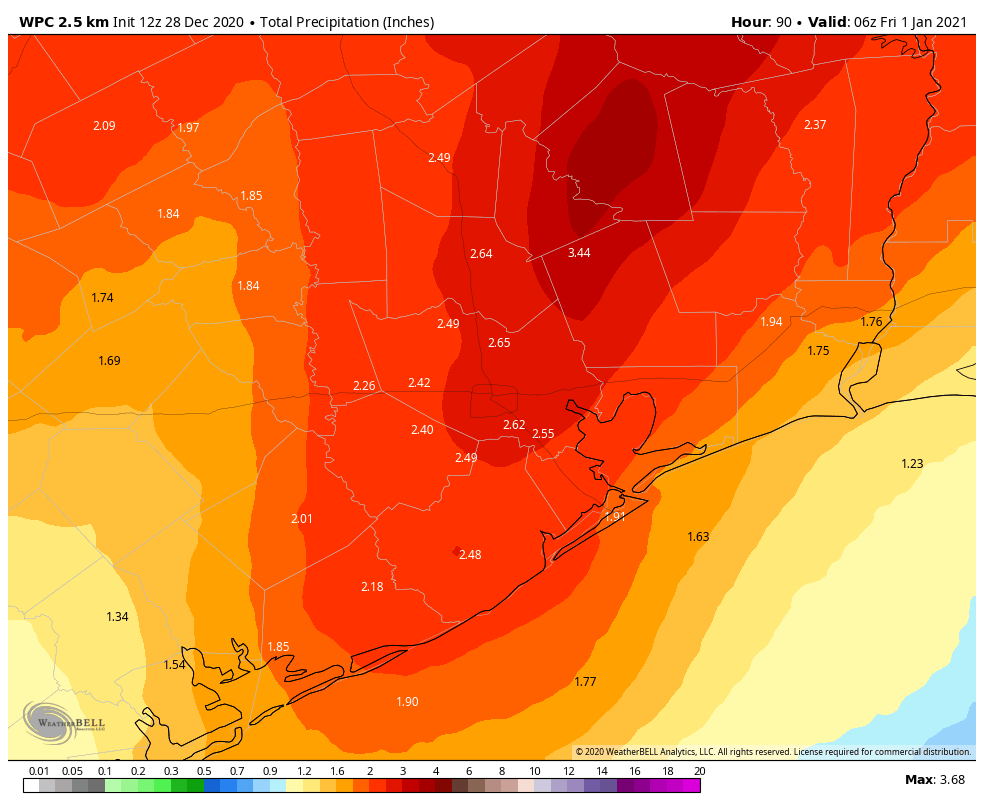
NOAA rain accumulation forecast for now through Thursday. (Weather Bell)

As colder and drier air comes into play on Thursday, rain chances will end over much of the metro area later in the day. However, a few showers may linger north of Houston, and as the colder air moves in on Thursday evening, the chance of some sleet or a few flurries in a place like Montgomery County is above zero, but only slightly. Thursday night—New Year’s Eve—will be cold across the region, with much of Houston reaching freezing, or near freezing conditions.

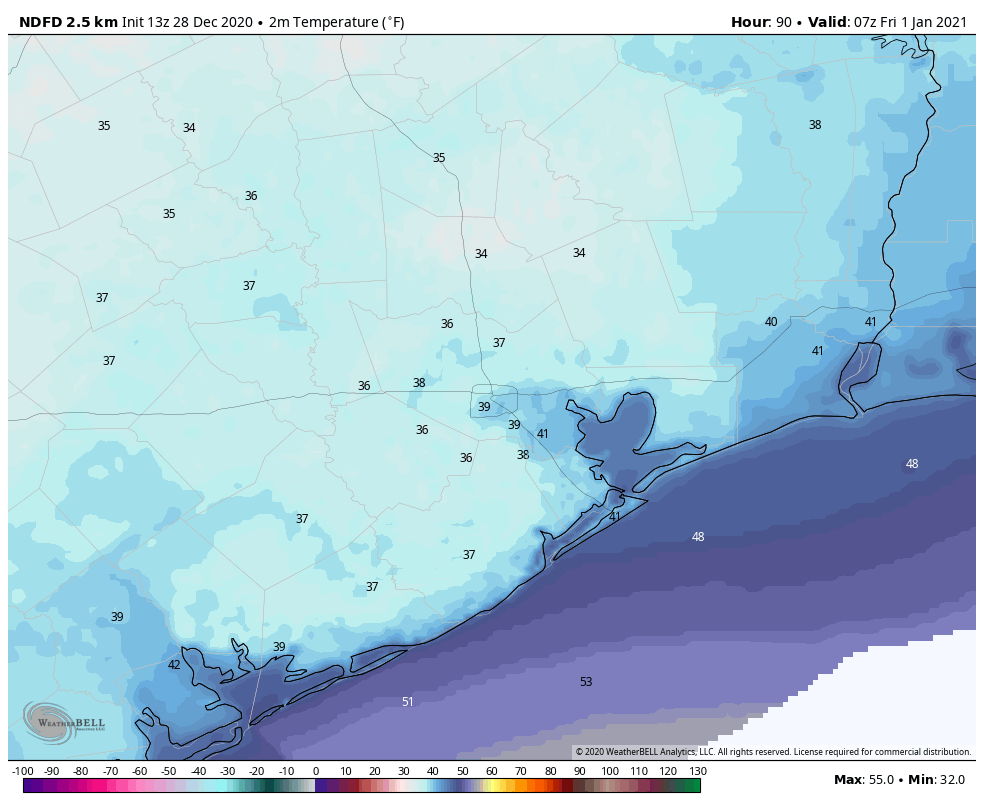
Temperature forecast for 1am CT on New Year’s Day. (Weather Bell)

New Year’s Day

The first day of 2021 should be mostly sunny and cold, with highs only reaching the upper 50s, most likely. We’ll see another chilly night on Friday night.

Saturday and Sunday

The weekend looks splendid, with sunny skies, and highs in the upper 50s to low 60s, and nighttime temperatures down around 40 degrees. A sign, perhaps, that 2021 will hold more promise that this year now ending?