In brief: In today’s post we discuss widespread rain chances today, especially for coastal areas. After this Houston will remain in a rather warm, late-summer pattern for most of next week. So it goes in September in Houston, my friends.
The day the world changed
We begin today with a non-weather topic. I am speaking, of course, of September 11, a day of unprecedented and horrific terrorist attacks on the United States of America that occurred 25 years ago today. At my age today, the attacks occurred at just about the half point of my life, and it really does represent a before-and-after moment. I distinctly remember the surprise and shock of those initial attacks, the uncertainty and fear, the dawning realization of what it all meant, and the heartbreaking losses suffered by so many. Undoubtedly all readers here in their mid-30s and older have their own vivid memories.
Looking back on those attacks with hindsight, a few things stand out. As a weather nerd, it is striking to me how exceptionally clear the skies over the northeastern United States were that day; how calm the winds. This lead to no weather delays or diversions, allowing the hijackers to largely stick to their schedules, and visually navigate toward prominent landmarks. And for those of us watching the horror unfold, the black smoke from the World Trade Center towers billowed away against azure blue skies.
The World Trade Center towers burn beneath blue skies. (Michael Foran)
That day was in many ways a defining moment for America. The 21st century may have begun on January 1, 2001, according to the Gregorian calendar. But in reality, the 20th century ended on 9/11, and we entered a new, uncertain century that is now one-quarter done. America found a way to largely come together after the tragedy of 9/11, unifying in the wake of tragedy. It is my hope that after a wrenching 25 years, which have increasingly set us against one another, we can do so again. I like my States united, rather than divided.
Friday
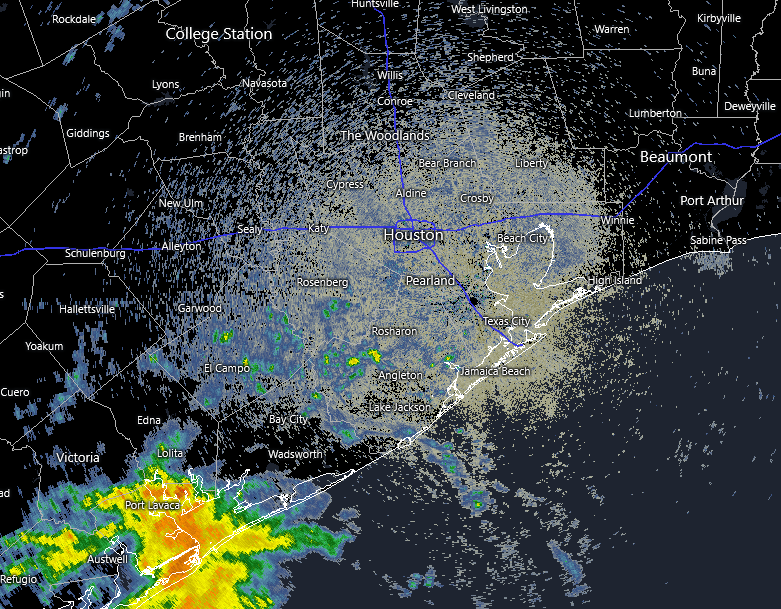
Alright, back to weather. The atmosphere above the Houston region remains unsettled, and there is plenty of moisture available, especially near the coast. This is likely to lead to fairly widespread showers and thunderstorms this morning, and into the early afternoon hours, for areas along and south of Interstate 10. Coverage will be less for inland areas, but we cannot rule out some showers there as well. In terms of accumulations, some of these storms will be capable of dropping 1 to 2 inches of rain, while most areas see less. With partly cloudy skies today, I think highs will remain in the vicinity of the lower 90s. Most of our high-resolution guidance indicates that showers should clear out by later this afternoon or early evening, which should be good for Friday Night Lights.
NOAA rain accumulation forecast for Friday. (Weather Bell)
Saturday and Sunday
We are going to remain in a similar pattern this weekend, although the background support in the atmosphere for precipitation will be a little bit lower. For the forecast, that translates into less fuel for widespread showers and thunderstorms—so I’ll go with daily rain chances on the order of 40 percent rather than 60 percent. Coastal areas will again be slightly more favored than inland ones. High temperatures will likely be in the low- to mid-90s for each day, with skies partly to mostly sunny. So for Texans tailgaters it will be pretty hot, with a decent chance of a passing shower.
Next week
Expect a late-summer pattern to persist for most of next week, with highs in the low- to mid-90s, and daily chances for showers and thunderstorms likely in the vicinity of 30 percent a day, give or take. Overnight lows remain stubbornly warm and humid, only briefly falling into the upper 70s. We’re still on the lookout for some kind of a weak front next weekend, but the chances of something making it all the way to Houston remain hit or miss. Hopefully we’ll get some clarity by the time of Monday’s post. Until such time have a wonderful weekend, Houston.
In this installment, we tackle your questions about “classic” Houston summer weather, fall front enthusiasm, variable houmidity, whether a slow hurricane season means more intense storm next year, and tropical storm directions. Got a question of your own, drop it in our contact form!
Q. I moved to Houston in 1995 and have lived here ever since. My memory from when I moved here is that summer days typically were hot, but that we often a short period of thunder and rain in the afternoon. My recollection is that this pattern was the ‘norm’ that was to be expected during the peak of the summer. We don’t seem to see that pattern so much now? I would be interested in your observations on this. Thanks for the great work you do, I have recommended SCW to so many people!
A: In my 14 years in Houston, I have heard this a lot. In fact, I remember last summer when people were quite pleasantly surprised by the seemingly daily storms, calling it almost a “throwback” summer. But do the numbers bear that out?
Well, in Houston it’s tough to truly measure the typical daily storms because, as everyone likes to joke, it can be raining on one side of the street and not the other. So what’s the best way to look at this statistically? Let’s start by look at the number of days in the summer months (which I’ll define as May through September) where rain occurs. We’ll look at both Hobby and Bush (which has an added record of threaded data back to 1950 for the “Houston area.”)
Number of rain days in the warm months in Houston. (From NWS Data)
A couple things stand out. First, you can see some of the drought years for sure. You also see those mid-2010s years where Houston got blasted. But, both trendlines are upward pointing, Hobby more so than Bush. This means we’re seeing more rain days, sort of.
If we shave off 1950-1969 and just run both 1970 through 2025 (since 2026 isn’t over), where both airports were operating together, there’s actually a slight downward trendline at Bush. I also shaved off May and changed the threshold to a “trace” of rain because we really don’t get into the “daily storm” pattern until sometime in June typically and nearby storms often produce trace amounts of rainfall.
What I suspect is happening? There could be a degree of variability here with some areas turning wetter with time and others less so. As the Gulf has warmed in the last 20 years or so, we may be seeing a different pattern of daily storms as the sea breeze comes in each day. Obviously, these are untested hypotheses, but it is interesting to see that sort of differential compared to the longer-term record.
–Matt
Q. Eric, it seems like your enthusiasm for the years first front has waned compared to previous years. I may be jumping the gun and maybe you don’t start talking about them until mid September, but it concerns me. Do you know something that I and the little more than average lover of meteorology don’t?
A. If readers know one thing about me, it’s that I love a good fall cool front. We started Fall Day at Space City Weather to celebrate this very thing! However, I’m also rather wary of over-promising and under-delivering on cool fronts when it comes to our readers. So I’m not going to mention the possibility of something happening unless I think there’s at least a decent chance of it happening.
OK, we are nowhere near THIS level of Fall. But consider this picture something to strive for. (Dwight Silverman photo)
Anyway, my general rule is to not even utter the words “cool” and “front” together on the website until after Labor Day because August fronts are super rare. Well, we’ve just gotten past Labor Day. And happily, some of our models are showing the possibility of a front toward the end of next week. Rest assured you can expect daily updates on this, the most important of Houston news at this time of year.
-Eric
Q: Even when there is a lot of humidity (houmidity?) in the forecast, it always seems to drop some in the afternoon, but at night it goes back up through the morning. Why?
A: For this, you have to look at two variables. Remember, relative humidity, which you see usually labeled on the news or in your app as just “humidity” (or houmidity) is a relative measurement of humidity. Relative to what? The moisture (water vapor) in the air relative to the maximum amount of moisture it can hold.
There’s a number of ways to think about this, but the I find that the easiest is to think about air temperature and dewpoint. Dewpoint is the temperature that the air would need to cool to to reach saturation. We also know that the warmer the air, the more moisture it can hold. During the day, the amount of moisture in the atmosphere isn’t changing a ton. Sure, dewpoints may drop from something like 76 in the morning to 70 in the afternoon. But what else happens during the day? It heats up. Let’s take a recent non-rain day, August 30, as an example.
Temp (blue), dewpoint (red), relative humidity (green) from August 30, 2026 in Houston. (From NOAA data)
On August 30th, you can see how dewpoint was pretty steady more of the day, with minimal variability. As temperatures began warming, just after 7 AM, the relative humidity began to drop. Humidity was its lowest at the hottest point in the day. Then, after sunset, as temperatures cooled closer to the dewpoint, the relative humidity began to shoot upwards again. This is one reason why we argue that dewpoint is generally a superior metric to relative humidity for determining comfort. I don’t think we’d call it comfortable at 5 PM, but the air is holding less moisture, relative to the morning hours. So there’s your lesson on humidity!
-Matt
Q: Very happy that, so far, hurricane season has mostly been a bust for us. Keep it that way. I know that storms can cool down oceans as they churn cooler water to the surface. Does a slow hurricane season mean the oceans stay hot and the next year’s season could be more severe?
A: The simple answer is no. The more complex answer is that while hurricanes do help redistribute warmer air from the tropics to the poles and do churn up subsurface cooler water when they pass (upwelling), this is generally a temporary and localized effect. What will dictate the subsequent hurricane season’s activity and water temperatures is more related to larger scale patterns across the tropical basin of the Atlantic or global influences (like El Niño). The tendency is to move onto the next season, but at this point, it’s tough to say anything meaningful about the 2027 hurricane season, and I would not worry about “paying” for a quieter season this year. Variability is the norm.
-Matt
Q. Both tropical storms Bertha and Edouardo seemed to follow the same path this year, headed west along the upper Gulf coast and into SE Texas. Is this east-to-west path unusual, or even unusual to happen twice in one season.
A. It is rather odd that in a quiet Atlantic hurricane year, three of the five named storms have decided to visit the upper Texas coast. That’s a very high strike rate, and we can be grateful that, some flooding issues aside, these were non-stalling storms that did not turn into hurricanes.
Both Tropical Storms Bertha and Edouard (shown here) moved from east to west, which is not all that unusual. (NOAA)
As for their movement, what we observed is not overly unusual. Tropical storms tend to move from east to west in the latitudes of the Gulf, and will do so until they find a weakness in high pressure to their north. Once they do so they will indeed move north, and then become pulled northeast as they reach the mid-latitudes and are influenced by winds known as “westerlies” which, perhaps not surprisingly, blow from west to east.
In brief: In today’s post we go a little deeper into the possibility of a cold front arriving by next weekend. Also, we discuss rain chances over the next several days, which remain healthy for most of the region.
Cold front or nah?
Houston’s first fall front typically arrives during the second half of September—not always, but often. Said front is almost always weak in the sense that it only brings very modest temperature relief and a relatively short period of modestly drier air. But psychologically it’s a huge deal, because it is a promise of what is to come, namely fall.
About half of the European model ensemble members bring in cooler conditions next weekend. (Weather Bell)
Because the first fronts are usually weak, they are difficult to predict. We end up in a will it, or won’t it make it scenario up until a couple of days before the front’s arrival. Some of our better models are continuing to indicate the possibility of the season’s first front arriving in about nine or 10 days time. That’s more or less at the edge of what is reliably predictable, so there is some double uncertainty about this front, both in the sense of it is difficult to forecast accurately, and it remains relatively far into the future from a forecast standpoint.
So, real talk, I think there’s a pretty decent chance a front makes it in by around September 19 or 20. I would not swear to anything like that, and realistically the chance is probably somewhere in the vicinity of 40 or 50 percent. We are unlikely to really have high confidence in this forecast until at least next Monday or so.
Thursday and Friday
Both of these days will see similar conditions, which is to say high temperatures in the vicinity of 90 degrees and partly sunny skies. Along with daytime heating we will scattered to widespread showers and thunderstorms during the afternoon hours. While most of these should move through fairly quickly, some of the stronger cells could produce 1 to 2 inches over smaller areas. Overall chances are probably higher closer to the coast than further inland. Winds will generally be light, from the south. Nighttime lows will be in the upper 70s.
NOAA rain accumulation forecast for now through Saturday. (Weather Bell)
Saturday and Sunday
I’m not sure a whole lot changes over the weekend. Temperatures will be similar. If I squint, it’s possible that Sunday has a little more sunshine and lower rain chances, but some showers are definitely still possible. So if you’re tailgating at Reliant Stadium—which is a great name for a football stadium by the way, glad it’s back—you can expect mostly sunny conditions but we unfortunately cannot rule out the possibility of some showers moving through, even if overall chances are fairly low.
Next week
Temperatures don’t change much next week as I expect the region to be in the vicinity of the lower 90s. Rain chances may drop back to 20 or 30 percent daily, but I don’t think they’re going away entirely. The big question, toward the end of next week, is whether a weak front does make it. This would probably bring a brief bump in shower chances. Obviously we’ll be keeping a close eye on this to see what happens and when we know, you’ll know.
In brief: For the next week or 10 days there won’t be much change in our weather, with fairly warm days, and scattered rain chances. This is basically the rule for weather in Houston during the first half of the month.
September doing September things
Here’s what we know about September weather in Houston: It often disappoints. Temperatures this month are typically a bit cooler than August, but not dramatically so. Days are a bit shorter. And we’re basically in what seems like an interminable doctor’s waiting room hoping to hear ‘cold front’ called out by a nurse. So it will go over the next week or 10 days, with highs generally ranging from 90 degrees at the coast to 95 degrees inland, partly to mostly sunny skies, and scattered afternoon showers. And we will remain in wait for a cold front. Our first chance does come about 10 days from now, but it’s not sure thing by any means.
If you like consistent weather, you’re in luck. (Weather Bell)
Wednesday
Our overall pattern is such that we’re not quite governed by high pressure, which lies to our west and east; but we’re also not exactly seeing disturbances fly by left and right. So we end up with a chance of showers each day, perhaps on the order of 30 to 50 percent. For areas south of Interstate 10 and closer to the coast, that chance is closer to the higher end, and for inland areas, it is closer to the lower end. Winds will be light for most of the day, but picking up to 10 to 15 mph with higher gusts during the afternoon. Nights remain stubbornly warm, in the upper 70s.
Thursday and Friday
Not much changes each day, with scattered showers and thunderstorms possible during the daytime. Temperatures for most locations will continue to top out in the lower 90s. In terms of rainfall accumulations through Friday, most of the area will likely pick up 0.25 to 1 inch, but there will likely be some bigger lottery winners.
NOAA rain accumulation forecast for now through Friday night. (Weather Bell)
Saturday and Sunday
Overall rain chances may drop back to around 30 percent this weekend, but there still will be enough weakness between high pressure systems to allow some scattered showers and thunderstorms. Highs remain in the lower half of the 90s for most of the area. You don’t have to ask about humidity, do you?
Next week
For much of next week, there’s just not a whole lot of change. Perhaps high pressure becomes a little more settled over us, in which case the likelihood of rain goes down a little bit. However, I still foresee the sea breeze producing at least some isolated to scattered activity each day. All of which brings us to the chances for a cool front late next week. I’m a little less optimistic today. Yesterday I probably would have put our odds at about 40 percent of seeing a front. Today I’m at 30 percent, which to be fair is not zero. But it’s also not a slam dunk. Welcome to the waiting room, y’all.