The tropics come alive: Here’s an update on the Gulf system, TS Hilary, and more

Happy Sunday, everyone. This weekend’s tropics update is a copy of what appeared on our sister hurricane site, The Eyewall, earlier today. It provides a full information on Hilary, the Gulf system, and all of the other activity ongoing in the Atlantic basin.

In regard to Houston’s forecast in particular, as we forecast on Friday, the region will be lucky to see rains from the Gulf disturbance, as it still appears likely to track too far south to bring much precipitation here. I wish it were otherwise.

One-sentence summary

Tropical Storm Hilary is expected to impact the Desert Southwest today with extremely heavy rain and a high risk of significant flooding, while South Texas eyes beneficial rains from a tropical wave this week, one of several Atlantic disturbances right now.

Hilary: Still likely to bring severe rain & flooding to the desert

The majority of the forecast is on track, with a few noteworthy changes today, mainly in the form of higher wind forecasts in southeast California, Nevada, and southwest Arizona. Hilary is approaching the coast of Baja this morning, mostly as expected.

Hilary should make landfall somewhere in northern Baja later this morning or this afternoon. Moisture extends well out ahead of it, and tropical moisture will arrive in the Southwest today. (Weathernerds.org)

Very little has broadly changed in terms of the track, but a few nuances lead to a little more wind for the Southwest U.S. Hilary should come north as a tropical storm into California, transitioning to a depression near Death Valley, and then getting absorbed into the U.S. weather pattern over Nevada.

Hilary will maintain tropical characteristics deep into the Southwest U.S., before becoming “post-tropical” over the Great Basin. (National Hurricane Center)

Let’s walk through impacts again today.

Coastal SoCal Metros (Santa Barbara-Ventura-LA-OC-San Diego)

For most in these areas, Hilary will be a considerable inconvenience. However, there will be issues with flooding in spots. There will also be concerns about mudslides and debris flows in the foothills and near burn scars. While the majority of valley and coastal locations will see 1 to 3 inches of rain, that will be enough to cause flash flooding of roads, and travel later today may become a little difficult. Urban flooding is always a concern when you get rain rates of an inch an hour possible, which may be what occurs in spots.

Wind gusts will peak in coastal SoCal later this morning and this afternoon into evening as Hilary comes north. Power outages are likely in spots. (NWS San Diego)

Flood watches are posted, and honestly if you don’t need to be out later today, it’s best to stay put.

While winds may not look dramatic on the map above (with 30 to 40 mph wind gusts on the coast), there will be stronger winds in spots and likely some power outages.

Conditions from Santa Barbara through San Diego will improve tomorrow.

Rainfall will range from 1-3″ between Ventura County and San Diego. Higher totals are likely in the mountains and deserts and in localized spots.

Inland SoCal Metro Valleys and Mountains

The impacts inland from the coast will vary. North and east-facing mountain slopes will likely see the heaviest rainfall with 3 to 10 inches likely and higher amounts not out of the question. Rate rates will be intense, and in those particular mountains, we may see mudslides, rock slides, and the potential for significant, rapid-onset flooding. This will include the mountains east of San Diego, the north side of the San Gabriels, San Bernardinos, and Ventura County mountains. The Antelope Valley north of LA may be very susceptible to flooding due to rain in the mountains upstream.

A “high” risk of excessive rainfall and flooding is in place today for the eastern half of San Diego County into Palm Springs, the Antelope Valley, Morongo Basin (including Joshua Tree), much of the Mojave Desert, Death Valley, into Nye County, NV/the Amargosa Desert. (Pivotal Weather)

Flash flooding or debris flows will be likely in some of the foothills and mountains, and travel, particularly into the mountains or across the Antelope Valley will be discouraged later today.

Winds will mimic patterns that we usually see in these regions during Santa Ana wind events, with gusts locally up to 50, 60, or 70 mph possible. This isn’t a Santa Ana, but because the wind direction of an approaching tropical storm is similar to how winds setup in Santa Anas, you’ll get that pattern. Prepare for power outages in some of these areas.

California Deserts

As noted above, the Antelope Valley will be particularly susceptible to heavy rainfall, but the Mojave Desert as a whole will be as well. That high risk from the NWS Weather Prediction Center remains in effect today, as it has since a few days ago. Confidence is high in major, damaging flooding impacts in these areas, which may see the equivalent of a year or more worth of rain today. Areas from the Imperial Valley and Salton Sea north to Death Valley are at highest risk for poor outcomes today. Locally, mountain peaks will enhance rainfall some, including the Panamints near Death Valley. Travel is discouraged today in the deserts and between the coast and interior.

Winds will also be an issue here, with 40 to 60 mph gusts widespread and risk for higher in spots. Prepare for power outages in these areas.

Tropical storm and high wind warnings are in effect for most of Southern California, including the deserts, with gusts of 40 to 60 mph and higher likely in some of the interior areas. (Pivotal Weather)

Arizona

Conditions tend to lessen some in Arizona, but there will still be issues with flooding and strong winds in the western part of the state.

Strong winds are likely in southwest Arizona, and power outages are a possibility in these spots. Rain totals (right) don’t look impressive, but there will be pockets of heavier rain and flash flooding possible, perhaps in some of the mountains north of Phoenix or in and around the Colorado River above Lake Havasu City. (Pivotal Weather)

Rain totals were dropped a good bit near Yuma today, as it appears a “dry slot,” or an area of dry air in between rainy bands may set up near Yuma.

Nevada

For Las Vegas, the threat of flash flooding is real, even if the highest risks are to the west of there. Urbanized desert is especially susceptible to flooding, so if a cell or band of heavy rain just happens to set up over the Las Vegas Valley, you will have a recipe for significant urban flooding. Be aware and prepared today in Vegas.

Heavy rains will be likely in Nye County in particular from Hilary. Significant flash flooding is possible there. Strong winds will extend well north into the Great Basin as well. (Pivotal Weather)

The heaviest rain may occur near Mount Charleston. As the NWS in Las Vegas noted this morning, the Nevada 24 hour state rainfall record previously occurred there. The 7.78 inch total on Mt. Charleston may get challenged today.

In addition to the rain, strong winds will be an issue here as well and power outages are possible in southern Nevada.

Conditions should improve from south to north tomorrow.

Lots of Atlantic nuisance and noise

Shifting into the Atlantic basin now. The NHC’s outlook map looks more like a leaked flag football playbook or something.

There are a lot of items on the outlook map today, but none of them look particularly serious in terms of impacts. (NOAA NHC)

Right out of the gate, let me just say that none of these systems look particularly menacing or troublesome for any areas. Busy as it may be, we’ll call this a nuisance setup. Let’s walk through these things.

Gulf wave: A rainmaker in South Texas

The tropical wave we’ve been talking about for several days is finally in the Gulf of Mexico this morning, and based on satellite imagery, it is not terrible looking. Organized, no, but vigorous, yes.

A tropical wave in the Gulf with a 50% chance of developing over the next couple days is robust looking but disorganized for now. (Weathernerds.org)

This will continue due west across the Gulf and make it into Texas by Tuesday morning. This has a 50/50 shot of becoming a depression or low-end tropical storm as it approaches Texas, but it is unlikely to surpass that level. The main impact from this system will be rainfall in Texas, a needed commodity. Sadly, for Houston and drought-stricken east Texas, this will do next to nothing. However, South Texas needs the rain too, and they will get some as this system moves in.

1 to 3 inches of beneficial rain is expected for South Texas, including Corpus Christi into Laredo and across northern Mexico. (Pivotal Weather)

Look for about 1 to 3 inches of rain for areas south of Matagorda Bay and lesser amounts north of there, to near 0 rain for the I-10 corridor in Houston and SE Texas.

Invest 90L: May develop today, rain for Hispaniola, Bermuda in the future?

The next wave to discuss is Invest 90L, which is located in the southeast Caribbean. It is beginning to attempt to develop there, and there’s some chance this becomes a depression or even Tropical Storm Emily today.

A robust tropical wave in the southeast Caribbean has a good chance at becoming a depression or storm in the next 24 hours. (Tropical Tidbits)

If you look at the NHC map above, you can see how 90L’s potential development takes on an “L” shape. The good news is that 90L should be drawn up north and out to sea rather quickly. The bad news is that it could impact Hispaniola, particularly with heavy rainfall. Bermuda may also want to keep an eye on 90L’s progress over the coming days. We will watch this closely for those areas this week.

Tropical Depression 6: Heads for the exits today

Invest 99L turned into TD 6 yesterday, and it will degenerate back into a wave today. Thanks for joining us.

Invest 98L & Africa waves

We expect development of Invest 98L in the next day or so, at least to a depression, maybe a tropical storm. But it will stay out at sea. Subsequent waves off Africa will likely behave similarly in the coming days.

Houston’s best chance of significant rain this summer, a tropical wave, will probably go south

Well, this is not great news I’m afraid. On Thursday the US Drought Monitor upgraded much of the Houston area to “extreme drought” conditions, with the remainder of the region in a “severe” drought. All one needs to do is look around at the area’s brown grass, or the sagging leaves on trees, to know that it is really dry out there.

We had been holding out some hope that a tropical system moving into the Gulf of Mexico this weekend would provide some relief. Unfortunately, the models are now increasingly in alignment that a potent high pressure system over the central United States will push this Gulf disturbance far enough to the south that it will probably not bring widespread, meaningful rainfall to our region. This forecast, certainly, can change. But as of now I would set your expectations low.

It’s increasingly dry out there. (US Drought Monitor)

Friday

Another very hot day for the region. Look for high temperatures in the low 100s, with ample humidity, sunny skies, and only a light southwest wind. Overnight lows will provide only a bit of relief, dropping down to around 80 degrees.

Saturday and Sunday

The weekend will bring more of the same with a high pressure system dominating our weather. Look for highs in the low- to mid 100s, which is to say that some inland locations could get up to 107 or 108 degrees for an hour or two during the afternoon. Yikes. For coastal areas, there is perhaps a 10 percent chance of rain on Sunday afternoon.

Next week

Our forecast for next week remains dependent on the track of the low pressure system that will be zipping westward across the Gulf of Mexico. It is expected to near the Southern Texas coast by Tuesday, most likely as a tropical disturbance, but there is about a 30 percent chance of it becoming a tropical depression or tropical storm according to the National Hurricane Center. However, I would not fret about strong winds or waves. This system will be mostly beneficial, in the sense that it will bring a decent amount of rainfall to some parts of Texas.

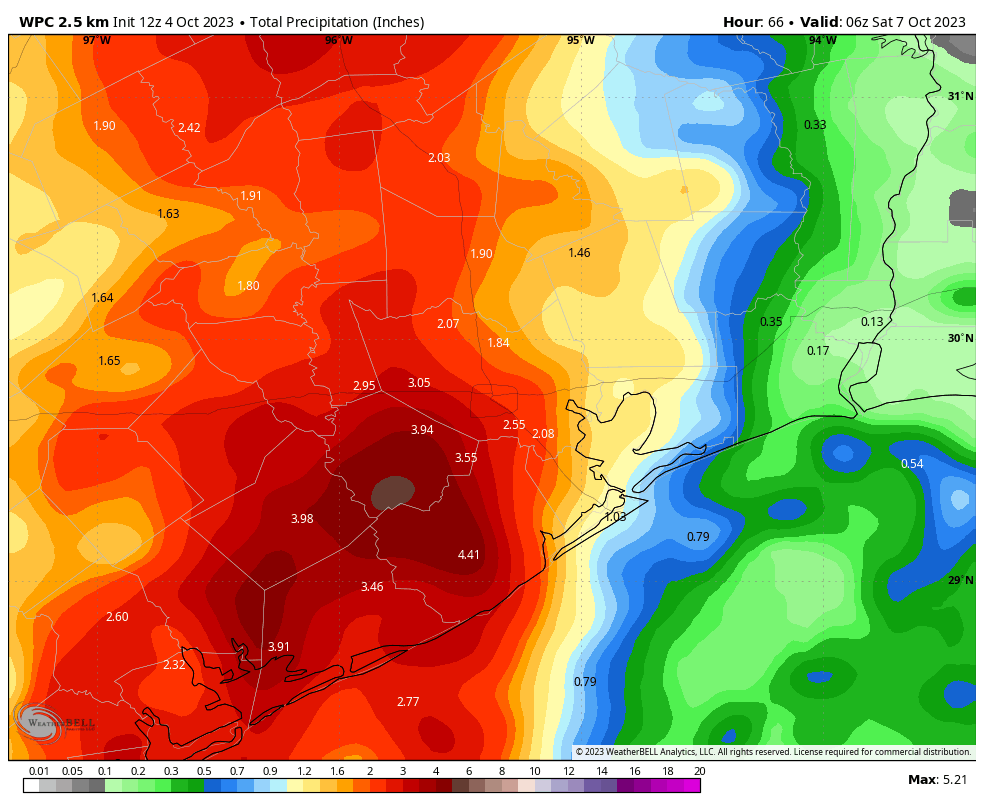
The GFS model forecast for rain accumulation through next Thursday is probably close to what will happen. (Weather Bell)

For now, and again this remains subject to change, the preferred location for 2 to 6 inches of rainfall is Corpus Christi and the state’s Coastal Bend. North of Matagorda Bay, rain chances start to diminish, although coastal parts of the Houston area are still likely to see some modest showers. I would peg rain chances in Houston at about 50 percent on Tuesday, and some increased cloud cover may hold high temperatures to the mid-90s. However, at this time, it does look like we are going to miss out on significant drought relief. If this forecast changes over the weekend, we’ll definitely update you.

After a brief reprieve in temperatures, we can expect highs to jump back up into the low 100s later next week, with sunny and hot conditions heading into the weekend.

Friday morning tropical outlook. (National Hurricane Center)

Tropics

The tropics are starting to really heat up, with Hurricane Hilary setting up to bring a potentially extreme rain and flooding event to parts of the deserts and/or mountains in California and Nevada; and increased activity expected in the Atlantic to end the month of August. You can find full details about all of this on our sister site, The Eyewall. For now, beyond the disturbance mentioned above, there are no other specific threats to the Gulf of Mexico.

What was the Hunga Tonga eruption, and is it causing our extreme summer heat?

Good morning. In the big picture, Houston’s overall forecast remains largely the same. After some lovely, drier air we’re back into high humidity and high heat through the weekend. By Monday, we’ll be watching the Gulf of Mexico with bated breath, to see whether a tropical system brings much needed rainfall to the Upper Texas coast. I think that’s still about a 50-50 proposition.

Before jumping into the forecast I want to answer a question I’ve received many times in recent weeks about this summer, which has seen record temperatures in the Gulf of Mexico, alarmingly low levels of sea ice, and extreme heat around much of the world. NASA recently concluded that July 2023 is the planet’s hottest month in the reliable global temperature record, which dates back to 1880. The question I’m getting is, could this be caused by the large amount of water vapor injected into the upper atmosphere by the eruption of the Hunga Tonga volcano in December 2021, in the Southern Pacific Ocean?

Earth’s average temperature this year is far above that of previous years. (Berkeley Earth)

Typically, big volcanic eruptions send large amounts of sulfur dioxide into the stratosphere, which reflects sunlight and cools the climate. By contrast, the Hunga Tonga eruption also produced large amounts of water vapor, a potent greenhouse gas. So is this the culprit for extremely warm temperatures this year?

As always with climate, the answer is complex, and nuanced. However, the Berkeley Earth non-governmental organization recently published an analysis that I think captures several of the factors that led to this summer’s heating. Principally, there is human-caused global warming; but there are a number of other factors that have contributed this year, including a switch to El Niño, the Solar cycle, the Hunga Tonga eruption, and a reduction in marine fuel pollution that has led to clearer air. All of these factors, layered on top of global warming, have really goosed temperatures this year.

Factors contributing to a warming planet over the last 10 years. (Berkeley Earth)

As the report notes, the effect of the Hunga Tonga eruption is probably relatively small, but it likely has added some warmth to the planet after injecting about 150 million tonnes of water vapor into the stratosphere. It will take a few years for this plume to dissipate. Please note that I realize that the mere mention of climate change gets some readers really upset. I’m sorry, but on a weather website it is occasionally necessary to mention that the planet is warming, and discuss potential causes. If you feel compelled to get nasty in the comments below, your IP address will be banned. Most readers have been polite in previous discussions, agreeing to disagree, and I appreciate that.

Now, on to the forecast.

Thursday

The dry air, sadly, is gone. And so we welcome back high temperatures in the low 100s, humid air, sunny skies, and light southerly winds. Nighttime lows are around 80 degrees. We all know the drill.

Friday

More of the same.

Saturday and Sunday

The weekend looks sunny and hot, with high temperatures again of around 100 degrees, or perhaps a tick or two higher. There’s a slight chance of some rain on Sunday afternoon, but I wouldn’t hold your breath.

This image compares the GFS forecast and European model forecast for rain accumulation next week. (Weather Bell)

Next week

So what’s going to happen next week with that tropical wave? Unfortunately the global models remain divided about its outcome. The Global Forecast System, or GFS model, keeps the low to the south of the greater Houston area, along with much of its rainfall. The European model, however, brings the low much closer to our region, and delivers a healthy dose of rainfall during the middle of next week. I think both scenarios are plausible, so I don’t have confidence in making a forecast just yet. If we do get some cloudy, rainy days, it will knock high temperatures back into the 90s. Please clap.

Humidity breaks briefly, and a lot of uncertainty remains about next week’s tropical wave

I don’t want anyone to get the wrong idea. In the big picture, the remainder of August looks very hot. There is just no way to sugarcoat that. However, there are some subtleties in the forecast to keep things interesting, including modestly low humidity today, and a tropical wave in the Gulf of Mexico next week. We’ll discuss all of that below.

Wednesday

A weak front has pushed very nearly all the way to the coast this morning. As we’ve been discussing, this is not an October cool front, so at most we’re seeing some dry air. But as Augusts go, it’s rather nice outside this morning. Much of the area is seeing temperatures in the 70s, with dewpoints in the 50s. This kind of weather isn’t coming back any time soon, so I’d recommend stepping outside to avail yourself of it.

Change in dewpoints from Tuesday to Wednesday mornings near sunrise. (Weather Bell)

This modestly drier air, alas, will also heat up rather quickly. So even though we’re experiencing a front, most of the area will still reach the upper 90s to lower 100s today. Still, I invite you to walk around and say, “At least it’s a dry heat,” to your friends because we simply don’t get to do that too often in Houston. As for the lower humidity, it will largely be gone by this evening for the southern half of the metro area, and overnight for everyone. So get outside this morning.

Thursday and Friday

I’m afraid we’re going right back to high humidity, daytime highs in the low 100s, sunny skies, and rain chances of about 5 percent or less. So basically, like the weather of August to date.

Saturday and Sunday

The weekend should bring more of the same, with hot weather and mostly sunny skies. If I squint, there might be some 10 to 20 percent rain chances on the horizon for Sunday.

Next week

Well, it’s complicated. We’re still anticipating a tropical wave to develop in the central Gulf of Mexico early next week, and then move westward. Since writing about this, several readers have expressed concern about this wave developing into a hurricane, but there are a lot of reasons why that is unlikely to happen, among them a fairly high forward speed. The National Hurricane Center suggests there is about a 20 percent chance the system becomes a tropical depression over the next seven days, and that feels about right to me. So while we’ll keep track of winds and waves, that should not really concern us much.

The tropical wave in the Gulf of Mexico is on the radar of the National Hurricane Center.

No, this is one of those August systems that is going to bring some beneficial rain to somewhere. The real question is whether that somewhere is Southern Texas and Northern Mexico, the Central Texas coast, or the Upper Texas coast and Louisiana. Now you may be thinking Eric, what do I have to do to make you bring that wave to the Houston area? First of all, I can’t be bribed—except maybe by ice cream. But secondly, the answer lies in the evolution of a potent high pressure system over the Midwestern United States.

The map below shows a rather intense high developing over Iowa, Missouri, Nebraska and Kansas next week. If the high is too strong, it will force the Gulf system south of Houston and Louisiana. If the high is further south than that, then again, it will force the wave south of the Greater Houston area. So we need that high to be a bit weaker, and a bit further north, to really enjoy the benefits of some widespread rainfall on Monday, Tuesday, and Wednesday of next week.

Where will the low go? (Weather Bell/Space City Weather)

Things could really go either way at this point. From an emotional standpoint, I’m pessimistic that we’re going to get the rain relief we desperately need. It’s been a long, hot, brutal summer, so why should things change now? From a data-based standpoint, there’s a reasonable chance of rain for our region next week. Hopefully the forecast clarifies itself in the next day or two.