In brief: With the World Cup’s Houston leg kicking off on Sunday, we take a look at the different types of weather our visiting nations usually experience at home and how they compare to our weather here in Southeast Texas.
We wanted to have some fun with the World Cup participants coming to Houston this year, so as a weather site, we decided to take a weather angle. Let’s learn some new things about global weather!
A lot has been made of this World Cup and the heat some of the teams will face on the pitch across North America. Here in Houston, thankfully the games will be in the climate-controlled confines of Reliant Houston Stadium (apologies to our gracious sponsors Reliant for removing their name on the stadium, but everything about the FIFA needs to be sanitized and controlled, of course). ANYWAY. It could be 110 degrees outside, and the teams playing each other in the stadium would never know it. But, during the rest of their stay in Houston, they will get reminders of our climate here in Southeast Texas. So we wanted to ask the question: How does the weather stack up in June in Houston compared to the countries where these national teams are coming from?
First, let’s introduce our contestants.
Germany
Curaçao
Portugal
Democratic Republic of the Congo
Netherlands
Sweden
Uzbekistan
Cabo Verde
Saudi Arabia
We won’t get into the knockout rounds for the purposes of this post. First, take a pause, look at the list, and take a guess as to which countries have the most similar weather to Houston and the most *dissimilar* weather to Houston. I am writing this before researching, and I will throw out Curaçao and Sweden as most and least similar respectively as guesses.
So with that out of the way, let’s go down the list and start comparing.
Germany
From what I have read and heard, Germany can be lovely in June. The first Reddit hit I get on Google in r/germany is entitled “June in germany Sucks,” however, so I suppose your mileage may vary. It’s also fairly large. Germany can have some variable weather in June from place to place, with temperatures ranging from the upper-60s to 80s most days. Heat waves can occur with temperatures well into the 90s. Taking June 15th as a decent proxy for the month and looking at the four largest Germany cities, here’s what we get.
| City | Average High | Average Low | Record High | Record Low |
| Berlin | 71° | 56° | 86° | 45° |
| Munich | 72° | 53° | 86° | 39° |
| Frankfurt | 75° | 55° | 90° | 43° |
| Hamburg | 70° | 52° | 86° | 41° |
Records can get into the low 90s in most places, with even some mid-90s. The sun sets as late as almost 10 PM in Hamburg, which is the farthest north of these cities as well, so there’s plenty of evening light to enjoy. Temperatures can obviously be cooler in the Alps as well. Rainfall averages about 2 to 3 inches in June across the country.
Verdict: Not at all like Houston.
Curaçao
A lot has been made about the kits Curaçao might have worn had they been the “away” team at a match in their first ever World Cup, though unfortunately it seems like that will only happen if they can miraculously make the knockout round.

What about their weather? Well, first of all, where is Curaçao? It’s considered a “constituent island country” that is part of the Kingdom of the Netherlands. It is in the far southern Caribbean, just off the coast of Venezuela and east of Aruba. Thus, it has quite the tropical climate, even more so than Houston. Average highs in June are around 81 to 82 degrees and average lows are 79 to 80 degrees. There’s not exactly a whole lot of variability to the weather there during the course of the year, being less than 1,000 miles from the Equator. June rainfall averages around 2 inches.
Curaçao is also far enough south to generally avoid most tropical storms and hurricane. Over the last 175 years, there has only been one direct hit by a tropical storm (Cesar in 1996) and the closest hurricane to pass near the island occurred in October 1892, when a presumed category 2 storm passed just south of the island.
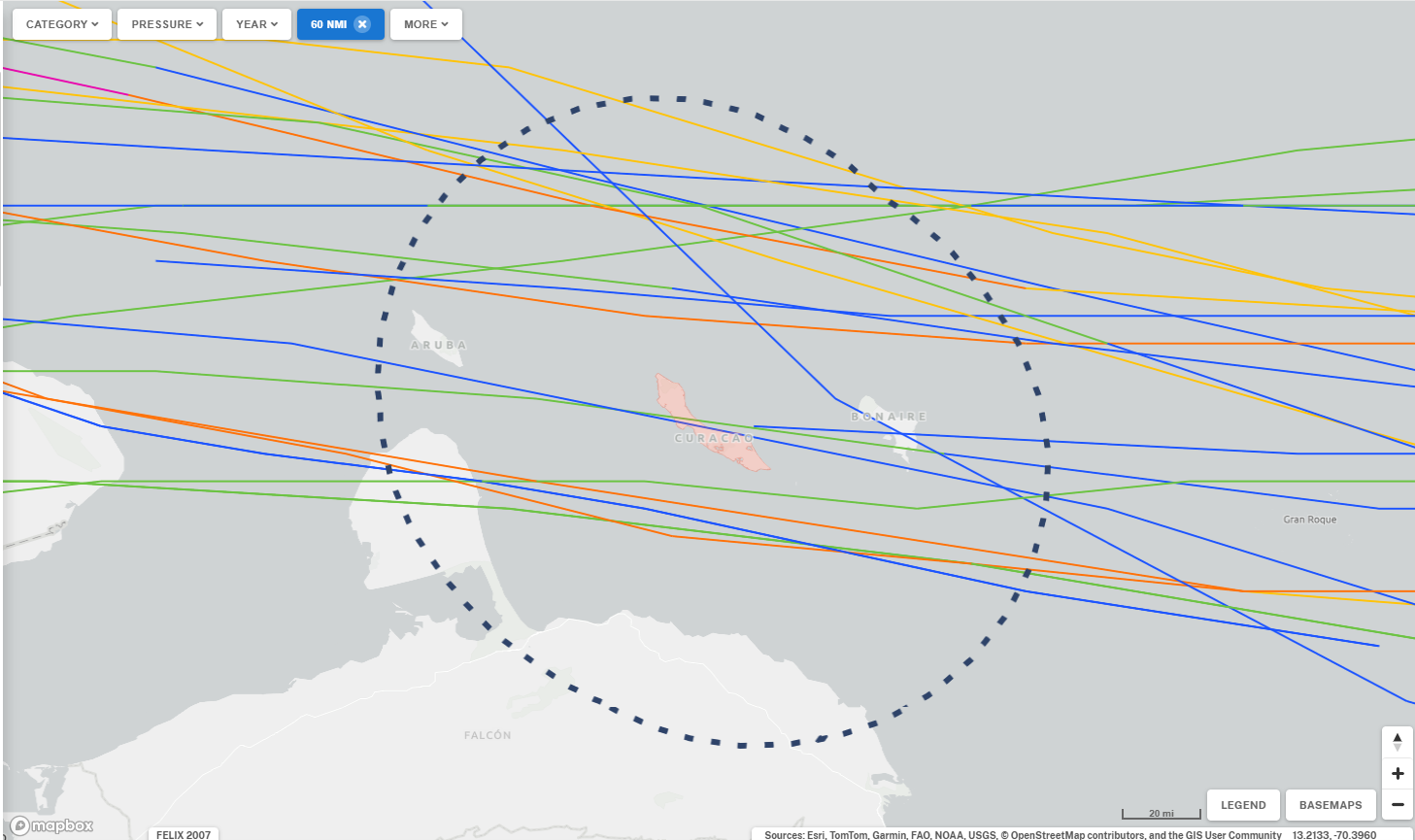
Verdict: Not severely dissimilar from Houston but with much less variability than we have.
Portugal
On the west coast of Europe, Portugal has a generally pleasant Mediterranean climate. It is one of the warmest countries in Europe overall. In June in Lisbon, average highs are near 80 degrees, with average lows in the 60s. Farther north, it cools off some. If you were looking for a comparable U.S. city to Lisbon, it might be Los Angeles (77/61 this time of year on average). If you wanted a comparable U.S. city to Porto in June, it might be Portland. OR (74/54 this time of year on average).
| June | Average High | Average Low | Record High | Record Low |
| Lisbon | 79° | 62° | 99° | 52° |
| Porto | 73° | 57° | 99° | 45° |
Portugal’s summer, like in the American West is their dry season. June only averages just shy of an inch of rain. In other words, summer in Portugal, while periodically hot, is generally delightful.
Verdict: Much drier and more comfortable than Houston.
Democratic Republic of the Congo
The DRC is the largest country in sub-Saharan Africa. Basically, it sits almost squarely in the middle of the continent, almost bisecting the Equator, with roughly 1/3 of the country in the Northern Hemisphere and 2/3 in the Southern Hemisphere. Much of the DRC is flat or with gently rolling terrain, but there is a major mountain range called the Rwenzori Mountains on the eastern border of the DRC with Uganda. The highest peak there, shared by both the DRC and Uganda is called Margherita Peak that stands 16,762 feet in elevation. One of the more dominant geographic features in the DRC is the Congo River, which carries the second highest volume of water of any river in the world (the Amazon River is #1).
Anyway, with that being said, the DRC has a fairly complex climate given that it straddles the Equator! The southern part of the country has a wet season in their summer/our winter. And the opposite holds true in the northern third of the country. You can clearly see that below, where Kisangani (in the north) averages over 4 inches of rain in June, while Lubumbashi in the south averages literally no rain at all in June.
| June | Average High | Average Low | Average Rainfall |
| Kisangani (north) | 86° | 70° | 4.50″ |
| Lubumbashi (south) | 77° | 46° | 0.00″ |
Verdict: Way too complicated to be similar to Houston, but Kisangani isn’t terribly far off.
Netherlands
Given its proximity to Germany in Europe, one would assume the Netherlands has a fairly similar climate, and you’d be right to an extent. Amsterdam is only about 200 miles west of Hamburg.
| June | Average High | Average Low | Record High | Record Low |
| Amsterdam | 71° | 55° | 82° | 40° |
But the country’s proximity to the North Sea does a heck of a job moderating the temperature. There’s a significant discrepancy between the record values in Amsterdam when compared to Hamburg, where the records are primarily in the 80s, with a couple 90s in June. Hamburg has far more records in the 90s. So they tend to miss out on the worst of the heat in the Netherlands, but they can still get hot. The all-time record high in Germany was 106° in Duisburg in July 2019. In the Netherlands, the record is merely a degree cooler (105°) also in July 2019.

Houston is very similar to the Netherlands in one area: Flooding. While much of the flooding the Dutch face comes from the sea and from rivers, they are considered the world leaders in flood control. And a highly engaged relationship has grown between Houston and Amsterdam.
Verdict: Similar challenges to Houston but not similar weather.
Sweden
Our farthest north country, the Swedes enjoy a wide diversity of latitude, stretching about 1,000 miles from top to bottom. Stockholm, the capital and largest city lies on the eastern side of the country, on the Baltic Sea. The largest cities are in the south, including Stockholm, Malmo (across the bridge from Copenhagen) and Gothenburg.
| June | Average High | Average Low | Average Rainfall |
| Stockholm | 69° | 50° | 2.40″ |
| Gothenburg | 65° | 49° | 1.75″ |
Highs generally average in the 60s and 70s throughout June with lows in the 40s and 50s. It has gotten as hot as 100 degrees in Målilla in the interior south way back in June of 1947.
Verdict: Much too temperate to even be comparable to Houston.
Uzbekistan
Uzbekistan was on my radar recently because I noticed that Foreign Grill over in the POST Houston, serves authentic Uzbek food. I will have to try that out. Uzbekistan is a landlocked country in western Asia. It is bordered by several other Stan countries. Of the seven total Stan nations, the only one that does not border Uzbekistan is Pakistan.
Being landlocked likely means an interesting, probably somewhat arid climate, right? Right. Tashkent, the largest city and capital of the country averages 17 and a half inches of rain. Per year. And much of the rest of the country is drier than that. Put it this way, there are places in Uzbekistan that see as much rain in a year as we see in an hour from our heaviest downpours. About 80 percent of Uzbekistan is desert. The summer is their drier season, and June typically only sees about a half-inch of rainfall in the capital.
| June | Average High | Average Low | Record High | Record Low |
| Tashkent | 92° | 65° | 109° | 39° |
Verdict: Suffice to say, Houston is not 80 percent desert. The Uzbeks will get a dose of true humidity here.
Cabo Verde
Cabo Verde and Cape Verde are basically interchangeable. For many years, we called it Cape Verde, but the country officially changed names to the Republic of Cabo Verde back in 2013. For most of us in Houston that recognize this nation, it’s because of hurricanes. Why? Because every disturbance that comes off the coast of Africa passes near the Cabo Verde Islands. In fact, August and September are often referred to as “Cape Verde” or “Cabo Verde season.” While Curaçao has seen less than 30 storms pass within 70 miles, Cabo Verde has seen over 65 of them that we know since the 1850s. Only 3, however were hurricanes at that point: Fred in 2015, Debbie in 1961 (which became a hurricane only after passing through), and an unnamed storm in 1892.
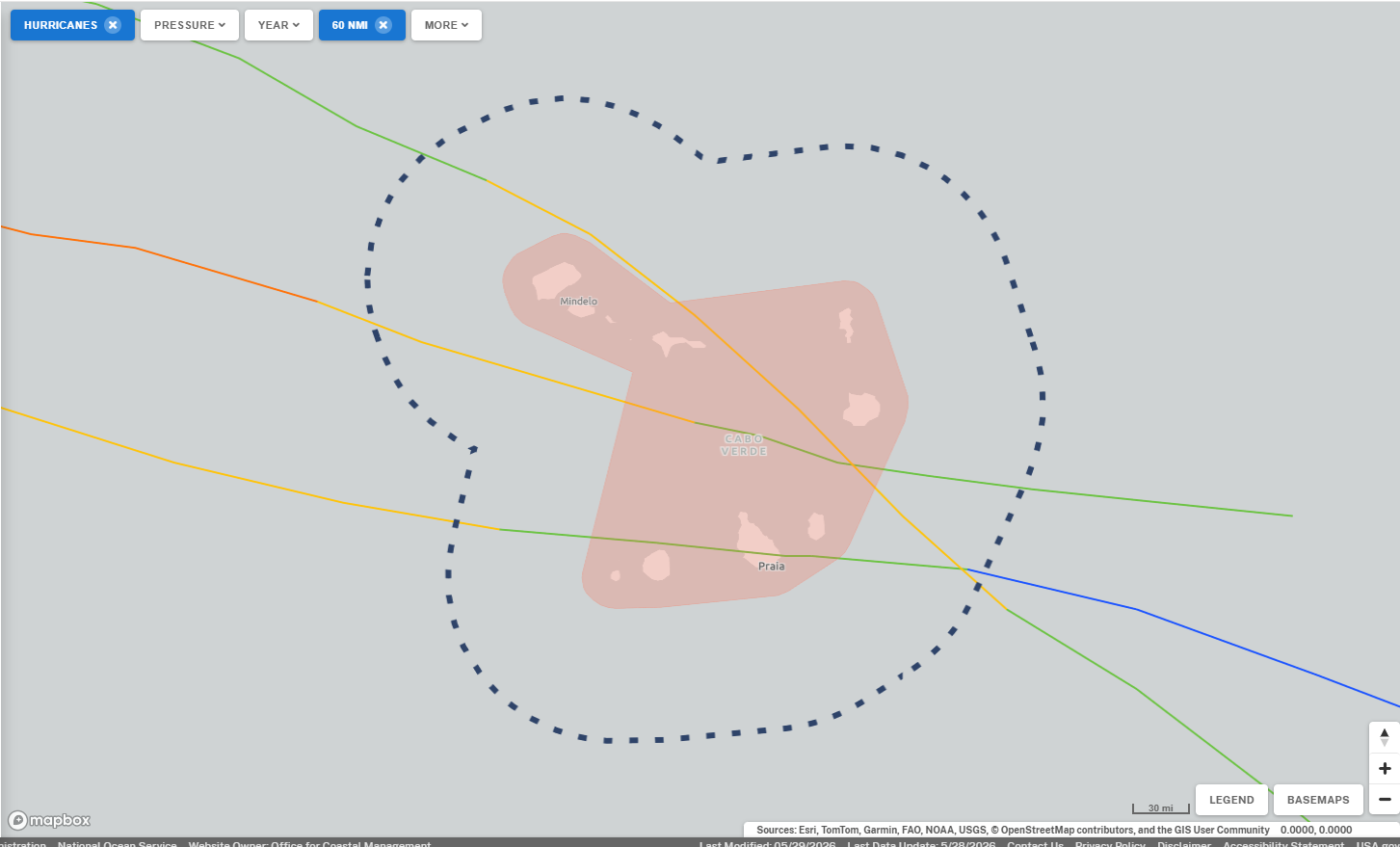
A lot is made of storms that form near Cabo Verde, but in reality of those 66 storms, only 9 have impacted the U.S., and only one made it to the Gulf (an unnamed 1947 storm that hammered Fort Lauderdale and flooded New Orleans).
Weather-wise, one might assume that Cabo Verde is frequently impacted by tropical waves emerging off the African west coast. However it’s actually a very arid country. In fact, much of Cabo Verde sees maybe 2 to 6 inches of rain annually. However, because it is mountainous, orographically induced precipitation can yield closer to 40 inches of rain at higher elevations. The bulk of the precipitation does come from tropical waves, and August, September, and less so October are the only wet months of the year.
| June | Average High | Average Low | Record High | Record Low |
| Cabo Verde | 81° | 71° | 93° | 59° |
Because it’s surrounded by water, it’s a bit cooler than the coast of mainland Africa but with warmer ocean temperatures.
Verdict: Cooler, drier, and less hurricane-prone (ironically) than Houston. No dice.
Saudi Arabia
We saved the hottest for last. Saudi Arabia, of course, is located in the very arid Middle East. While the vast majority of the country is just outright desert, the southwest (south of Jeddah and Mecca) does have higher mountains. It’s actually an escarpment that marks the eastern edge of the Great Rift. Most of the mountains north of Jeddah and Mecca are about 6,500 feet high or less. South of there, some of the peaks can get as high as 9,800 feet. The Soudah Peaks average about 79 degrees for highs in June and 51 for lows, far different than most of the rest of the country.
| June | Average High | Average Low | Record High | Record Low |
| Jeddah | 109° | 82° | 118° | 68″ |
| Riyadh | 109° | 83° | 117° | 70° |
| Dammam | 111° | 82° | 123° | 70° |
We often hear about the massive humidity levels of the Persian Gulf, but that’s only on Saudi Arabia’s east coast. Dammam is the third largest city in the Kingdom and is right across from Bahrain. The average dewpoints in summer in Jeddah and Riyadh are in the 30s. The average summer dewpoints in Dammam are in the 60s and 70s. A 111° day with a dewpoint in the mid-60s can feel more like 115 to 120 degrees. A 111° day with a dewpoint in the 30s feels more like 105°, yes, cooler than the actual temperature.
Verdict: Houston is not a desert, nor is it as hot as some coastal cities along the Persian Gulf.
Final verdict
For the most similar countries, we can safely eliminate Saudi Arabia, Cabo Verde, Uzbekistan, Sweden, the Netherlands, Portugal, and Germany. That leaves us with Curaçao and the Democratic Republic of the Congo. By virtue of a slightly more variable climate and higher rainfall in June than Curaçao, I am declaring the northern DRC our champion. Feel free to tell me I am wrong in the comments.
As for who is most dissimilar? Sweden and Saudi Arabia for opposite reasons may be the champions. I would crown Uzbekistan a runner up.
Hopefully you enjoyed this and also learned a thing or two about different climates around the world!
