In brief: Houston is back to more classic December fare today, with low clouds, a gusty wind, and temps in the 40s. We’ll have a couple chilly nights tonight and tomorrow night before we make yet another run toward 80 by Friday. New Year’s plans look delightful, with no weather concerns at all right now.
Whew! It feels quite different outside this morning. Here’s a map of our 24-hour temperature changes.
Temperatures are currently 15-25 degrees colder than Sunday morning across the area. (Pivotal Weather)
This is our first morning in the 40s since December 20th. In that stretch, we’ve had 8 days in the 80s and 1 day near 80 (79° on Christmas Eve). Only 2012 and 2021 saw more 80-degree December days. We also set or tied 6 record highs in that stretch, hitting 84° on Sunday, our 2nd warmest December day on record. But that’s done for now. And so we discuss cool temperatures.
Today and Tuesday
That wind is going to remain with us most of this morning. By afternoon, it will begin to wind down, though it’ll remain a bit breezy. Gusts have been north of 50 mph at Hooks Airport in Tomball and in Galveston, 48 mph at Hobby, and 40 mph at Bush. Temperatures won’t go very far today. If the low clouds can clear out this afternoon, we’ll attempt to get into the low-50s as the models suggest. If the low clouds stay put, I may be apt to undercut model guidance and say we limp into the upper-40s at best.
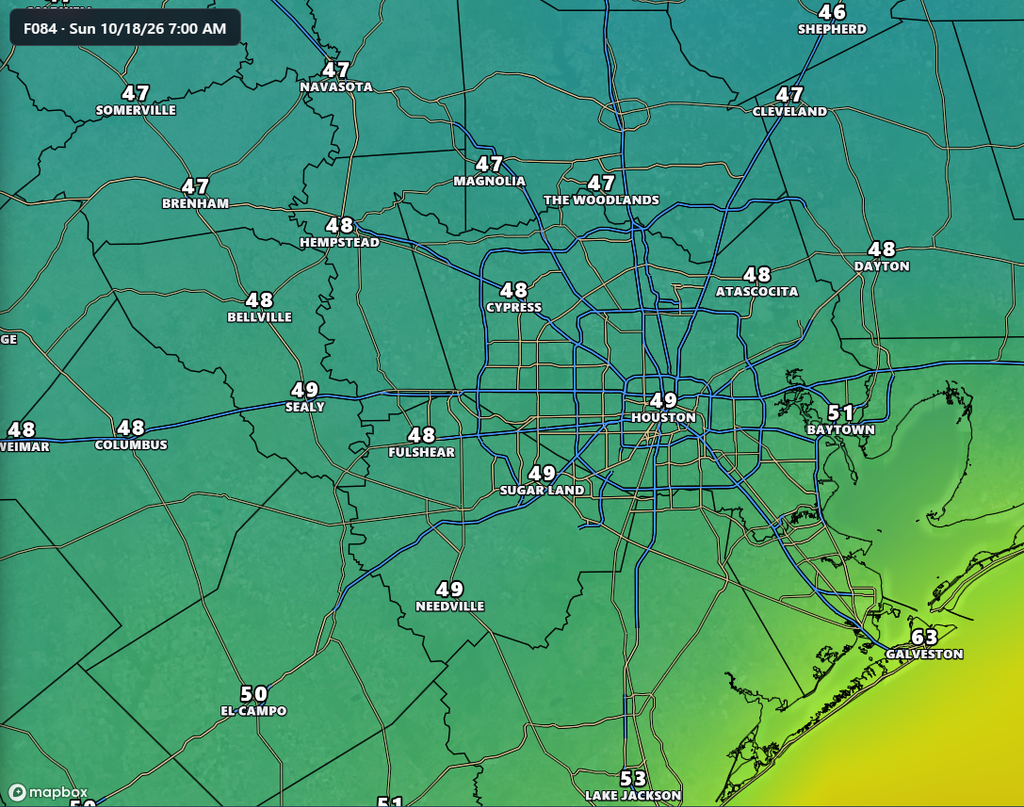
Tonight will be cold, and there is a chance that a few spots get down around the freezing mark. It will probably just be the Conroes and isolated pockets in the Brazos Valleys of the world that get there thanks to a continued breeze and continued clouds. But either way, expect 30s away from the coast, a few low 30s north and west and 40 to low 40s at the coast. Tomorrow night will be a bit colder.
Tuesday looks splendid with sunshine developing. We should easily push into the 50s with lighter winds. Thanks to those clear skies and lighter winds, Tuesday night should be a bit colder than tonight.
Expect more 30s area-wide and a chance of a light freeze creeping closer than Conroe, perhaps in some of the more wooded areas in Montgomery, Liberty, and northern Harris Counties or isolated rural pockets of Fort Bend and Wharton Counties.
New Year’s Eve & New Year’s Day
We start to turn the corner Wednesday back upward into the 60s. Thursday may even push close to or past 70 degrees. For most NYE festivities on Wednesday, it looks great: Sunny and pleasant for the kiddos celebrating Noon Years and clear skies, light winds, and evening temps in the 50s, dropping into the 40s around or after Midnight. Enjoy!
Friday into the weekend
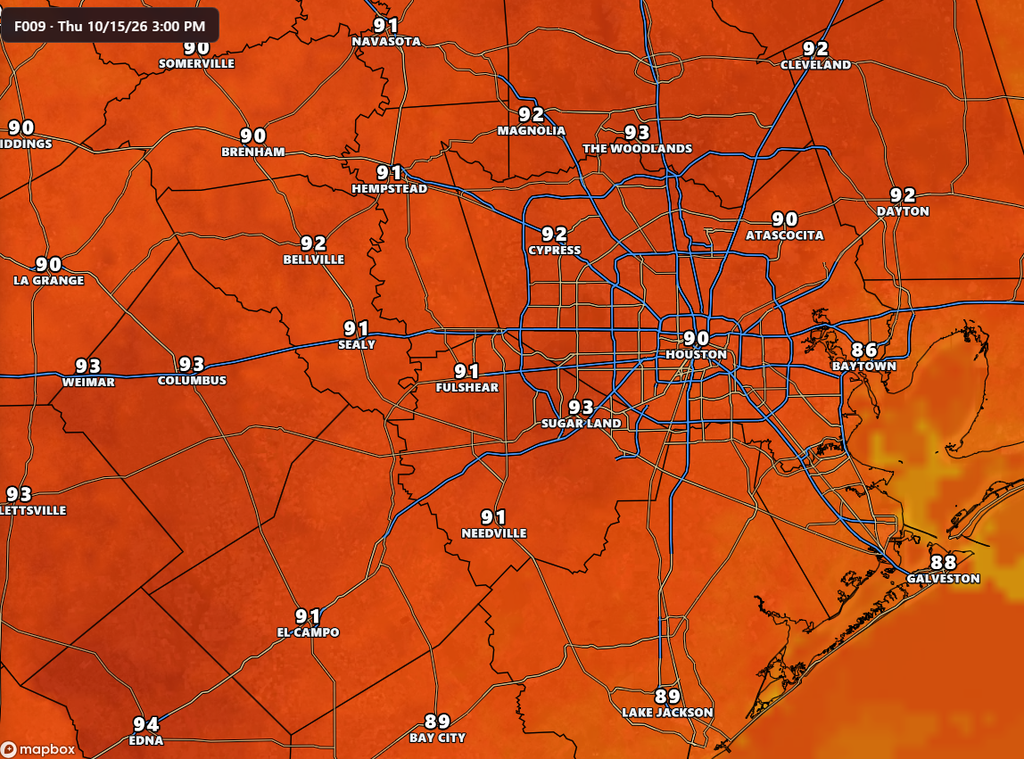
Temperatures should peak on Friday, as we’ll make yet another run toward 80 degrees. It’s probably notable that most of the area has not seen any appreciable rainfall since the beginning of December, which likely isn’t hurting these temps at all.
Friday looks toasty. Again. (Pivotal Weather)
Whatever the case, the forecast trends a bit less confident beyond Friday, with some models indicating a bit of a small cool down, while others say Friday won’t be our last attempt to hit 80 degrees. Stay tuned.
In brief: Merry Christmas, everyone. We hope the holiday was wonderful for you. We’ve got three more days before a strong front arrives, and then we’re watching for the possibility of a light freeze in parts of Houston. Also, some readers explain why they like fog!
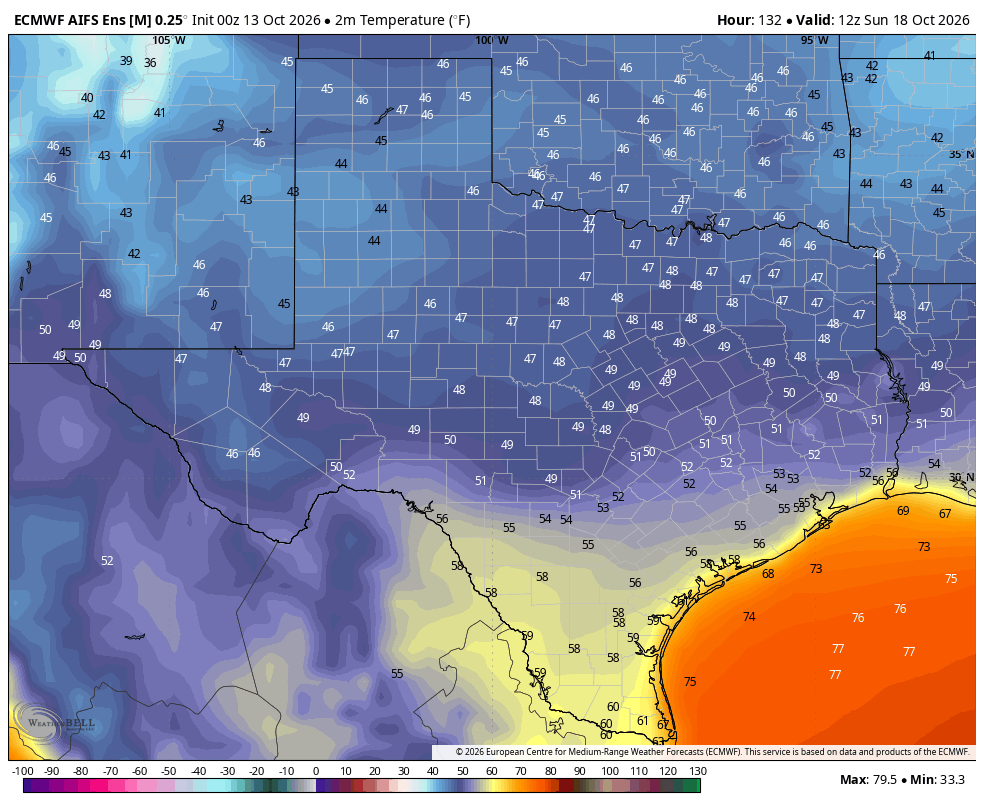
It’s winter for half of Texas, and not winter for our half. (Weather Bell)
Remembering Neil Frank
Word that Dr. Neil Frank had died arrived shortly after I hit ‘publish’ on Wednesday’s post, so this remembrance is coming a little late. In any case, I first moved to Houston in 1997, and for the next decade he was the meteorologist I watched most on television. I always had a lot of respect for Frank because of his longtime leadership of the National Hurricane Center. He and I were not particularly close, but from time to time he would write me notes about my coverage of weather and related issues at the Houston Chronicle. I always enjoyed those interactions. What I learned most from Frank is the importance of not just scientific rigor in forecasting, but also the value of clear communication, personal warmth, and humor. In that sense, he lives on here. I offer his family and friends, as well as his former colleagues at KHOU, our best wishes from the whole Space City Weather team.
Readers share reasons to embrace fog
We were slightly critical of fog a couple of days ago, and I asked readers who did not mind it to explain why. You replied with some fun responses, so, as we deal with fog for a couple of more days before winter returns on Sunday night, I though I would share some of them.
It sits looking over harbor and city on silent haunches and then moves on.
Cecilia sent in an email to say she likes the way it dampens sound: “It softens sounds. Sometimes to the point of silence. Living in Houston close to the loop, silence is a rare welcomed event.” And she’s right. The reasons for this are two fold. First, when it’s foggy it just means there are more tiny droplets of water in the air. This attenuates sound waves, especially at a higher frequency (or pitch). Fun fact: this is the reason why fog horns blow at a very low pitch, so their sound carries further. The second reason fog sounds quieter, I think, is because fewer people are out and about when it gets really thick.
A pilot wrote in to say fog is a good chance to brush up on flying skills: “You asked for a reason I like fog, here it is. As a pilot, foggy weather is a great chance to brush up on flying instrument approaches. Just as long as it’s not too foggy at my home airport. If the ceiling gets much below 200-300 feet or visibility below 1/2 mile, it gets dangerous to impossible to land.
Paul said fog should be best thought of as Southern snow: “In the south having lived here 90% of my life it is, to me, like southern snow! Everything is quiet but not as cold as snow. It wraps you into an intimate, quiet, and comforting blanket. Time stands still. All is as quiet as a recent snowfall except most of the time you’re not freezing your arse off!!”
Friday and Saturday
Really, these days will just be more of the same. We can expect high temperatures ranging from the upper 70s to low 80s, with plenty of humidity. Nights will be warm and muggy, with lows falling only into the upper 60s for most locations. Winds, generally, will be light from the south. We’ll have a mix of clouds and sunshine. And that’s about it.
There is a risk of thunderstorms on Sunday night. (NOAA)
Sunday
This will be another warm day. In fact, with compression ahead of the front, we might see highs pushing into the low 80s for much of the region. Cooler temperatures will eventually arrive on Sunday evening, or during the overnight hours. When you wake up on Monday morning, temperatures will be much colder, likely in the 40s. Speaking of the frontal passage, there may be some brief, light to moderate showers on Sunday night with its passage along with a few thunderstorms. They should not last long as the front pushes through.
Low temperature forecast for Tuesday morning. (Weather Bell)
Next week
Monday and Tuesday will be sharply colder. Daytime temperatures on both days will likely peak at around 50 degrees, and conditions on Monday should feel even chillier due to fairly gusty winds. Both days should see partly to mostly sunny skies. We’re closely watching for the possibility of a light freeze in Houston, which will depend on a variety of factors including winds, clouds, and just how cold a narrow wedge of air near the surface can get on Tuesday and Wednesday mornings. For now I’ll predict that most of metro Houston lands just above freezing, in the ballpark of 33 to 36 degrees. But it should be fairly close, and you should be prepared for the possibility of sub-freezing temperatures similar to what we experienced 10 days ago. A freeze is more likely for areas outside of Houston’s urban core, and away from the coast.
Highs on New Year’s Eve should reach about 60 degrees, but lows that night will drop into the 40s. I’m not concerned about rains or winds, but conditions will still be fairly chilly if you’re outside as you ring in the new year. We should be around 70 degrees for highs to end next week, with mild nights probably somewhere in the 50s.
In brief: In this Christmas Eve update we discuss all of the fog recorded by Houston recently. Why has there been so much? When is it going away? Will Rudolph find his way tonight? Also, next week’s cooldown looks fairly stout, sending nighttime temperatures into the 30s.
All about fog, because it’s not going away
Ugh. That’s the typical reaction you’ll get from a meteorologist when it comes to fog. It’s no fun to forecast, and it’s no fun to drive through. About the only thing fog is good for, in my opinion, is establishing a really atmospheric scene in the movies, like the opening battle in the original Gladiator. But aside from that? Ugh. If you’ve got reasons to love fog, I’d like to hear them.
Anyway, the main engine of fog in the greater Houston region during the late fall, winter, and early spring months is the Gulf. By this time of year we have had enough cool fronts come down that the near-shore waters of the Gulf, and Galveston Bay, have generally cooled down to 60 to 65 degrees. (You can check the data for yourself, here).
Note the cooler shelf temperatures in the Gulf near the upper Texas coast and Louisiana. (NOAA)
The important thing is that at night, and in the morning hours, air temperatures remain a little bit warmer than water temperatures, even without the Sun shining. So when we’re in a steamy pattern like we’ve been in, you’ve got this warm and humid air moving over the colder water. This cools the air to the point of saturation, which means the air is saturated with water vapor. This occurs when the air temperature equals the dewpoint temperature. So presto, we’ve got a big fog machine that gets turned on every night. This is known as marine fog.
Houston is susceptible to another kind of fog over inland areas, that forms at night when the air temperature starts to cool. Because the air is already fairly humid, the temperature does not have to drop that far to reach saturation. This process generally needs light winds, so that the lower and more humid air at the surface does not mix with slightly drier air above. This is known as “radiation fog,” and it goes away as the air temperature rises along with the Sun in the morning. This is the origin of phrases like the Sun is “burning off” the fog. In reality, the air temperature is rising above the dewpoint temperature, causing the fog to evaporate.
This foggy pattern is going to be with us until we get a wind shift (from the north rather than southeast), which is likely to happen on Sunday.
Christmas Eve and Christmas Day
The next two days are going to be more or less the same as we’ve experienced so far this week. They’re going to start out with patchy fog, followed by temperatures rising into the upper 70s to lower 80s, and partly cloudy skies. Nights will be warm, generally in the mid-60s. Rain chances are low to non-existent. If you’re wondering how my long-range Christmas forecast (issued 12 days ago!) did, here you go:
I’m sorry I was not wrong.
Friday and Saturday
The end of the week should continue to see warm and fairly humid weather. If anything, we should see a little more sunshine, and this will push air temperatures to 80 degrees, or the low 80s, for many records. We have already tied several high records this week, and we are apparently gunning for more. Nights remain with, with a chance of patchy fog.
An early look at the low temperature forecast for next Tuesday morning. (Weather Bell)
Sunday and beyond
Sunday should be fairly warm as well, with highs pushing into the upper 70s, to possibly 80 degrees. A strong front is coming, but it’s now unlikely to reach our region before Sunday evening or the overnight hours. After this we’ll have a few cold days next week, with highs likely in the 50s, and lows in the 30s and 40s. I don’t think the majority of the metro area will see a freeze on Tuesday morning, but it’s a possibility we’ll be watching for as the mercury bottoms out. Temperatures should rebound a little by New Year’s Eve into the 60s, but at this point I suspect temperatures that night, heading into New Year’s Day will be chilly and in the 40s. So it will be fairly cold if you’re planning to be outside for revelries. The end of next week looks a little warmer.
From all of us at Space City Weather, we would like to wish you a very Merry Christmas and Happy Holidays. See you on Friday morning.
Since it appears that Houston not only will miss out on a white Christmas, we’ll have pretty toasty one instead, we thought we’d spread some holiday cheer with a Festivus-themed Q&A. We do these every so often, and you can always leave questions for future Q&As in the Weather Talk category of our Discourse forum. Time to saddle up Rudolph and get to answering!
Q. You’ve been talking about “White Christmas” a lot, but how many times in Houston have we actually had snow on Christmas Day? Is that kind of information readily available and if so, where would I find it?
A. Snow on Christmas feels like a true Festivus miracle in Houston. This is because our city is located pretty far south, and near the warm Gulf. It can snow here and roughly speaking we get at least some flurries about once every four years. But most commonly these snowfalls come in January or February. It is more difficult to get air cold enough, with lingering moisture for snowfall, in December. But we have had one White Christmas in Houston, at least for a majority of the area.
Not Christmas (Jan. 21, 2025, actually), but if it snowed on Christmas in Houston, this is what it might look like! (Dwight Silverman photo)
Most locations along and south of I-10 recorded meaningful snow on Christmas Eve, 2004. Areas such as Alvin and Brazos got 6 or more inches (see more totals here). I lived in Clear Lake at the time, and I remember walking outside that night, holding my two-month-old daughter, so she could experience it. For most locations the snow stuck into Christmas morning. Houston had never recorded a White Christmas before then, and we have not since. So yes, it is possible. But the odds of seeing one again in our lifetimes is probably pretty low. The chance of it happening this week is zero.
I don’t know of any source of information that’s just about snowfall, but you look up historical weather data here and here.
– Eric
Q. Sometimes I feel like this forecast is for a completely different city. I ran outside this morning in a T-shirt and shorts and at no point was I cold. Also, my temp was 47 on my ride into work at 4 a.m. today, Tomball to Woodlands. Last week, or maybe two weeks ago, my dashboard thermometer said 39, and it was legitimately cold outside. And again, SCW said it hit freezing that day. Something with the temps doesn’t align with what I actually see. It’s a solid 8-10 degree gap each time. What gives?
A. All right, air your grievances, reader!
So, we can’t speak specifically to the cases you’re talking about here. However, there is some context to add. First off, never, ever trust your car thermometer. Just don’t. Most temperature sensors in the area are calibrated to a certain degree of accuracy, whereas your car thermometer can be wrong due to any number of reasons. Even at night, when heat isn’t radiating off the pavement, it can still be too warm. Perception and reality are two very different things.
On any given morning, there can actually be temperature variability. Take last Monday for example. Temperatures ranged from 28 to 35 across the region in the morning. Back on December 9th, the differences were even greater, with temperatures ranging from 36 to 48 degrees. Morning lows depend on proximity to the Gulf, urban heat island, and cloud cover, among other things. So we may say that it’s freezing in parts of the area, which would be true. However, in other parts? Maybe not.
And your own personal experience running with a T-shirt and shorts is probably different than if my neighbor chose the same attire. (For the record, I’d probably be with you on it not feeling too bad.) Everyone adapts to cold differently and feeling one thing or seeing one thing in your backyard and seeing another in another location doesn’t necessarily make any of those temperatures incorrect. But just don’t use the car thermometer!
– Matt
Q. What makes the jet stream move? Why does it move north and south, and give us El Niño and La Niña?
A. The jet stream is, essentially, a narrow river of wind in the upper atmosphere at about 30,000 feet. This is near the cruising altitude of many airplanes. The jet stream shifts north and south in response to cold and warm air masses. Generally, the Northern Hemisphere jet stream shifts north during the summer and shifts south during the winter months.
As you note, the presence of El Niño and La Niña also play a role in the location of the jet stream. For example, we are currently experiencing a La Niña in the equatorial Pacific Ocean, which should continue for the next month or two. During a La Niña winter the jet stream often meanders high into the North Pacific and and is less reliable across the southern tier of the United States. For us in Texas, that generally means a warmer and drier winter, which we are going to experience this week.
A typical La Niña jet stream setup. (NOAA)
Q. I finally got rain at my house! Things are still a little dry but it was welcome. How much rain has to fall before a drought is considered over?
A. The unsatisfying answer to this question is very much “it depends.”
Much like every flood, every drought has a unique set of circumstances. It depends on the time of year, duration of dryness, prior weather in the weeks and months leading up to that point, soil and geography, and on and on. All droughts have fingerprints that differ from previous ones. Some are more water-supply problematic. Others are not a problem for water supply but a serious one for farming and livestock. Some come with high fire danger, others will slightly less fire danger. Again, it all depends.
In general, you want to make up most of the deficit you’ve accrued since the drought began, but it needs to occur over a sufficiently long period of time for the soil and system to respond adequately. Getting 20 inches of rain in a day when you’ve racked up a 20-inch deficit over 8 months will only temporarily ease drought. But 15 inches of rain spaced out over 3 months is probably enough to do it. Like all things weather and climate, it’s nuanced!
– Matt
Q. With climate change causing, well, changes to the climate, at what point does “unusual for the season” become “the new normal”? When do meteorologists get to say “80 on Christmas is about normal for this time of year”? And I wish I didn’t have to ask this question!
A. I wish that as well. But here we are.
When meteorologists use normals, we are referring to an average of temperatures over the past 30 years. (To see Houston’s normal temperatures, go here). These get updated every decade. So at present, our “normal” temperatures are based on a period from 1991 to 2020. Over time these “normals” have been warming due, at least in part, to climate change. For example, the map below shows how the dataset for “December maximum temperatures” changed when the dataset switched from 1981-2010 to 1991-2020. Nearly the entire country had a “new normal” that was 0.5 to 2 degrees warmer, on average.
At present the “normal” high is 64 degrees in Houston on Christmas Day, and the “normal” low is 44 degrees. This year, for many of us, the daily low on Christmas may not even reach 64 degrees. Hopefully meteorologists never get to the point where we say 80 degrees is “normal” for Christmas in Houston. If that does happen, however, our boiling planet will have a lot greater problems than just worrying about a warm Christmas in Texas.