It may not feel like it, but Houston narrowly escaped a much worse fate from Hurricane Nicholas

Well, they don’t call them natural disasters for nothing. For some residents, of course, last night was but a breezy affair. For others, especially along the coast, there is substantial wind and flood damage to contend with this morning from Hurricane Nicholas. And then there are the half a million customers in the greater Houston region without power this morning.

For those of you recovering today—and I count myself among you as power went out in my neighborhood, trees are down, my backyard flooded—it may not feel like it, but this storm could have been so so much worse. With this post I want to discuss that, but first lets update the status of Nicholas and present a short-term forecast.

Tropical Storm Nicholas

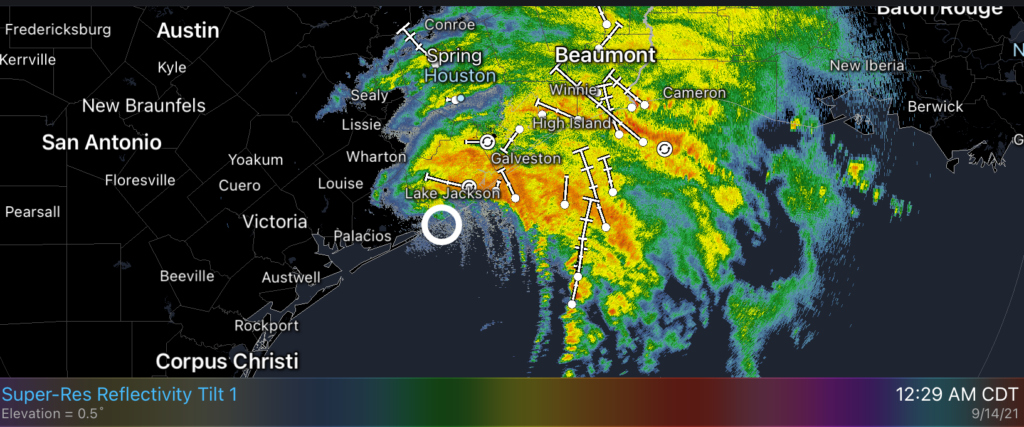
As of 10am CT, the center of Nicholas is very nearly directly over Houston, located just 10 miles southeast of downtown. As it has moved inland for nearly 10 hours, Nicholas has weakened to a storm with sustained winds of 45 mph. The storm is moving slowly, the northeast, at about 6 mph. It should continue to turn more easterly, and then dissipate over Louisiana in two or three days. The main rainfall threat has moved east, and the southern half of Louisiana could see 6 to 10 inches of rainfall over the next several days.
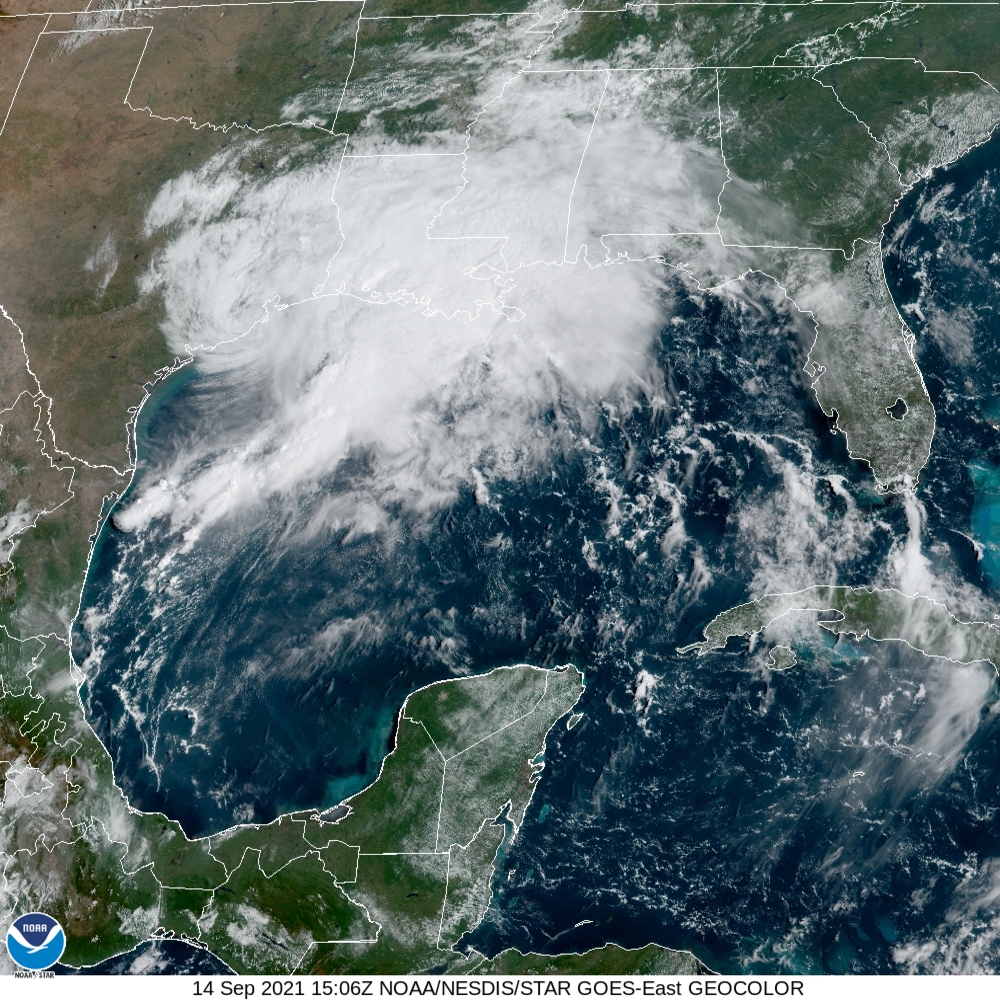
Nearly all of the moisture associated with Nicholas is now east of Houston. (NOAA)

Short-term forecast

The forecast for today and Wednesday will allow for recovery in the greater Houston area. Some light, scattered showers will be possible today and Wednesday, but chances are fairly low and accumulations should be slight. The strongest winds, too, have moved east of the area despite the presence of Nicholas’ center.

If you’re without power, high temperatures today will be quite reasonable for this time of year, in the upper 70s. Humidity will be high, of course. Lows tonight will drop into the low 70s. Highs on Wednesday should reach the mid-80s with a mix of sunshine and clouds.

If you want a more hopeful thought, we’re seeing fairly strong hints in the models for a decently strong fall front moving into the region in nine or ten days time. That’s a long way out to forecast, so grain of salt and all that, but it is the right time of year for a front. So maybe, hopefully, fall is but 10 days away. I’m ready.

Nicholas could have been so much worse

First of all, if you can remember all the way back to Saturday, I presented three different scenarios for Nicholas’ track and eventual flooding in Houston. The first of these was the “Coast Hugger,” in which the storm remained close to the Gulf, brought 2 to 4 inches of rain to Houston and higher amounts along the coast, while keeping the heaviest rains offshore. This is largely what happened, with Nicholas remaining very close to the coast even after moving inland. If we look at satellite-derived precipitation totals for the last three days, the heaviest swath of 10-20 inches of rainfall came offshore.
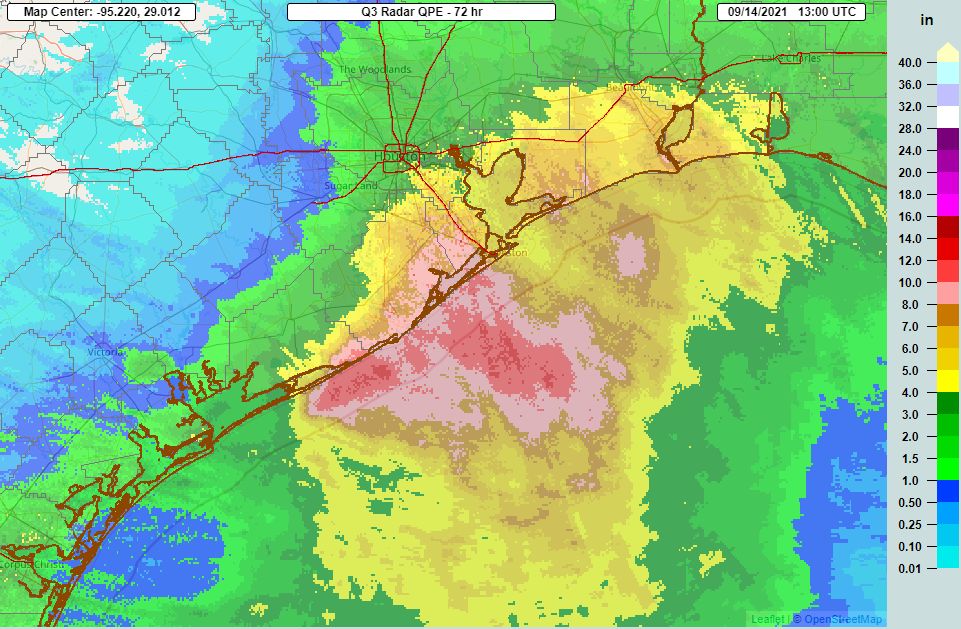
Satellite estimated rainfall totals for Nicholas during the preceding 72 hours. (NOAA)

A track even 40 or 50 miles further inland would have set up those heaviest rains directly across the Houston metro area, and created a much more serious flood situation. Hopefully this offers you some insight into the challenge of predicting these kinds of rain events. It was a very close call, a matter of miles, between significant inland rainfall flooding in Houston, and relatively clean bayous this morning.

The second factor is wind. Nicholas turned out to be a fairly nasty storm in terms of wind gusts, and pushed a larger storm surge—as high as 6.1 feet into Clear Lake—than predicted. This is a reminder of the power of a hurricane, even one that was “only” a minimal Category 1 storm. The truth is that the track of the storm was very nearly a worst-case one for Houston in terms of winds and putting a maximum storm surge across Galveston Island and into Galveston Bay.
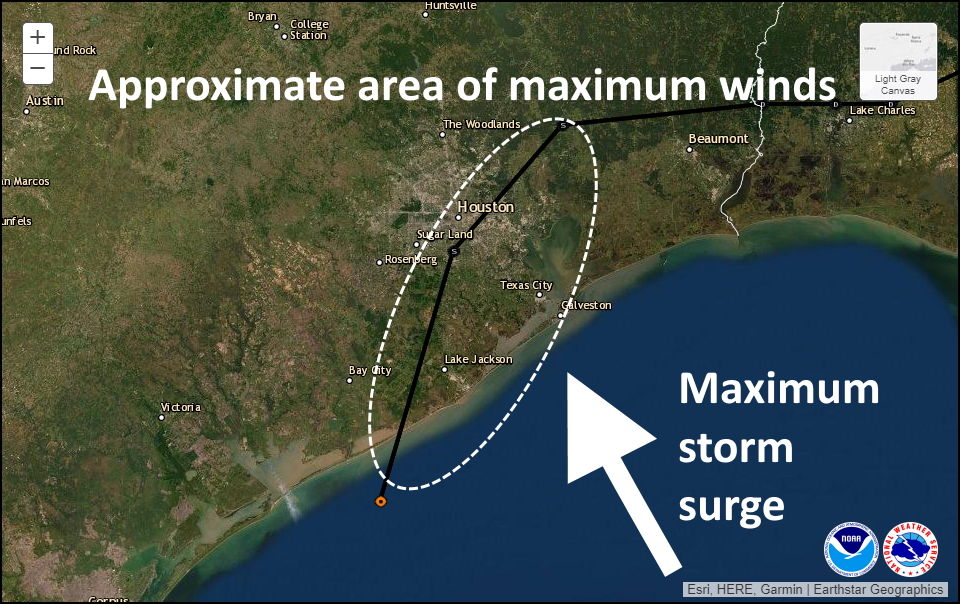
Image showing approximate track of Nicholas, with winds and surge overlaid. (NOAA)

It is September 14, the absolute peak of hurricane season in the Atlantic, and a time when sea surface temperatures in the Gulf of Mexico are at their warmest of the year. So this morning I’m thinking about what would have happened if we had not had some wind shear over the western Gulf of Mexico yesterday, or if Nicholas had been able to consolidate a more well defined and consistent center of circulation. It would have been much, much worse for all of us had a significantly stronger hurricane made landfall last night. So while we pick up the pieces this morning, realize Nicholas could have been much more of a terror.

Matt will have our next update—and probably our last update specific to Nicholas—at 5 pm CT today.
Nicholas makes landfall south of Houston, will pass over the city later this morning

Hurricane Nicholas made landfall at 12:30 am Tuesday on the eastern part of Matagorda Peninsula, about 10 miles west of the small city of Sargent. It had maximum winds of 75 mph at landfall. The storm is moving about 10 mph to the north-northeast, and along this track the storm should pass almost directly overhead Houston on Tuesday after sunrise. After that it should turn more to the northeast.

Winds

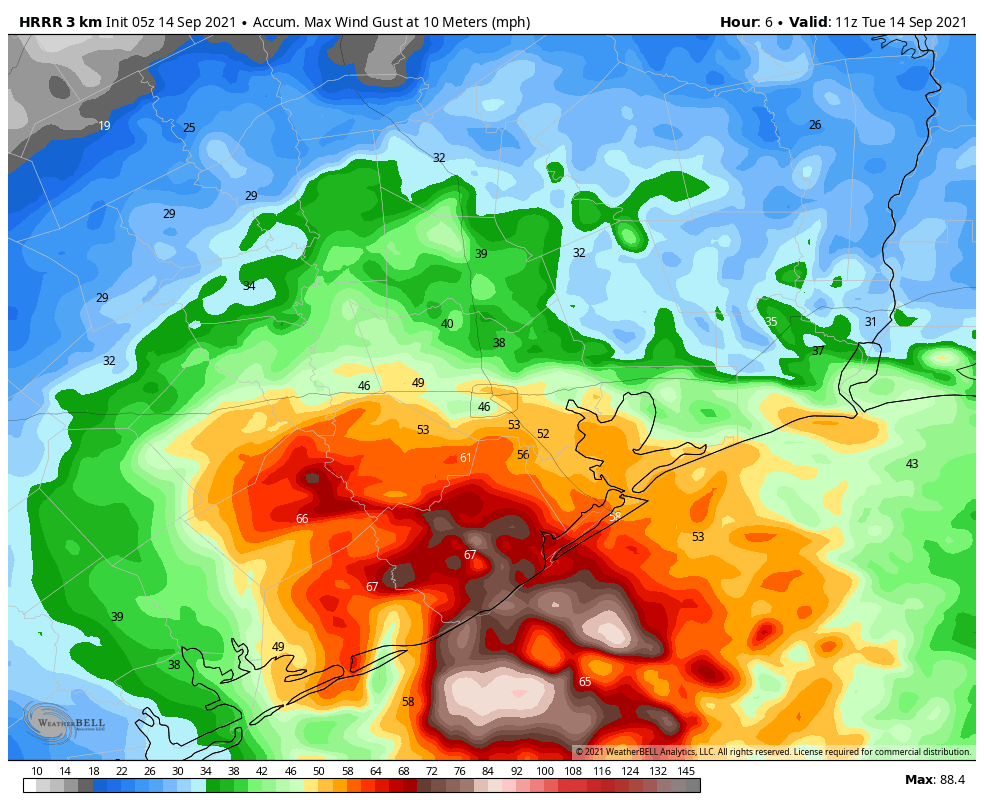
We’re starting to see wind gusts above 60 mph along the coast of Galveston Island, and we expect to see gusts in the 40s and 50s spreading inland over night. So far power outages in coastal counties range from about 90 percent of customers out in Matagorda County, closest to Nicholas, to about 20 percent in Brazoria County, to 10 percent in Galveston County. Further inland, Wharton and Austin counties have significant outages. More can be expected as Nicholas moves closer to Houston and Harris County this morning.

Forecast for maximum wind gusts through sunrise on Tuesday. (Weather Bell)

Rains

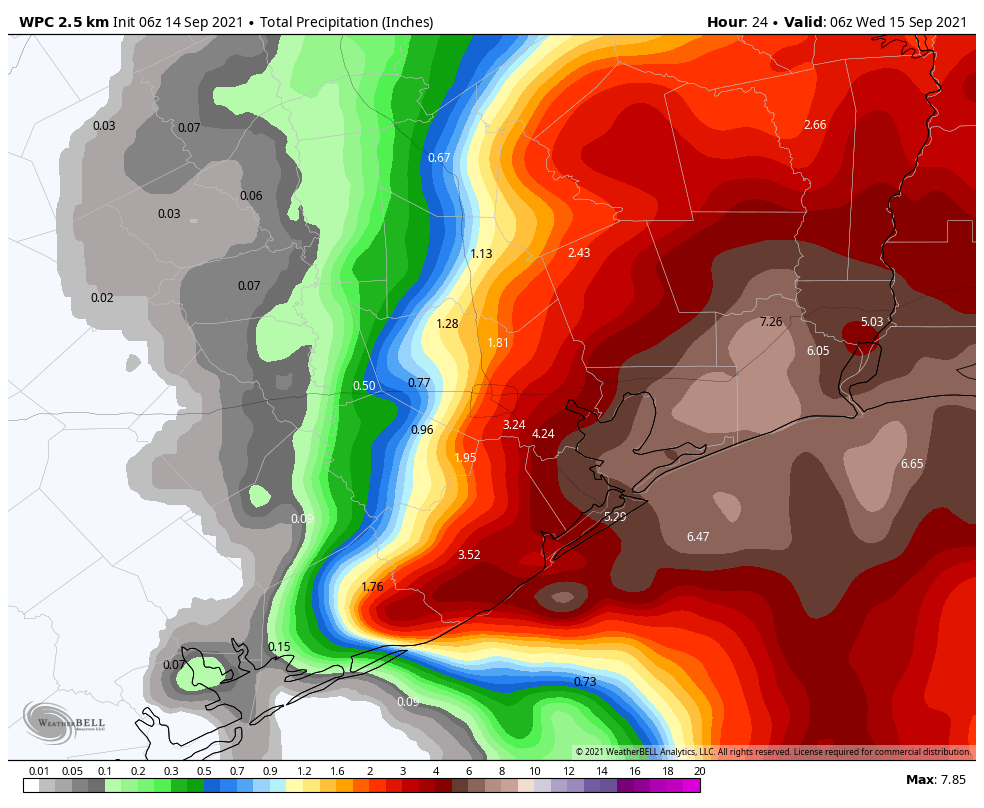
So far tonight we’ve seen a thick band of rain showers moving inland from Nicholas, and while the rains have been heavy they have not been excessively so. These rates of generally less than 2 inches per hour are helping to moderate totals. Overall accumulations through Tuesday should be 2 to 8 inches for coastal counties near Houston, with potentially more rain east near Beaumont as Nicholas tracks inland and slows down. Here is the latest rain accumulation forecast from NOAA for now through Wednesday morning.

NOAA rain accumulation forecast for now through Tuesday night. (Weather Bell)

For the Houston area, it’s likely that the heavier rainfall will wind down between sunrise and noon on Tuesday, with lesser chances afterward. Winds should die down as well. A sense of normalcy should return to our weather by Tuesday afternoon.

“Dirty” side of the storm

We often talk about the “dirty” side of a hurricane, which is located to the right of a storm’s center. This is where the strongest winds, rains, and surge typically lie. And this evening as Nicholas was moving into the Texas coast, its radar signature provided a textbook example of all the activity falling on the east side of the storm, with virtually nothing occurring to the west of the center.

Radar signature of Nicholas, with the center highlighted, shows the “dirty” versus “clean” side of the storm. (RadarScope)

Matt will have our next update by or before 5:30 am CT.

Nicholas becomes a hurricane, will batter coast, and bring heavy rains south of Houston tonight

‘Twas the night before Tuesday, when all through the city
None were stirring, not even Harry Styles more’s the pity;
Dry stockings were hung by the chimney with care,
In hopes that St. Nicholas soon would not be there.

Alas, Nicholas is here. And he’s bringing lumps of coal for all. So we’d better discuss the forecast.

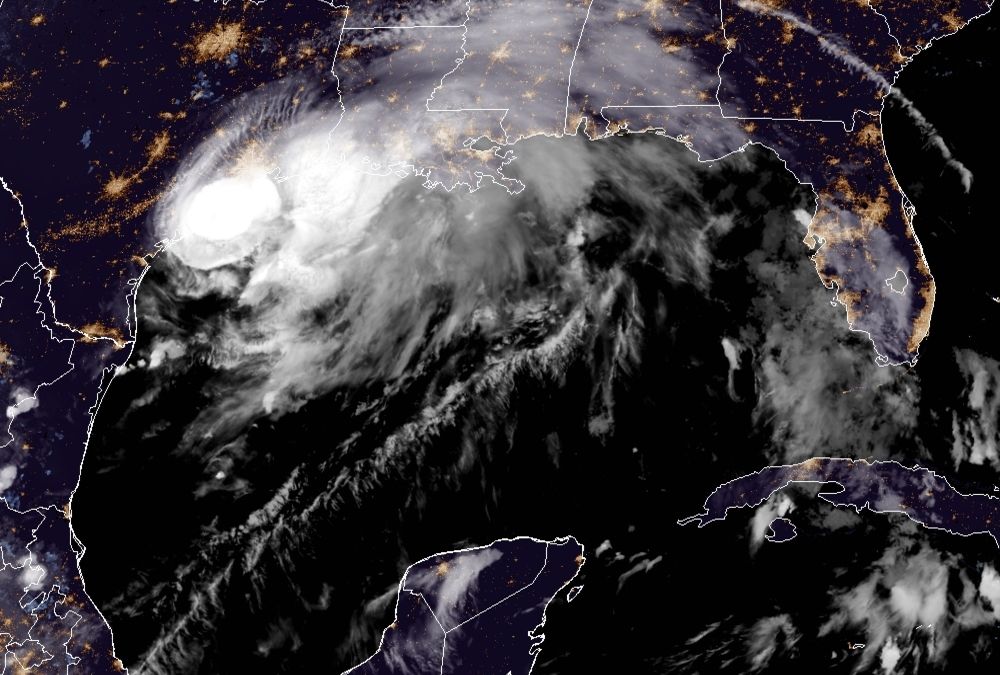
As of 10 pm CT, the National Hurricane Center says Nicholas has become a hurricane with 75-mph winds. Its center is presently located 20 miles southeast of Matagorda, Texas. The storm is moving to the north-northeast at 10 mph, and should come ashore the upper Texas coast later tonight, possibly near Sargent, Texas. No additional strengthening is anticipated, the hurricane center says. The storm is expected to cross the Houston region on Tuesday morning and then move into southeastern Louisiana and essentially stall before dissipating by Thursday or so.

Satellite appearance of Hurricane Nicholas at 10 pm CT. (NOAA)

Houston area rainfall

Our overall rainfall forecast remains largely unchanged. If you live inland of Highway 59 and Interstate 10, you’re very likely to miss out on heavy rainfall overnight and into Tuesday morning. My expectation would be for 2 inches, or less. If you live closer to the coast, particularly in Brazoria, Galveston, and Chambers counties, heavy rainfall is much more likely. Widespread totals of 4 to 8 inches are likely, with bullseyes of 10 inches or more that may produce localized flooding.

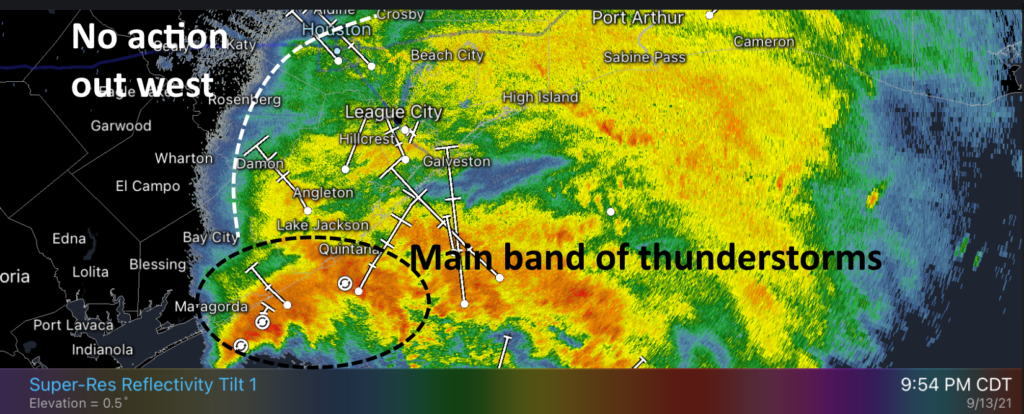
The radar image below tells the tale of the night. We can see the main band of thunderstorms along the Texas coast, but mostly offshore. This band of gnarly storms will to move to the northeast tonight, and how bad things get for the Texas coast will depend on how far inland it gets (or how far offshore it remains). Right now I’d be surprised if the heaviest rains pushed much farther inland than League City tonight. But we’ll see. I’ve also annotated the line where there’s no rain now. There probably won’t be much precipitation west and north of this line tonight, either, as Nicholas moves to the northeast.

Annotated radar snapshot shortly before 10 pm CT Monday. (RadarScope)

As this system slogs toward the northeast over night, it will have the potential to drop rainfall across all Texas coastal areas. However, for now, it appears the heaviest rains will come over Galveston and Chambers counties, with lesser amounts further east, including the Beaumont and Port Arthur areas on Tuesday morning.

Wind and power outages

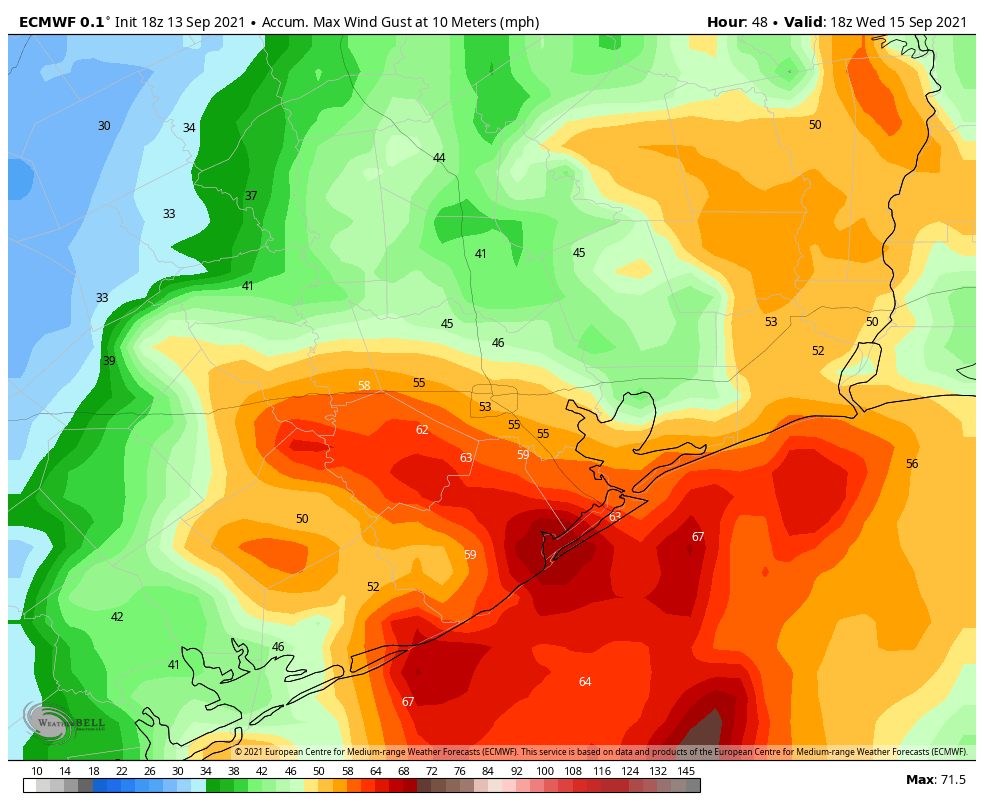
For inland counties, including Fort Bend and a majority of Harris County, this now appears more likely to be a wind storm rather than one of significant rains. As of 9:30pm about three quarters of Matagorda County were experiencing power outages as Nicholas battered its shores with hurricane-force wind gusts. These winds, although diminished, should spread inland over the next several hours. I’d expect at least scattered outages as trees fall into power lines.

One model forecast for maximum wind gusts from Tropical Storm Nicholas. (Weather Bell)

When does this mess end?

Our confidence in when the heaviest rains from Nicholas push east of Houston remains middling, but I’d expect rains in Galveston County to wind down around sunrise or mid-morning.

Our next update will come at around 1 am CT.

As Nicholas nears, we are lowering our Flood Scale alert for all but the coast

Good evening. Tropical Storm Nicholas is nearing the middle Texas coast and should make landfall near Matagorda Bay within several hours. The storm’s maximum winds increased to 65 mph this afternoon, and it’s quite possible Nicholas will become a Category 1 landfall before landfall tonight. Wind gusts from Nicholas are starting to arrive along the upper Texas coast, and should peak around midnight or during the wee hours of Tuesday.

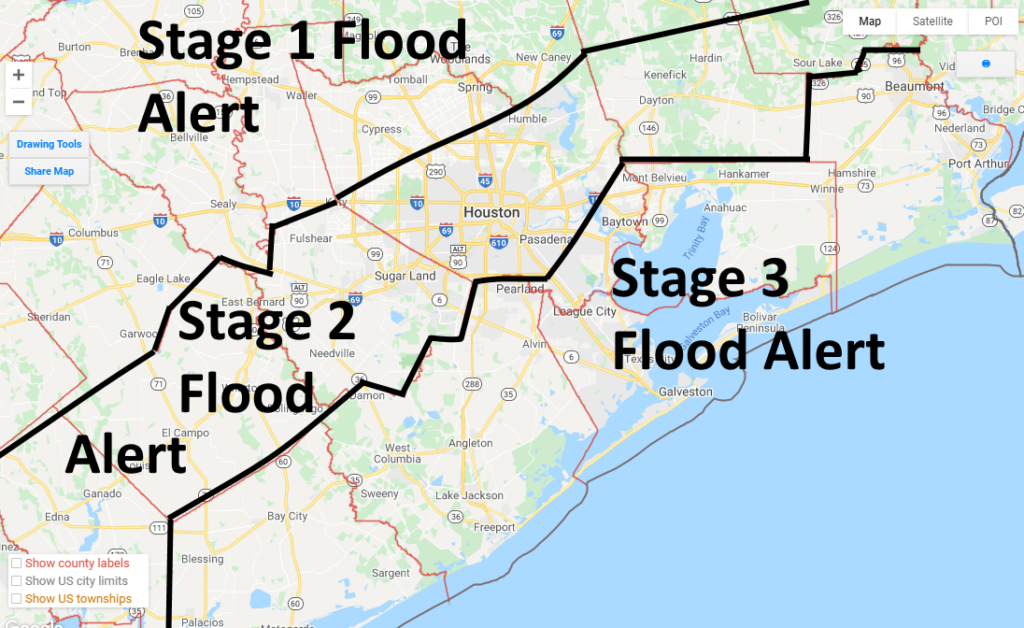
As Nicholas nears the shore we are starting to get more confidence in rainfall forecasts for tonight and Tuesday morning as the heaviest rains from the storm move through. And as a result of this we are lowering our Flood Stage alert for all but coastal counties.

Space City Weather Scale Alerts as of 5 pm CT on Monday. (Google maps)

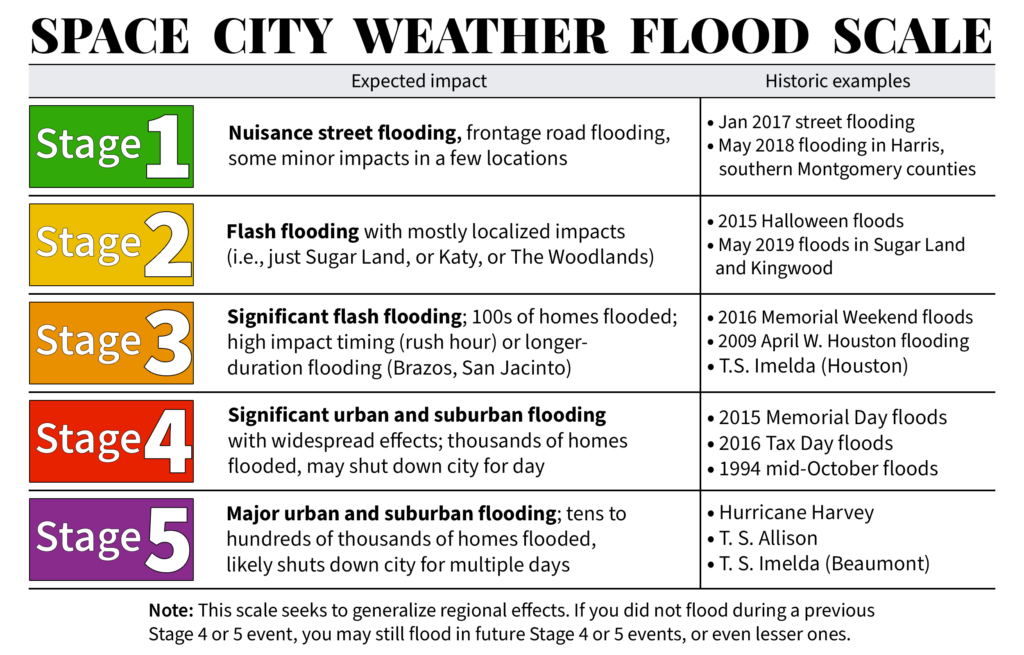
As you can see on the (very professionally drawn) map above, we are keeping a Stage 3 alert for coastal counties, Stage 2 for the next tier, and Stage 1 for areas northwest of Houston. Basically, if you live near the coast, an additional 6 to 12 inches of rain is possible tonight, with higher localized totals. For areas roughly along Interstate 10, values should be about half of this, give or take. And for areas well inland, overall accumulations will likely be 3 inches or less. As a reminder here’s what our various flood scale alerts mean:

Timing of events

The overall pattern for events tonight should not change a whole lot. Heavy rainfall will advance from the southwest into the Houston region tonight, likely reaching a corridor from I-45 South to downtown Houston around midnight, or an hour or two later. These storms will then continue to push to the northeast, perhaps moving away from Harris County by around sunrise or mid-morning.

Maximum wind gusts of 50 to 60 mph will likely move into Brazoria and Fort Bend counties by late evening, with gusts in the 40s reaching Harris County by around midnight. These winds should begin to weaken by around sunrise on Tuesday morning. Expect scattered power outages, at least, as trees and debris fall into power lines.

We think conditions may begin to improve across the area by around sunrise on Tuesday, or perhaps mid-morning. So our advice is to not have any concrete plans for Tuesday morning, as we cannot say a whole lot about conditions with confidence. By Tuesday afternoon we expect conditions to improve markedly. At this point we think Wednesday should see a return to normal activities across the region without too much difficulty, and excluding any areas that saw widespread flooding on Monday night.

Our next post will come by around 10 pm to fine-tune the forecast for tonight and Tuesday.