In brief: In this post we go deep on what’s happening with El Niño, and what it means for Houston and Texas, and globally as well. Basically, we are in uncharted territory here.
What is El Niño and why do we care
El Niño is the periodic warming of sea surface temperatures in the tropical Pacific Ocean. Historically water temperatures in this area have oscillated between warmer than usual (El Niño), neutral, and cooler than usual (La Niña). These changes can generally be predicted several months in advance. We care because El Niño and La Niña affect weather and climate around the world.
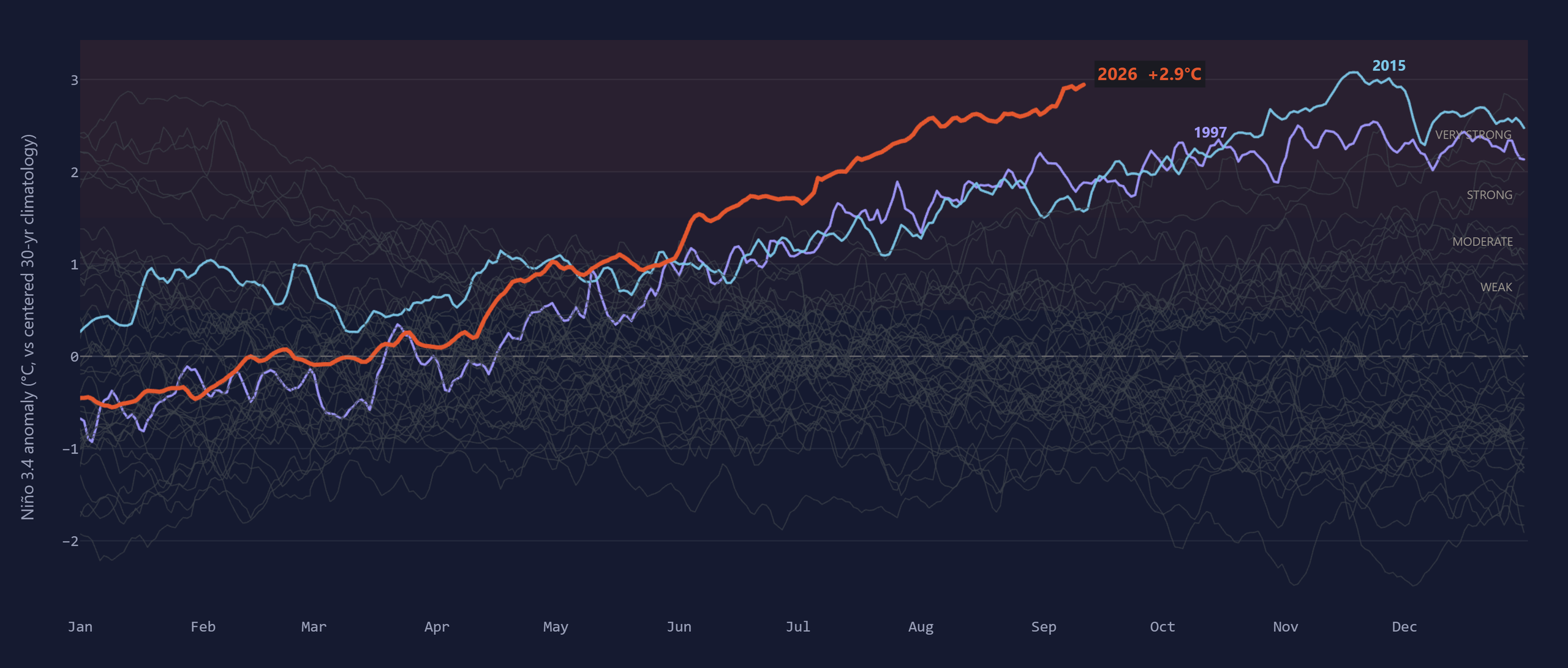
This year we care more because El Niño is already very, very strong, and it is likely to reach even higher levels this fall and winter. NOAA currently estimates that during the period of October to December there is a 75 percent chance of a historic event that would exceed the strength of previous El Niño events dating back to 1950. In short, this could be the strongest El Niño in the modern observational record.
But should we care?
Actually, you probably should. However it probably is not going to bring certain doom, or anything, locally. As with any weather or climate phenomenon, when you start to talk about extremes like this, there is going to be an extraordinary amount of information, misinformation, and hype. But El Niño can be a truly impactful event, and indeed we are already seeing some of its impacts.
Such as?
Take a look at the 2026 Atlantic hurricane season. This past week represents the utter peak of the season, and it has been dead quiet out there. El Niño is not the only reason for this, but it is the predominant factor. The Atlantic has never gotten this deep into the season, in nearly 150 years of records, without the development of a hurricane. And yet here we are. It’s quite astounding to have such a low amount of activity.
But that’s a good thing …
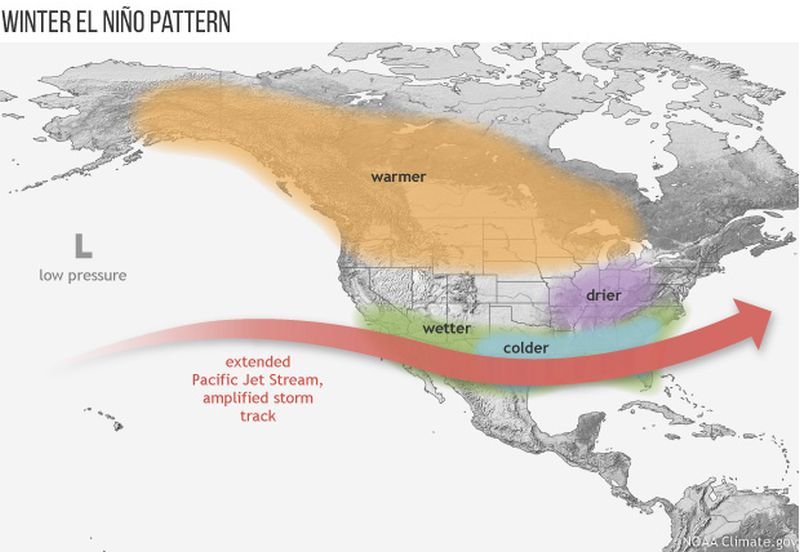
It certainly is. El Niño can have beneficial effects, and increasing wind shear across the Atlantic tropics is one of them. As for our weather for the rest of this year, and early 2027, the result is a mixed bag. Typically during an El Niño winter we see a more pronounced subtropical jet stream across Texas. This means more upper-level disturbances.
In terms of weather, generally this brings above-normal rainfall and slightly cooler than normal temperatures during the winter months in Texas. To be clear, this is not a signal for a hard freeze or a major snowstorm. There is not a significant association between these weather patterns and El Niño. However it does mean we are likely to see more cloudy days during the winter, and the likelihood of more severe thunderstorms and possibly flooding events.
All in all, the local impacts of El Niño are not too serious for Houston. But that’s not the end of the story.
El Niño has global impacts
The potential is high for disruptions around the globe, and that’s not great for economies already strained by wars in Ukraine and the Middle East.
Let’s start with the Panama Canal, which relies on water from Gatún Lake to raise and lower ships traversing the waterway. During El Niño, precipitation is typically lower across parts of Central America, including Panama. The Canal Authority has already begun reducing the number of daily slots for large ships to move through the canal due to lower precipitation. There is not a global shipping crisis yet, but ongoing drought in the region could have even more significant consequences this winter and into 2027.
Similarly, El Niño often causes droughts in Southeast Asia delaying the production of rice and other important agricultural crops in places such as Thailand, the Philippines, Vietnam, and elsewhere. According to the World Food Program, tens of millions of people could face acute hunger due to the strengthening El Niño. There will likely be similar disruptions in other parts of the world.
Lots of uncertainty
One of the biggest concerns I have about this El Niño is that we are headed into unknown territory in terms of the strength of this event, and its impacts on a more populous, interconnected world. This creates tremendous uncertainty about the severity of impacts locally and globally.
Global temperatures are going to spike
Typically global temperatures lag behind El Niño by a few months. This means that temperatures in 2027 will almost certainly be the hottest on record. During the 1997–98 El Niño, global temperatures jumped substantially in 1998, which became the warmest year then observed. This also occurred during the major El Niño in 2015-2016, and the 2023-2024 El Niño, when 2024 reached about +1.55°C above preindustrial temperatures, becoming the hottest year recorded in the modern era.
Now we have an El Niño that is going to be stronger than any of those, with a world already experiencing rising temperatures due to global warming. Global temperatures are likely to spike. In Texas, the influence of El Niño is less pronounced in the summer than winter, but I think we can safely predict a tremendously hot summer next year locally, and around much of the world.
A message from Reliant
At Reliant, we’re grateful to Eric and the team for their no-hype outlooks and helping us navigate the varying weather El Niño may bring our way. When weather is cooler than normal in the winter and hotter than normal in the summer, it can make air conditioning and heating systems (HVACs) work even harder to keep up. Maximize your home’s efficiency with tips for HVAC maintenance, thermostat settings and seasonal adjustments to help you save and stay comfortable year-round with these energy efficiency tips.
