Storm update: Heavy rain likely to remain concentrated along the coast, in Galveston and to the east

Good afternoon. With this post we will provide an update on rainfall expected tonight and Friday, before our region dries out and starts to heat back up this weekend. The bottom line: We are maintaining a Stage 1 flood alert for coastal counties through Friday. The biggest change in this afternoon update is that our area of greatest concern has shifted eastward: We now expect the heaviest rainfall from now on to be focused on Galveston Bay and points eastward.

As expected, the rainfall today has been largely focused along the coast. Whereas most of the metro area north of Interstate 10 has not seen more than a few stray drops, parts of Galveston Island have received as much as 4 inches. This trend is largely expected to continue as a tropical system moves northward, continuing to push a river of atmospheric moisture on shore. Because we expect such a wide variance in outcomes, let’s break the forecast down for two different areas: the coastal counties of Galveston, Chambers, and Orange; and everyone else, including Houston.

This forecast for precipitable water, a measurement of the moisture in the atmosphere, indicates where the greatest potential for heavy rainfall will be tonight. (Weather Bell)

Galveston, Chambers, and Orange counties

Forecast modeling has zeroed in on these areas bearing the brunt of heavy rainfall, most likely from about midnight tonight and running through Friday afternoon. Locations in these counties may see between 2 and 8 inches of rainfall during that time period, and despite the dry soils the most intense rainfall rates will nonetheless quickly back up streets. (This kind of tropical moisture is capable of producing intense rainfall rates of 2 to 4 inches per hour.) If you live in these areas, you should definitely check the radar before getting on the road tonight and Friday. While things may be fine, there’s also a chance they might not be. The worst should be over some time on Friday afternoon.

Houston, Harris County, and other parts of the metro area

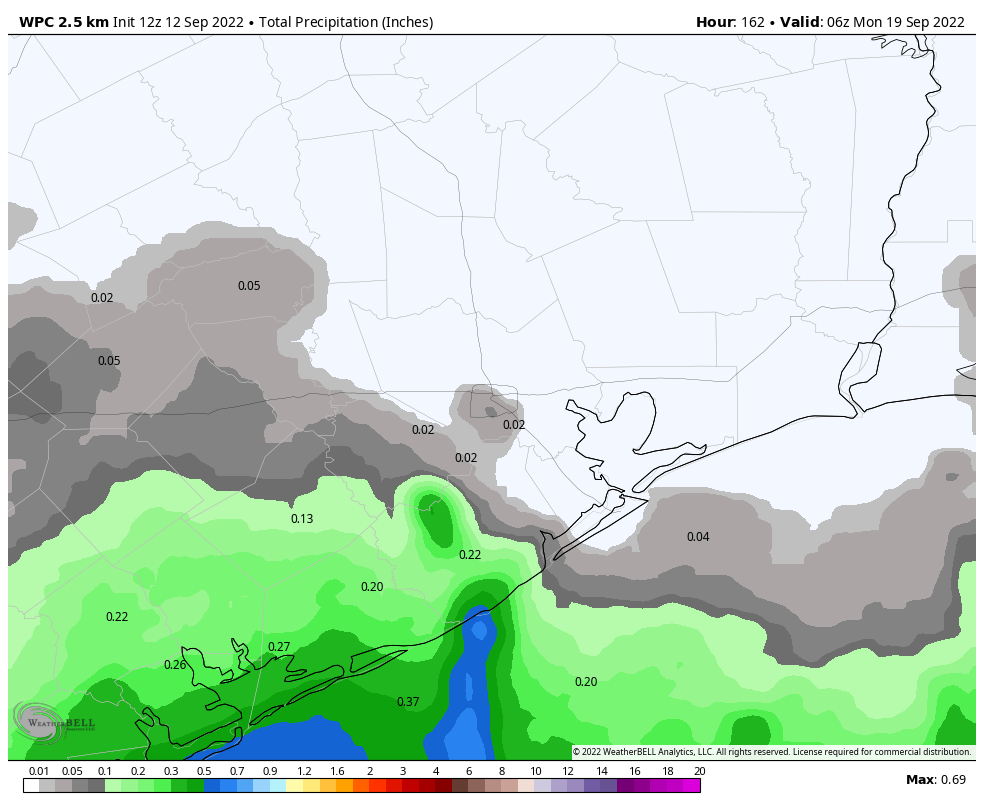
For everyone else the rain showers are likely to be far more spotty, and the impacts minimal. Expect a day on Friday to be pretty much business as usual. While we could see a few areas away from the coast pick up some significant rain accumulations, it would not surprise me to have much of the inland parts of our region stay below one-half inch of rain. This is especially true for locations inland of Highway 59/Interstate 69. It just looks like the moisture is going to get shunted off too far to the east to really provide meaningful rainfall to those areas. I know, our lawns and trees could certainly use a lot more.

If needed, Matt will have an updated forecast later tonight. If not, look for a post early Friday morning to catch you up on the latest.

We are issuing a Stage 1 flood alert for coastal counties, and watching the situation closely

Good morning. A tropical low pressure system is nearing the South Texas coast this morning, and should begin to move inland today. As a result, beginning tonight and on Friday, much of the Houston metro area is likely to see moderate to heavy rainfall. But the biggest threat should come in our coastal counties: Matagorda, Brazoria, Galveston, Chambers, and Orange. Therefore, for these areas we are issuing a Stage 1 flood alert on our Flood Scale.

Broadly speaking, we expect 4 to 6 inches of rain for coastal areas, which is a lot for two days, but since these areas have been so dry the totals should be manageable. However, some model data indicates the potential for coastal areas to see larger bullseyes of rain with this tropical air mass, and we are monitoring this closely. Suffice it to say that we may need to increase the flood alert later today to Stage 2, but do not feel confident in doing so now. (These bullseyes could also very well miss offshore). We plan to update you later today as we know more.

Approximate area of Stage 1 Flood Alert. (Google Maps/Space City Weather)

The remainder of the metro area should see more moderate totals of rainfall over the next two days, generally 1 to 4 inches, with amounts decreasing the further inland you go. We do not expect to need to issue any flood alerts for these areas, but again we are watching closely.

Thursday

We have seen some coastal showers develop prior to sunrise and push inland, but this activity will probably wane later this morning. Additional scattered showers and thunderstorms are possible this afternoon, but none of these are likely to be too organized. Therefore we think today should be business-as-normal for most people, and most activities. Look for highs in the upper 80s with mostly cloudy skies. The threat of heavy rain from the tropical system probably will not arrive until at least midnight along the coast, and a bit later than than that for inland areas.

Friday

Right now we think Friday will yield the most hazardous weather in terms of heavy rainfall. The key question, as we’ve been saying for a couple of days, is where the tropical low ultimately moves and brings its excessive moisture. We could find ourselves in a situation where the heaviest rain remains largely offshore, or we could find ourselves in a situation where Galveston Island receives 10 inches. What we can say for certain is that there is the potential for very heavy rainfall on Friday for coastal counties, with lesser chances as one moves into Harris County, and lesser chances still further inland. The potential for heavy rainfall should exit coastal areas on Friday afternoon or evening, and move north as the system is also moving to the north or northwest.

NOAA rain accumulation forecast for now through Saturday morning. (Weather Bell).

Saturday

The potential for widespread, moderate to heavy rainfall will linger on Friday night into Saturday morning as the tropical low starts to move away from the area, but we should start to see skies clearing out during the afternoon hours, allowing highs to reach about 90 degrees.

Sunday and Monday

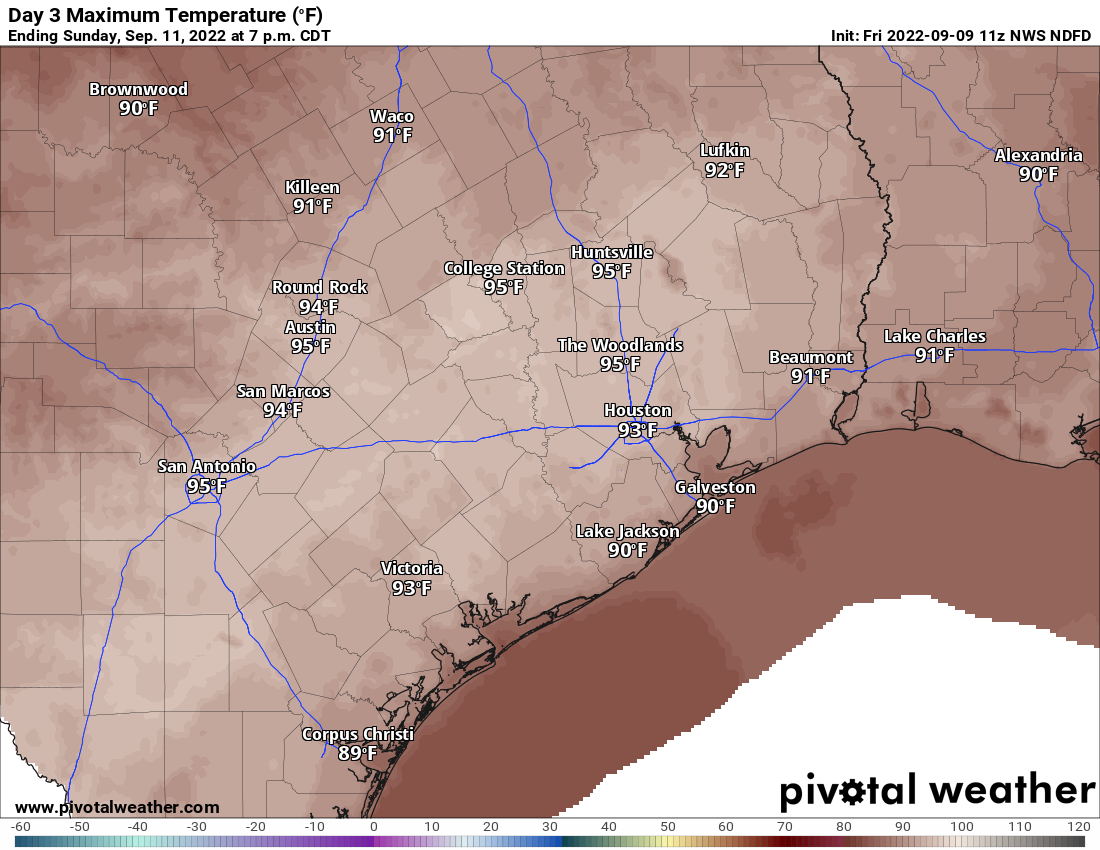
The remainder of the weekend should see mostly sunny skies, with highs in the low- to mid-90s. There is a slight chance of rain both days, but I would only put it at 10 to 15 percent. Therefore, there should be no weather concerns for the Fourth of July holiday.

Next week

Houston’s weather will fall back into a hot and sunny pattern for most of the rest of next week, with highs probably in the mid-90s, or thereabouts. It will be a little warm for early July, but not excessively so.

We will post an update on the potential for flooding on Thursday afternoon or evening.

Moderate to heavy rainfall is possible through Friday for Houston

Houston’s warmest June ever is going to end much cooler than it started. With an increase in cloud cover, and at least decent daily rain chances, the next four days will generally see high temperatures of only around 90 degrees, give or take. The bigger question remains rain totals as a low pressure system approaches the Texas coast. Between now and Saturday I would expect 0.5 to 2 inches of rain for inland areas north of Interstate 10, and 1 to 4 inches for areas closer to the coast. But there will be wide variability across the region, and a lot still depends upon the movement of the tropical low over the next few days.

The location of the tropical low pressure system on Wednesday morning. (NOAA)

Wednesday

The aforementioned low pressure system is a couple of hundred miles due south of the Texas-Louisiana border this morning, over the Gulf of Mexico. And that’s where the bulk of the rainfall is, offshore. Still, we’ve seen coastal areas getting clipped by rains moving inland early this morning, and that could happen again this afternoon and early evening. If you live inland, north of Interstate 10, rain chances are less today, but not zero. Highs will generally reach the low 90s, beneath mostly cloudy skies. But if some sunshine pokes through this afternoon, a few locations could reach the mid-90s. Light winds (except in thunderstorms) will shift from the northeast to southeast later today, and rain chances may slacken over night.

Thursday and Friday

These two days still look like the best time for moderate to heavy rainfall to fall along upper Texas coast. This is when the tropical low pressure system—which has a 40 percent chance of becoming a tropical depression, the National Hurricane says—should come onshore somewhere along the middle Texas coast. Again, the most favored regions for heavy rainfall will be coastal counties, including Matagorda, Brazoria, and Galveston. However, the best chance for inland rainfall will also come on these days, as the tropical system marches inland. Our rainfall totals will ultimately depend on whether the system makes a northward jog, in which case some coastal areas could see 5+ inches. At this point, we just can’t say for sure.

The increased cloud cover and widespread rain should help to keep temperatures in check, with daily highs perhaps not making it beyond the upper-80s for a lot of locations. Enjoy the reprieve from the heat, which we certainly earned after a torrid June.

NOAA rain accumulation forecast for now through Saturday morning. (Weather Bell)

Saturday, Sunday, and Monday

For many this will be a holiday weekend. It is looking like we’ll see a carryover of rain chances into Saturday morning, but at some point they’re going to end and our skies will likely turn sunnier. Highs on Saturday will be around 90 degrees. Sunday looks partly to mostly sunny, with highs in the low 90s, and the Fourth of July should see partly to mostly sunny skies with highs in the mid-90s. We can’t entirely rule out a fleeting shower on these days, but I’d put the chance down in the 10 percent range. Note that while Harris County Commissioners did vote to enact a burn ban on Tuesday, fireworks will remain legal in the unincorporated part of the county.

Next week

Most of next week will likely see highs in the mid-90s, with mostly sunny skies, and precious few rain chances. So be sure and top off over the next several days, if you can.

Eye on the Tropics: Let’s get this party started

Welcome to our first edition of Eye on the Tropics for the 2022 hurricane season. Each Tuesday, Eric or myself will get you caught up on the big picture in the Atlantic basin. From now into August, it gives us a space to expand on some tropical thoughts a bit more expansively than we can in our morning posts. Usually by mid-August there’s enough happening each day to include in our regular emails. Until that time, though, we’ll cover the bases on Tuesday.

Tropical outlook in a sentence

We have a fairly active Atlantic basin, especially for late June, and although no storm is expected to be significant we have something to watch close to home with Invest 95L in the Gulf of Mexico.

2022 to date

Through this morning, we have had one named storm this season. We were up to the “D” storm by this point in the season in both 2021 and 2020. Good omen? Perhaps, but this is really just normal for June. It’s typically not that active of a month. We normally see storm two in mid-July. So instead of being a month or more ahead of schedule this year, we’re only about two or three weeks fast. Progress!

Gulf system (Invest 95L)

Eric had a very thorough and fine write-up on this system and how much rain it could bring to Texas this morning. I won’t reinvent the wheel here, and I encourage you to read his post for the latest.

Potential Tropical Cyclone 2

Elsewhere, we have nothing to worry about in the tropics, but things are active. A common question we get this time of year involves people planning trips to various tropical paradises. They want to know if they have to worry about “that thing out there.” That’s why we’re here!

Potential Tropical Cyclone #2 will approach Trinidad later today and it should scrape the coast of Venezuela on its way toward Central America. (NOAA)

Potential Tropical Cyclone Number Two is located just east of Trinidad and Tobago. That’s a mouthful, but in simple language: It’s a system that meets tropical storm criteria (winds of 39 mph or higher) near land, but lacks a defined center just yet. It’s moving steadily westward, potentially on a collision course with <checks notes> Venezuela. Not a lot of history of storms in June and July this far south. In fact, if PTC 2 can develop into an actual tropical storm, it would be one of the farthest south this early on record.

A map of all known June and July storms traveling within 60 nautical miles of where PTC 2 is expected to go near Trinidad and Venezuela later this week. It’s not many. (NOAA)

The good news is that track forecast confidence is very high with this storm now. We have very little serious deviation between models or ensemble members, which gives us good support for a predictable outcome. In this case, it involves PTC 2 hauling due west, with maybe just a slight northward component. But ultimately, it’s likely on a collision course with Nicaragua or perhaps Honduras. As confident as we are on track, the opposite is true about intensity. Given its historically hostile location (the eastern Caribbean), the time of year, its proximity to land, and the fact that it’s moving around 20 mph or faster, there are a lot of extraneous factors that could impact the storm’s intensity negatively. Yes, this has a chance to become a hurricane as it approaches Central America, but it probably has equal chances of not being one too.

If your travels take you to the islands or Mexico, you probably have no issues to worry about. Elsewhere in Central America, it’s worth continuing to watch. The good news is that this thing is moving fast enough that it will probably emerge into the Pacific Ocean fairly quickly. So hopefully that leads to minimal flooding issues in Central America.

To note: The next name on the list after Alex is Bonnie. So if PTC 2 can develop, it will get that name. Sadly, the “C” storm is not Clyde, it’s Colin.

Other Atlantic items

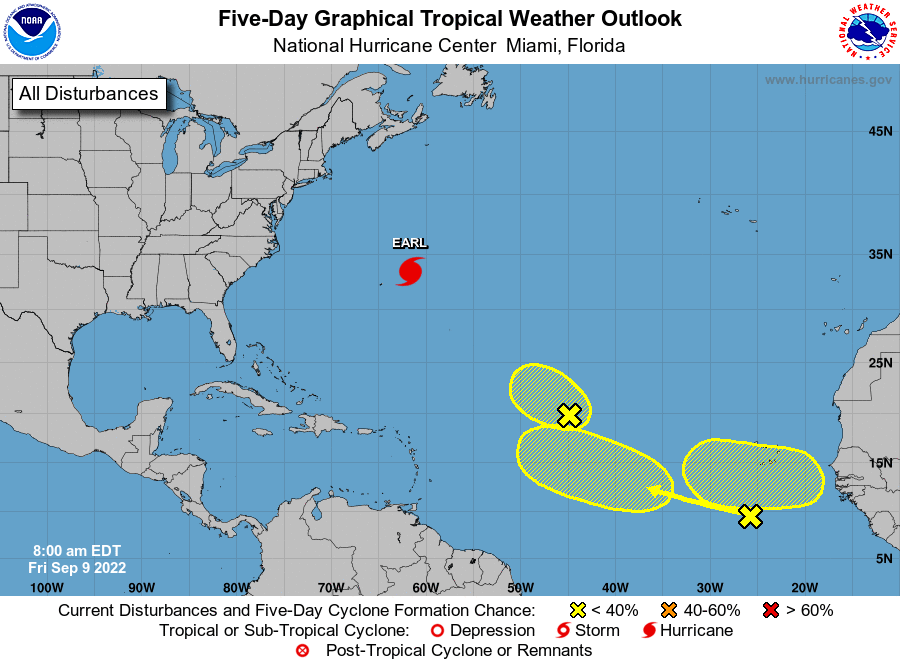
The National Hurricane Center is offering 20 percent odds that another tropical wave can develop in the Atlantic over the next 2 to 5 days.

PTC 2 at left and the 20 percent chance wave at right in the Atlantic earlier this morning. (Weathernerds.org)

At this point, model support is pretty mediocre on this one, unlike PTC 2, which had pretty robust model support. So, while we’ll continue to watch this wave, honestly, there’s nothing intelligible we can say about its future at this time. Unlikely to develop, but there’s a small chance. We’ll see where we are next week.

Beyond that, there’s nothing on our radar for the next 10 days or so. Hopefully we can enjoy another July lull this year after a fairly busy start to the month. More next week!