In what has quickly become a family tradition, our clan visited Space Center Houston on Sunday evening to take in Galaxy Lights, presented by Reliant at Space Center Houston. It was a lovely evening, with light winds, temperatures in the low 50s, and clear skies. As you might imagine, the space-themed holiday cheer was once again a hit with a website named after “Space City.”
It’s holiday lights—with a space twist.
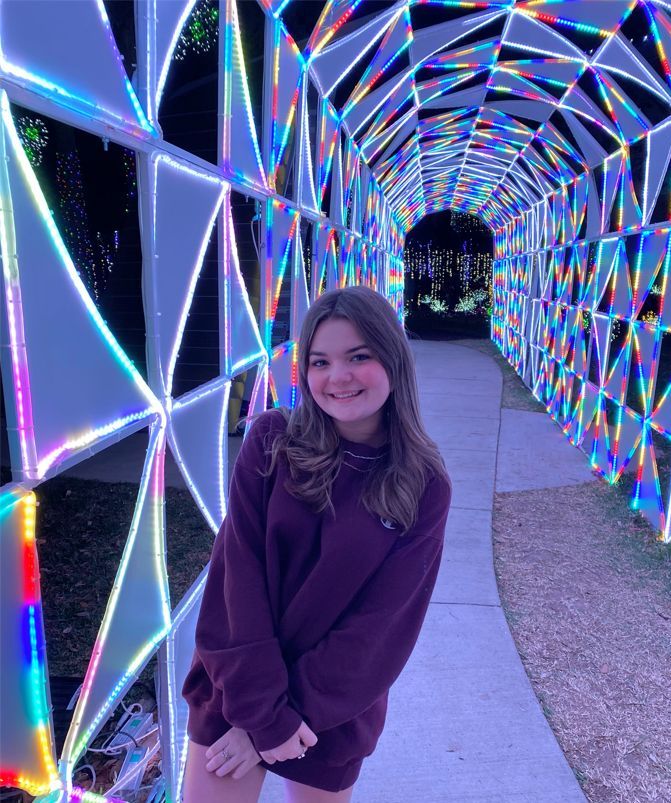
If you’ve not been before, Galaxy Lights features a mix of indoor and outdoor spectacles. You walk into and out of the museum, which is lit up with technologically advanced light displays. Many of the light displays are space-themed, from astronauts and rockets to planets. The highlight, for me, was walking through a 200-foot LED light tunnel composed of more than 250,000 lights synchronized to holiday music.
What’s nice about this exhibit is that you get both a sense of Christmas spirit as well as access to nearly all of the museum. So if you want to catch up on your space shuttle carrier aircraft history, or see a previously flown Falcon 9 rocket first stage, you’re more than welcome to do so. And if you’re just there for the s’mores, hot chocolate, and bright lights, that’s perfectly fine too. As my 14-year-old daughter can attest, there are plenty of great spots to grab a unique selfie.
Daughter: “Dad, would you take a picture of me?” Me: “Again?!?”
Galaxy Lights is open daily, except for Christmas Eve and Christmas Day, from now through January 2. The hours run from 6 pm to 10 pm CT, and it takes one to two hours to explore the holiday display. I’ve found that if you go during the latter two hours the crowds are significantly less—with little waiting to get inside, and more room to move about the many exhibits. As for weather, if you want mild conditions, this week of Dec. 13 is good. If you want a more winter-like chill in the air, the week of Dec. 20 will serve you better. For ticket information and more, click here. Enjoy the show!
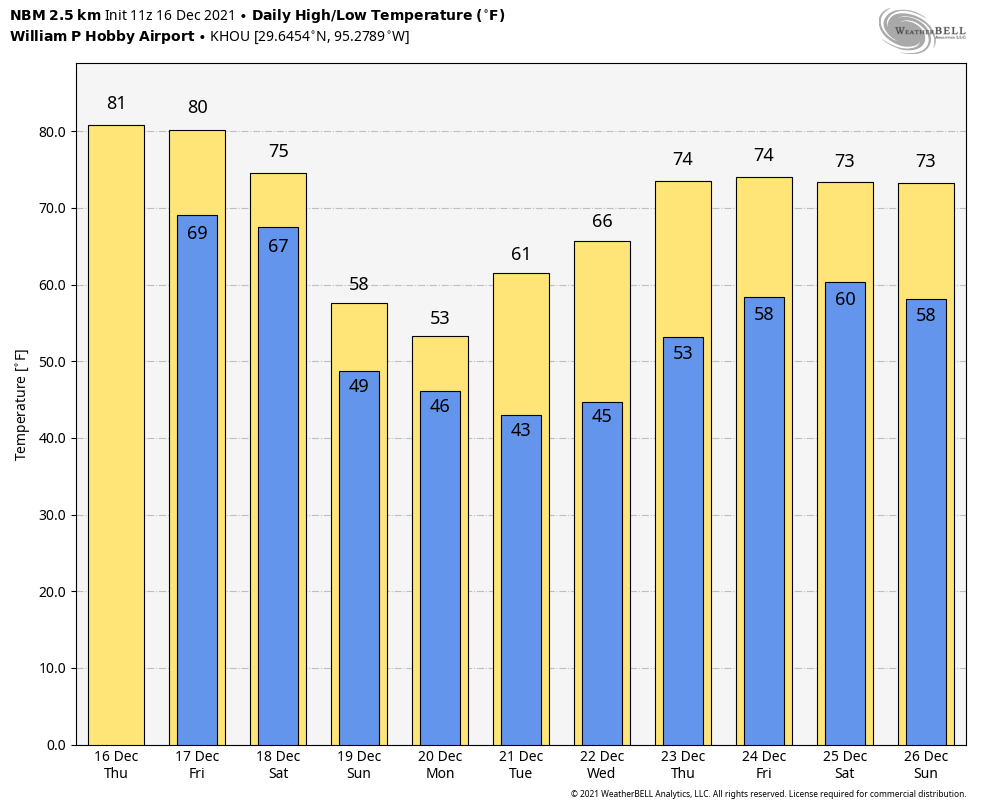
Good morning. The overall forecast for the next week is straightforward. We’ll see abormal heat for two days, and then about a five-day stretch of much more seasonable weather, with high temperatures in the 50s and 60s, and low temperatures in the 40s and 50s. By next Friday, or Christmas Eve, we’ll definitely be warming up, but the forecast for Christmas Day remains uncertain.
I’d like to note one interesting development before moving on to the daily forecast. The US Army Corps of Engineers has announced plans to study the development of a massive underground tunnel to carry floodwaters from inland parts of Houston to Galveston Bay. This is an ambitious plan that is potentially very helpful. But I think there are two important things to note. One, this is not a substitute for a coastal barrier, commonly known as the “Ike Dike.” The proposed tunnel would alleviate inland flooding, that is, heavy rainfall from tropical systems and other events. The coastal barrier would address storm surge flooding. Both inland rainfall and storm surge cause flooding, but they are very different mechanisms that require different solutions.
The US Army Corps of Engineers has already studied coastal flooding “defense” strategies. (USACE)
The other point is that 13 years have elapsed since Hurricane Ike and its storm surge, and Hurricane Harvey is now four years in the past. We simply cannot continue to “study” solutions to the problems highlighted by these storms, as the US Army Corps of Engineers has done with storm surge. We must actually build solutions to prevent their catastrophic effects. With all that said, I’m glad to see this idea get a full blown study.
Thursday and Friday
These will be a pair of warm and partly sunny days, much like we’ve experienced this week. Highs will likely reach the low 80s, and there is the slightest chance of a light shower. Mostly, however, it’s going to be warm and humid, with southerly winds blowing at 10 to 15 mph. Nights remain sticky, with lows dropping only to around 70 degrees in Houston. Both days have a chance to set record high temperatures. Not normal for December.
Saturday
Saturday morning will see more of the same before the arrival of a cold front in Houston brings some relief. The front’s timing has shifted somewhat. It now looks as though will arrive in northwest Houston during the late morning hours, and reach the coast during the afternoon. Showers and potentially a few thunderstorms will accompany and linger after the front, with overall accumulations likely on the order of 0.5 to 1.5 inches. Lows Saturday night will drop to about 50 degrees in the city of Houston, with cooler conditions inland, and a bit warmer near the coast.
Sunday and Monday
These will be a pair of partly to mostly cloudy days, with highs likely peaking in the 50s. Some spotty showers will be possible both days as the upper atmosphere remains somewhat perturbed. Things should finally begin to clear out later on Monday, or Monday evening. Lows will likely bottom out in the low 40s on Monday night, with the potential for upper 30s for some inland areas as skies clear.
Winter, finally. (Weather Bell)
The rest of Christmas week
Things stay dry and cool with mostly clear skies through Thursday morning, after which time we’re likely to see highs rebound into the 70s.
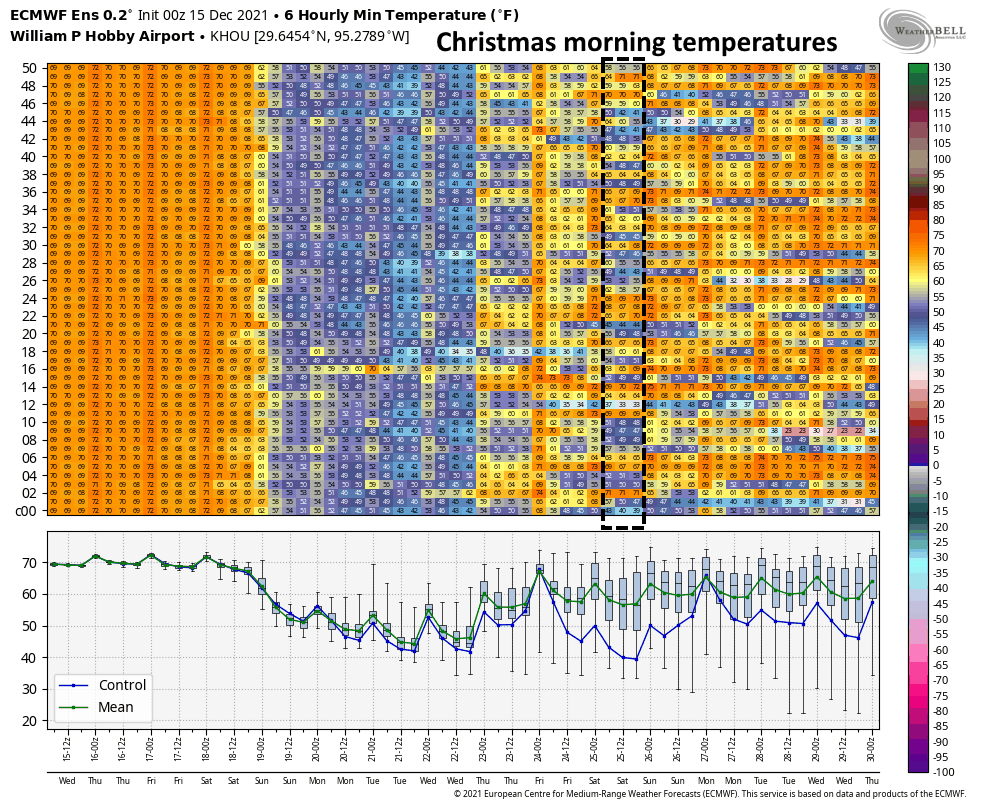
Unfortunately, I still don’t have much clarity for you after that time. I’d define Christmas morning as feeling at least somewhat “like Christmas” if the low temperature is 55 degrees or lower. Right now the odds of that are probably 40 percent, or less. But the forecast could still really go any way. At least things look pretty dry, in terms of rainfall. Perhaps Matt will have better answers for you in Friday’s post.
Speaking of the holidays, we’ll maintain a mostly normal schedule for the next two weeks, and in the unlikely event that there is inclement weather we’ll have full coverage. However, both Matt and I will be taking some time off from our regular jobs, and doing a bit of traveling. So if a post is published a little later on some days, that is why.
Good morning, Houston! We are now at the mid-point of December. In the big picture, the forecast is pretty straightforward. After three very warm days, a front arrives to make for a wet and chilly weekend. This colder pattern persists into the middle of next week. And after that? We start warming and waiting to see if another front makes it through before Christmas Day. If not, then Mele Kalikimaka my friends, as it will feel more like Honolulu in winter than Houston.
Wednesday
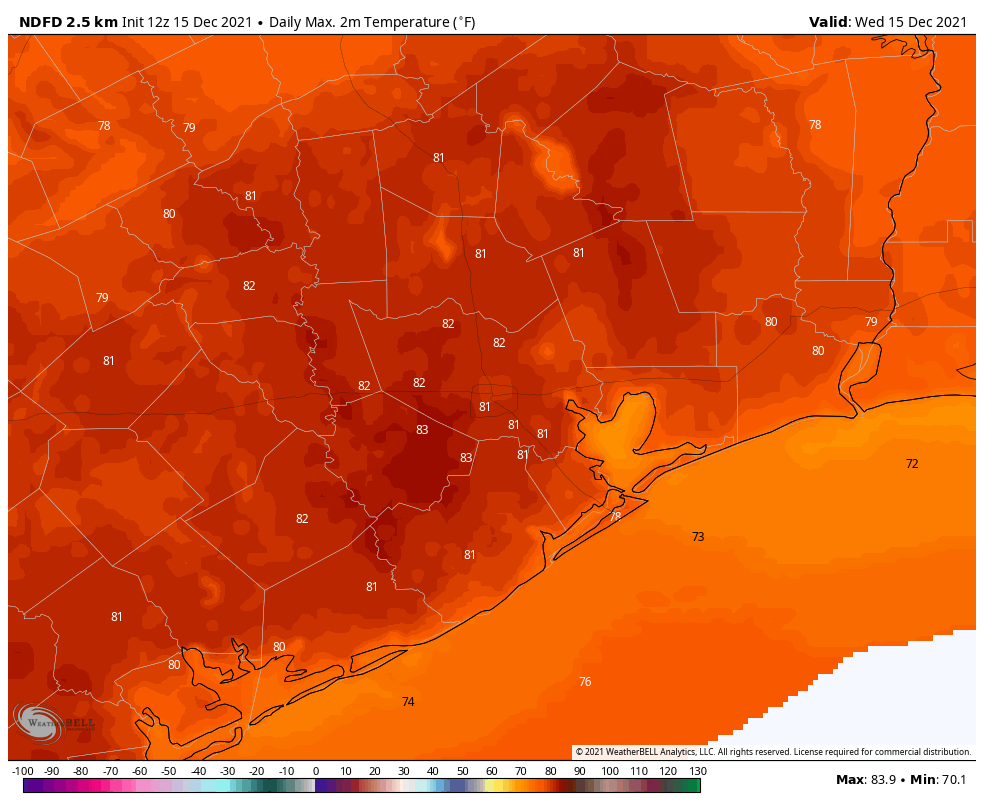
Modest southerly winds are helping to mitigate the formation of fog this morning, although there are still a few patchy areas around town. Otherwise, we’re going to see partly sunny conditions today, with highs reaching about 80 degrees, or possibly warmer for inland areas. Those winds will continue from the south throughout the day, possibly gusting as high as 20 mph. Some very light, spotty showers will be possible. But rain chances are less than 20 percent. Overnight lows will be warm, only dropping to around 70 in Houston.
Forecast high temperatures for Wednesday. (Weather Bell)
Thursday
See Wednesday’s forecast.
Friday
More of the same, with a mix of sunshine and clouds, highs around 80 degrees or a tick warmer, and a pronounced onshore flow of moist air from the Gulf.
Saturday
The timing of the front remains somewhat in question, but most likely it will move through the Houston area between sunrise and around Noon on Saturday. Temperatures will drop into the 60s during the afternoon hours, and lows down near 50 in the city overnight with cloudy skies. On and off rain showers will be possible throughout the day, with accumulations averaging an inch, with some areas seeing more, some less.
Sunday
This will be a mostly cloudy day, with high temperatures likely peaking in the upper 50s. Some scattered showers are possible during the daytime and Sunday night, but we’re not looking at anything too heavy. Mostly, it should just be cloudy and cool. Lows Sunday night should get into the upper 40s for Houston, with colder conditions for outlying areas. Rain chances persist into Monday morning.
European ensemble forecast for low temperatures in Houston. Some members are cold for Christmas, and some are not. The average is in the 50s. (Weather Bell)
Next week
As mentioned, Houston will remain on the cooler and drier side of things through about Wednesday of next week, after which daytime highs are probably going back into the mid-70s, with mild nights. Rain chances, for now, look low next week. So will this pattern persist all the way into Christmas? I still don’t have a definitive answer on that, unfortunately. It all depends on the timing of the next front, which remains uncertain, but now seems a little more likely to arrive just in time for Santa. Yesterday I was predicting a 60 percent chance of no Christmas front, and a 40 percent chance of a front. Today I’m 50-50. One thing is for sure, the probability of snow is the same as that of the Houston Texans making the playoffs.
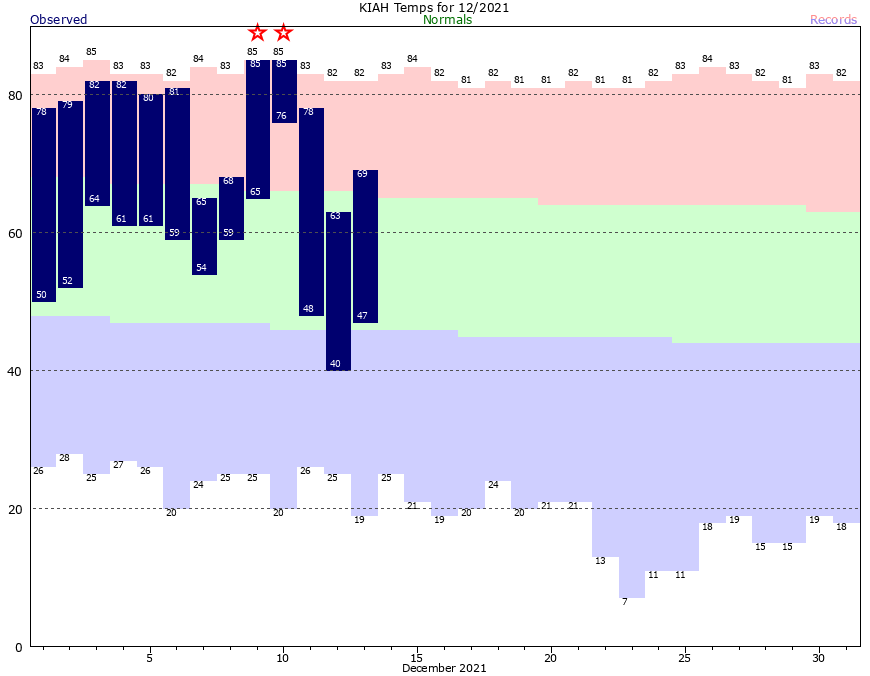
The weather Houston has experienced this month is very far from normal. Through the first 13 days of the month the average temperature has been 9.7 degrees above normal. If the month ended today, this December would go down as the warmest on record. The month, of course, is not over. But that record remains well within striking distance as the rest of this week will see temperatures soaring 20 degrees warmer than is customary for December. We will see a cooldown this weekend that will last into Christmas week. But will it last into Christmas Day? That’s a big question right now.
That’s … a lot of 80-degree days for December. (National Weather Service)
Tuesday
If you like fog and humidity and high dewpoints, have we got a December delight for you. Low temperatures this morning have only fallen to about 70 degrees, and as this warm and moist air moves over cooler waters it is creating what’s known as sea fog. This fog is fairly thick in some places, but should erode later this morning. In its wake we’ll see a mostly cloudy day with highs of around 80 degrees. Some rather light, scattered showers will be possible throughout the day. Your chances of seeing rain are probably about 20 percent or less, however. As for tonight, you guessed it. Warm, muggy, and more fog possible.
Wednesday and Thursday
Not much changes as we get into the middle of the week. Probably the only noticeable shift will be winds becoming a bit more pronounced out of the south, with some gusts up to 20 mph. Slight rain chances remain.
Friday
Does significant change come on Friday?
Nope.
Saturday and Sunday
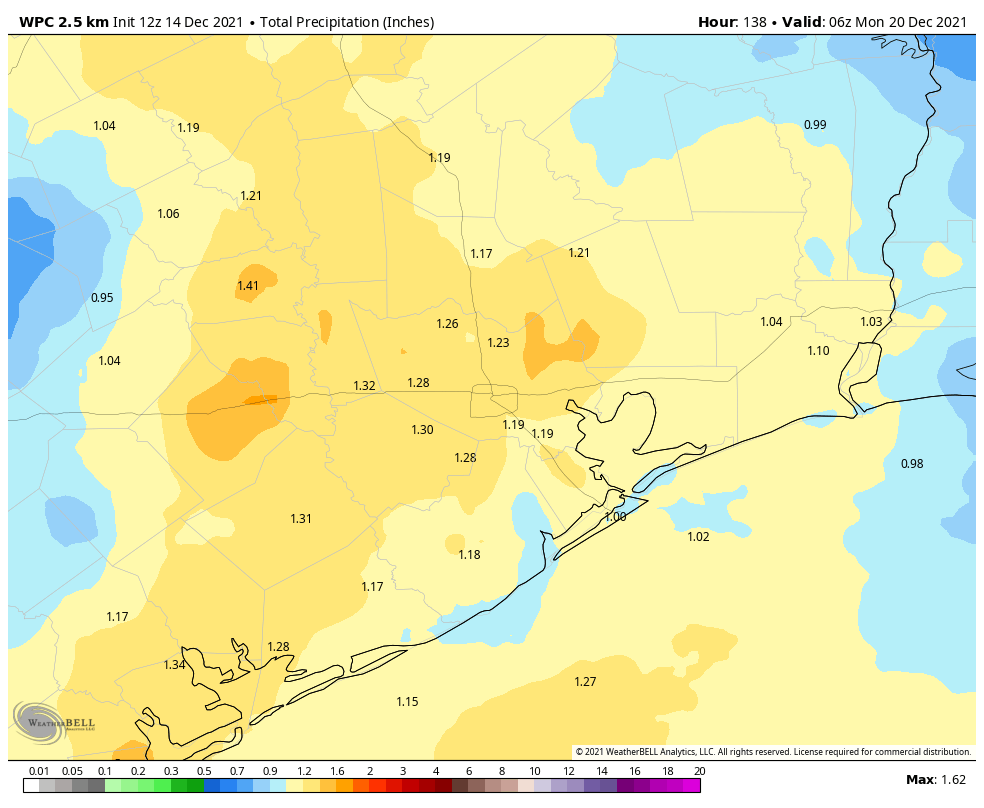
However, change will arrive by the weekend as a front drops down into the region. In terms of timing, my best guess is that the front moves through between sunrise on Saturday and noon. And it’s going to be a wet frontal passage. I don’t think we’re looking at anything extreme, but a line of showers and perhaps some thunderstorms will accompany the front. Unfortunately high pressure won’t move in immediately afterward, which means we’re going to see a continuation of moderate rain chances through Sunday night. Overall accumulations are probably about 1 inch of rain for most, give or take.
NOAA rain accumulation forecast for between now and Sunday. (Weather Bell)
In terms of temperatures, they’ll drop into the 60s in the wake of the front. Clouds will probably limit lows on Saturday night to about 50 degrees in central Houston. Sunday may peak at about 60 degrees, with scattered showers, and lots of clouds. Lows Sunday night will probably drop into the upper 40s in Houston.
Next week
Skies clear out on Monday and this will lead to sunny days and cooler nights. Monday and Tuesday should both see highs in the 60s, with lows in the 40s. (Tuesday morning will likely be the coldest of the week). After that we start warming up, and if you’re wondering about Christmas weather the question becomes the timing of the next front. If one doesn’t come before the holiday, which seems like the most plausible scenario, then your Christmas Day weather may be something like today. (I know, right?) Right now I’d lean 60-40 in favor of no front, versus the next front to cool things down.