Eye on the Tropics: Speculation season has arrived

Like we did in 2020, Eric and I are pleased to bring back the “Eye on the Tropics” series to Space City Weather. Each week, normally on Tuesday afternoons, either myself or Eric will write a more detailed post specific to tropical weather in the Atlantic. This allows us to go more in depth on what is happening, what we are watching, and what might be buzzing on social media with respect to tropical storms or hurricanes. We will keep these weekly updates going into August. Usually by mid-August there’s enough happening each day that we’re covering it in our daily posts.

Anyway, we are off to a roaring start this year.

Tropical outlook in a sentence

While we are monitoring the progress of a tropical wave east of the Caribbean islands and some model solutions have brought that or another system into the Gulf as a substantial tropical storm, there is still far too much uncertainty regarding its future to consider it a serious concern at this time.

2021 so far

Before we get to the Atlantic system we’re watching, let’s hit you with some statistics about the season so far. Claudette’s remnants are steaming out to sea in the Atlantic, our third named storm of the young 2021 hurricane season. While Claudette was quite quick to become our third storm, it did not come close to last year’s speed, when Cristobal was named on the 2nd of June. We won’t threaten the fastest to storm #4 either, as Danielle’s record in 2016 is already in the rearview mirror (June 20th). So, at least we aren’t quite pacing 2020 right now. Beyond that, there’s little to deduce based on this season’s activity so far.

Atlantic disturbance

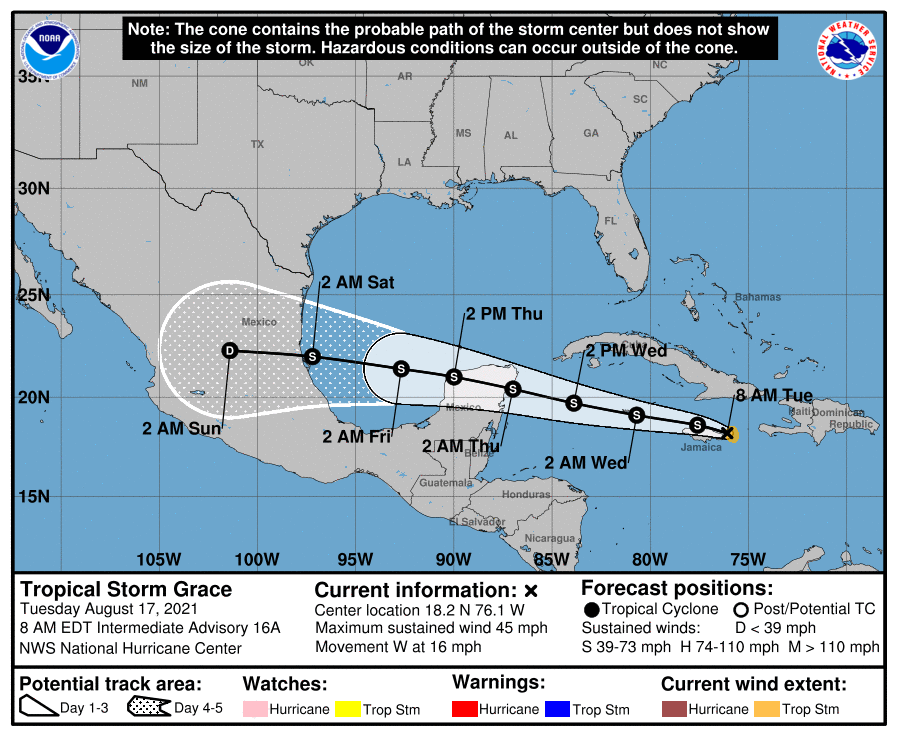
The main thing to talk about this week is a disturbance in the Atlantic basin that the National Hurricane Center is currently giving 30 percent odds of development over the next couple days (Author’s note: Since publication, this has been dialed back to 20 percent odds).

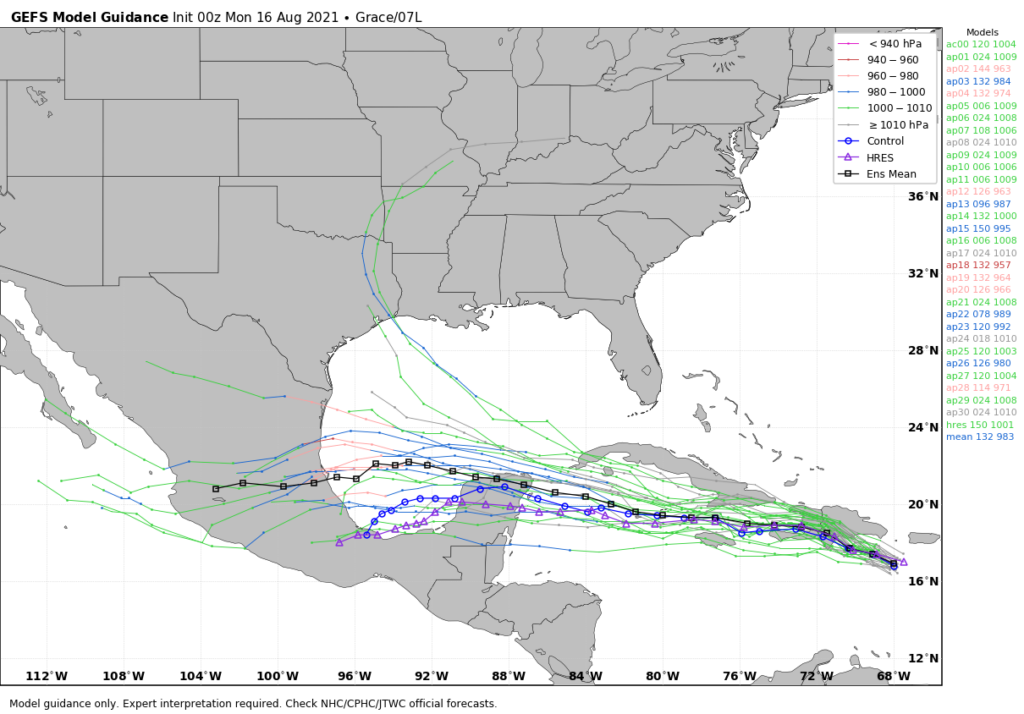
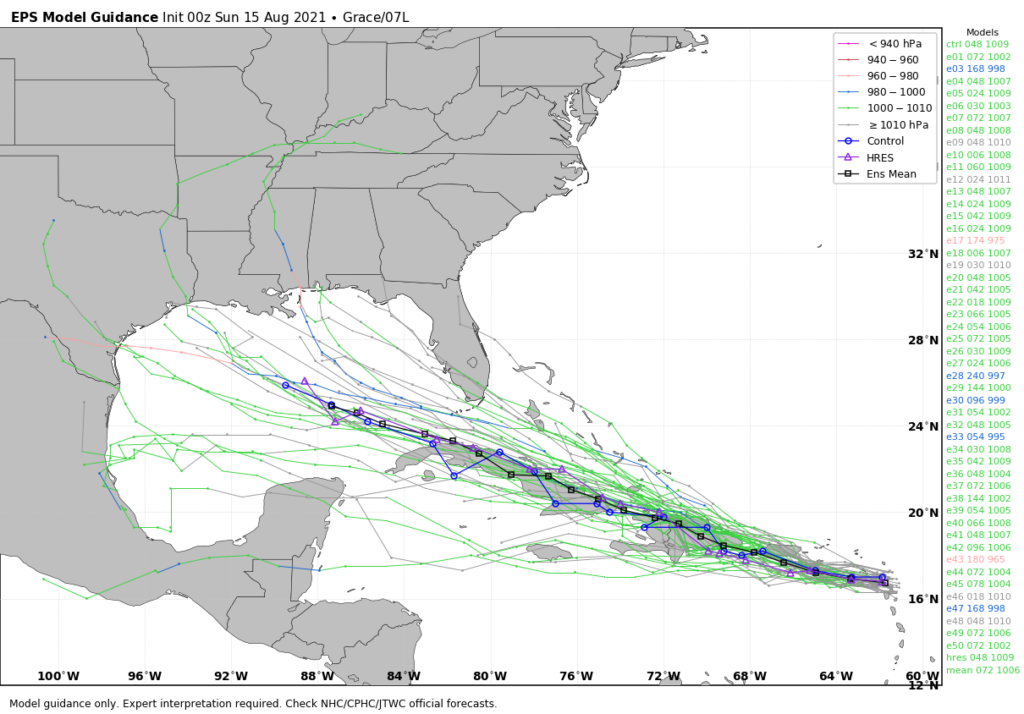
This particular disturbance has probably already caused some folks heartburn as a few social media focused weather pages have irresponsibly shared operational model guidance from Sunday showing a presumed major hurricane hitting Texas in early July. What they don’t tell you, besides failing to offer any context, is that the very same model has subsequently sent a weaker storm to Brownsville, Mobile, the Florida Big Bend, Tampico, New Orleans, and Pensacola in various runs. In fact, I’ve put together a gif of the pinball game the GFS model has been playing lately below.

The GFS operational model forecast for next Friday over the last 6 days has shown a potential tropical system anywhere from Mexico to Texas to Florida to not even developing at all. Operational models aren’t your friends during hurricane season. (Pivotal Weather)

Again, some of the best advice we can give you, besides not looking at operational model runs to mentally prepare for a storm forecast, is to not waste your time on various Facebook weather pages that don’t identify who the authors are and with whom they are affiliated. But I digress.

So the real question is: Should we watch this system? The answer is yes but with the big caveat that there’s probably a very good chance this develops into nothing. And what some models have latched onto in the Gulf late next week may not even be directly associated with this system.

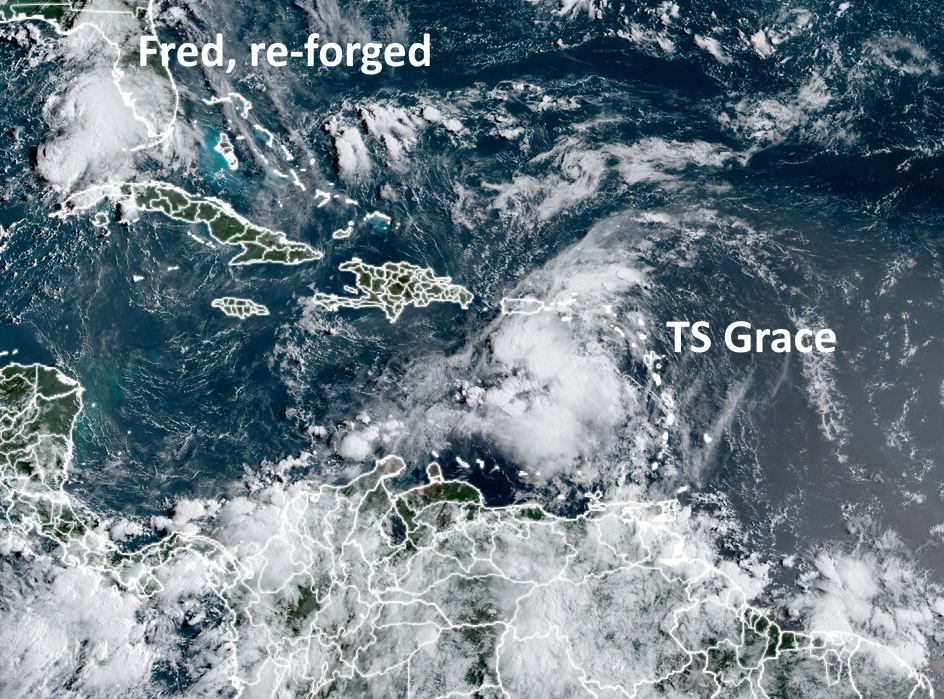
Looking at satellite imagery of the disturbance in question today, we can see just a disorganized “blob” of thunderstorms approaching the southern Windward Islands.

A tropical disturbance west of the Caribbean islands is not well organized but it may slowly try to organized over the next couple days. (Weathernerds.org)

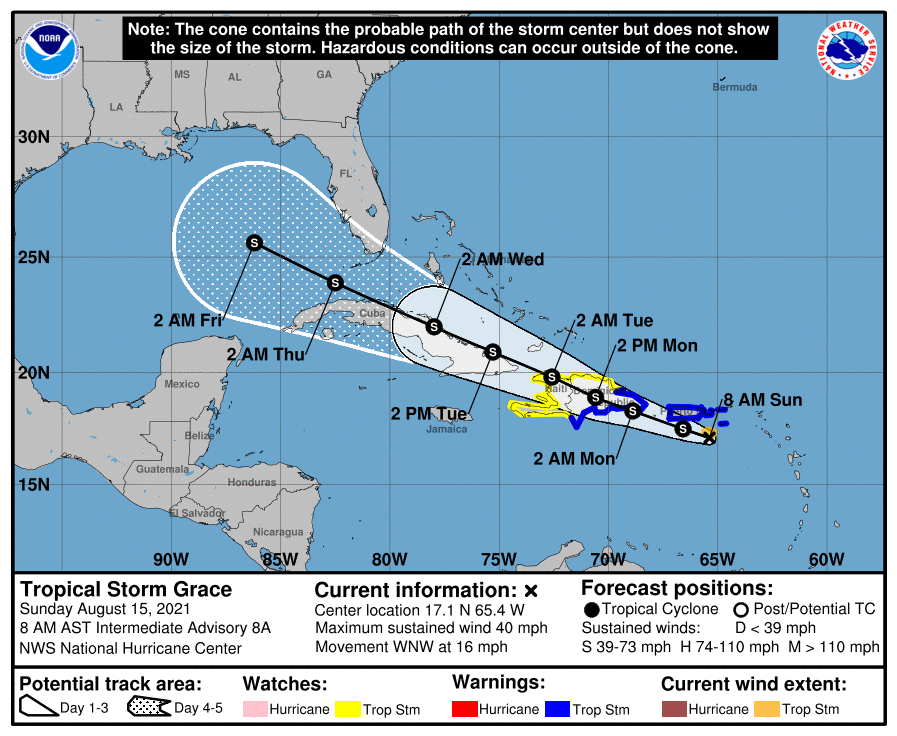
The NHC going with a low chance of development over the next 5 days seems reasonable based on this. The system is likely to be steered west or west-northwest around the periphery of high pressure in the Atlantic. This should bring it into the Caribbean, where conditions over the next 5 to 7 days won’t exactly be hospitable for development.

Wind shear is very high in most of the Caribbean (red color), which makes any sustained or serious development of this Atlantic disturbance unlikely over the next 5 to 7 days. (University of Wisconsin SSEC)

So even if this survives the trip, don’t expect it to be particularly healthy looking when it gets to the western Caribbean.

Beyond that, our ensemble guidance is very lukewarm on development and no real model at a place where I’m sitting up straighter in my chair out of concern. There’s some chance this could end up falling apart completely. It may make its way to the Pacific. Or perhaps it does indeed come to the Gulf. We don’t know, but we also don’t see anything notably alarming in model guidance either.

So the advice? Check back in every couple days for the latest, as you normally would during hurricane season. I would not waste energy worrying about this one though. Hurricane season is a marathon. Inevitably we are going to have to watch a storm or two with legitimate interest and concern come later July, August, or September. So pacing yourself if you can is a good plan of attack.

Anything else?

The good news is that beyond this system, there’s nothing else of note in the tropics. With a cold front crossing into our area this week and possibly another one next week, it’s probably best to not write the unexpected off completely. But there’s nothing in any modeling that suggests we need to really focus on anything specific for at least a little while.

Storms rumbling through Houston as a “cool” front arrives

In meteorological terms, a cool front is in fact moving into the region. However, in practical terms, it’s late June. So don’t expect much cool or dry air. Far inland areas may see some dewpoints in the upper 60s, but overall the only sensible effects from this storm will be elevated rain chances. We saw scattered storms on Monday—some of which were pretty intense on the east side—and a slightly more organized line of storms dropped into Houston overnight. These rains should continue to progress toward the coast this morning.

Tuesday

Skies will clear out later this morning for most of the region, with light northeast winds and high temperatures reaching about 90 degrees. All in all, for late June, not bad. Moisture levels will remain higher south of Interstate 10, so we could well see the redevelopment of at least some scattered showers there after noon today. Overnight lows will generally be in the upper 70s.

You can find lows in the 50s in the Panhandle this morning. (Weather Bell)

Wednesday

The “front,” such as it is, will retreat back north on Wednesday and high pressure will gradually replace it. This will allow for skies to remain partly to mostly sunny, and highs should push back into the low 90s at least. A few showers may develop during the afternoon hours, along the sea breeze.

Thursday and Friday

Full-on summer weather returns, with ample sunshine and highs reaching the mid-90s. Again, the sea breeze may spark a few showers, but most of us will remain dry.

Saturday and Sunday

The high pressure that will make for sunny conditions during the second half of the work week will likely weaken by Saturday, leading to an increase in rain chances. Saturday still will probably be mostly sunny, and with perhaps a 30 percent chance of rain I’d say many outdoor activities should be OK. I’m less confident in Sunday, when shower coverage might increase some, especially during the afternoon hours. Highs will be in the low- to mid-90s, regardless.

By Friday, highs will reach the mid-90s at least for Houston. (Weather Bell)

Next week

Rain chances will likely tick up further on Monday and Tuesday of next week as atmospheric moisture levels are likely to increase, and atmospheric conditions favor rising air. It’s too early to say much about accumulations, but 1 to 2 inches of rain after several hot and sunny days would be not be unwelcome.

Tropics

The Gulf of Mexico is quiet in the wake of Tropical Storm Claudette, but we’re starting to see some signs that the deeper tropics are waking up. (To be clear, there is nothing out there right now that should really concern us at all). Matt will have a full roundup on the tropics in a post early this afternoon.

After the summer solstice days get shorter, but alas, not less hot

The summer solstice arrived late on Sunday night, at 10:32 pm CT. The solstice, of course, is the longest day and the shortest night in the Northern Hemisphere, and results from the 23.4-degree tilt in the Earth’s axis and the planet’s rotation around the Sun. The solstice begins a three-month period known as “astronomical summer.”

In Houston, of course, it generally feels summer-like from June through September. Although our days will now slowly begin to grow shorter, due to our proximity to the Gulf of Mexico and a lag in oceanic warming (and cooling), most of our summer heat comes after the longest day of the year.

The following map, shared by Brian Brettschneider on Twitter, shows the the time of the sunset across the United States and Canada on the summer solstice. This is affected both by the solstice as well as time zones that humans have created around the Earth. The area that sees 24 hours of daylight on the solstice, of course, lies above the Arctic Circle.

Map showing the time on sunset on the summer solstice. (Brian Brettschneider/Twitter)

As for our weather this week, we will experience a couple of more wet and slightly cooler days before high temperatures return into the mid-90s for the second half of this week.

Monday and Tuesday

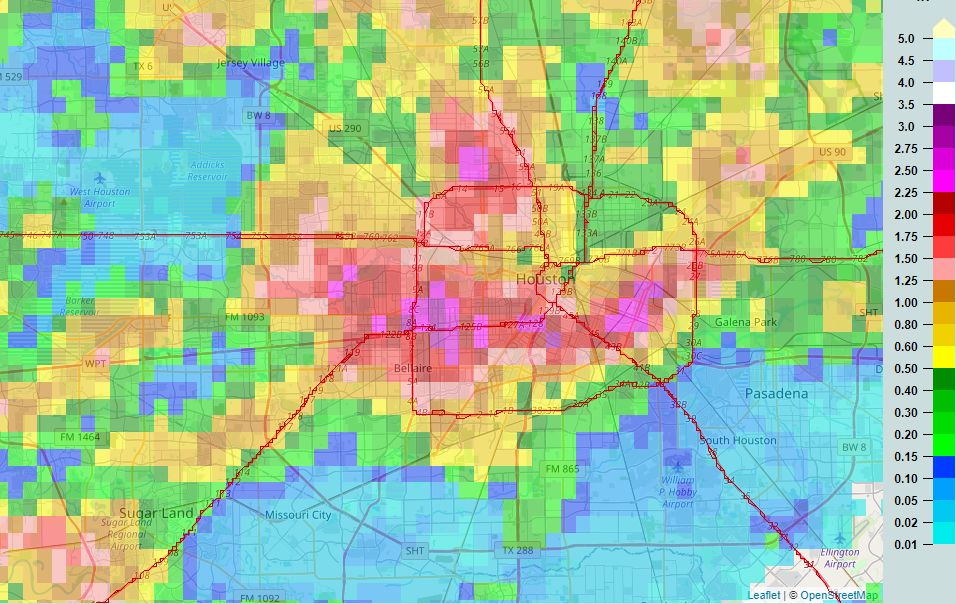
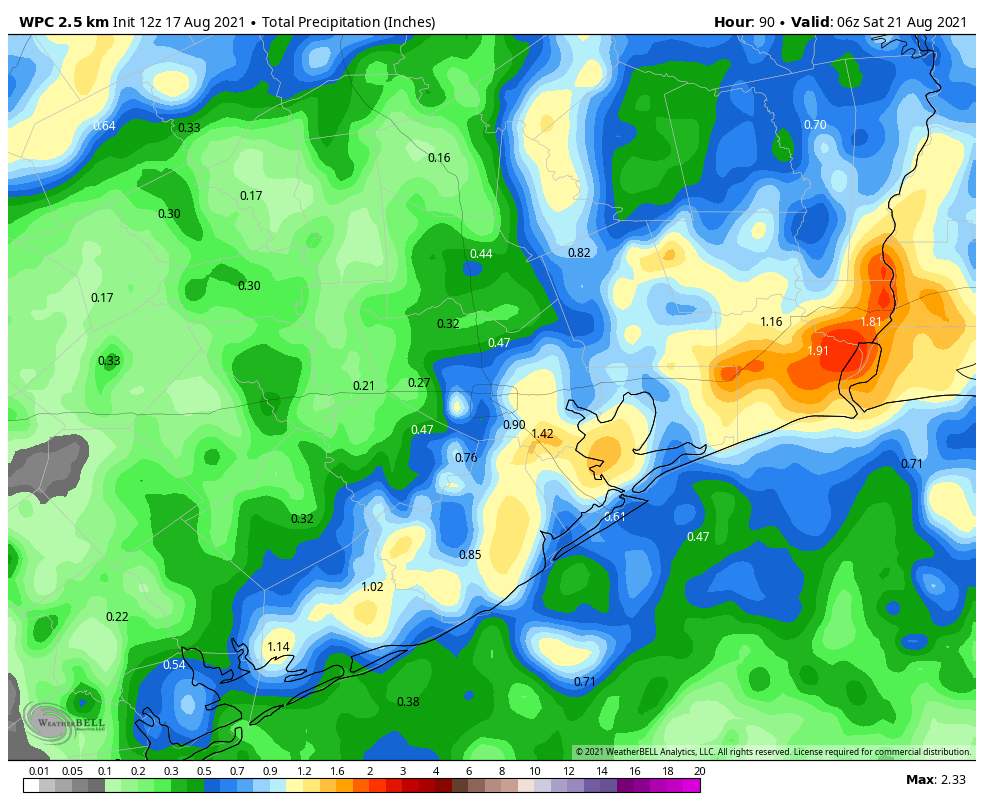
Our weather over the next couple of days will be driven by a cool front—and we’re using the meteorological definition of a front, because it won’t have too much effect on how things feel out there. This front will act to increase the likelihood of rainfall on Monday, Monday night, and Tuesday morning. I don’t think we’re going to see widespread, heavy rainfall, but some of the showers that develop will be capable of fairly intense rainfall rates. I think much of Houston will see 0.5 to 1.5 inches of rain, with a few bullseyes of 3 or more inches possible. Our best rain chances will likely come during the overnight hours.

In terms of temperatures, most of us will see highs around 90 degrees for the next two days due to the combination of cloud cover and the front. Will you feel it? If you live inland of Interstate 69/Highway 59, and you go outside on Tuesday evening or Wednesday morning, it may feel slightly drier outside.

NOAA rain accumulation forecast for now through Tuesday. (Weather Bell)

Wednesday, Thursday, and Friday

For the second half of the week we should see mostly sunny skies as high pressure begins to build over the area. Highs will likely rebound into the mid-90s and we’ll be right back into full-on summer days in Houston, with overnight lows of around 80 degrees.

Saturday and Sunday

The weekend forecast is a little bit less certain, as yet another front is likely to approach the region. However, this one very likely will stall out before reaching the Houston metro area. Nonetheless it may introduce some clouds and rain chances for the weekend. It does look like Saturday will be mostly sunny, and while there may be some scattered showers, the chances for wider rainfall likely will not come until Sunday. But all of these details will need to be hashed out in future forecasts.

Father’s Day may see the return of storms, especially near the coast

Hi all. I’m jumping in on Father’s Day to say that we are seeing some fairly high atmospheric moisture levels this morning that may, in turn, lead to at least scattered thunderstorms today, if not more widespread storms. This will provide a contrast to the recent string of hot and sunny days Houston has experienced.

NOAA rain accumulation forecast for Father’s Day. (Weather Bell)

The next three days all look fairly wet for the region. Given the higher moisture levels, a disturbed atmosphere, and a weak “cool” front on Monday night and Tuesday, each day should see elevated rain chances. Sunday through Tuesday will each probably have about a 50 to 70 percent chance of rain during the daytime, with lesser odds at night. The better rain chances will come closer to the coast, and for the eastern half of the region.

In terms of three-day accumulations, most of the area will probably see 0.5 to 1.5 inches if rain. However, for areas closer to the coast, and east of Interstate 45, it would not surprise me to see some areas pick up 3 to 5 inches between now and Tuesday night.

It’s not going to be a total washout, by any means. And areas west and north of Houston will likely see a fair bit of sunshine over the next few days. But if you’re heading to the beach to celebrate dad today, you probably should also buy him an umbrella as a gift—just in case.

We’ll return with a full post on Monday morning.