Good morning! Although some parts of the Houston area saw flakes or sleet on Sunday, the real snowfall action remained to the north and west of the Houston metro area. Bryan-College Station saw a record 4.5 inches, and some nearby areas saw as much as 6 inches. For the rest of us closer to the coast, it was just a cold rain, with an average of 1 inch falling during what was a very chilly day. We’ll continue to see cold weather for much of the rest of this week, which falls during the dead of winter.
Monday
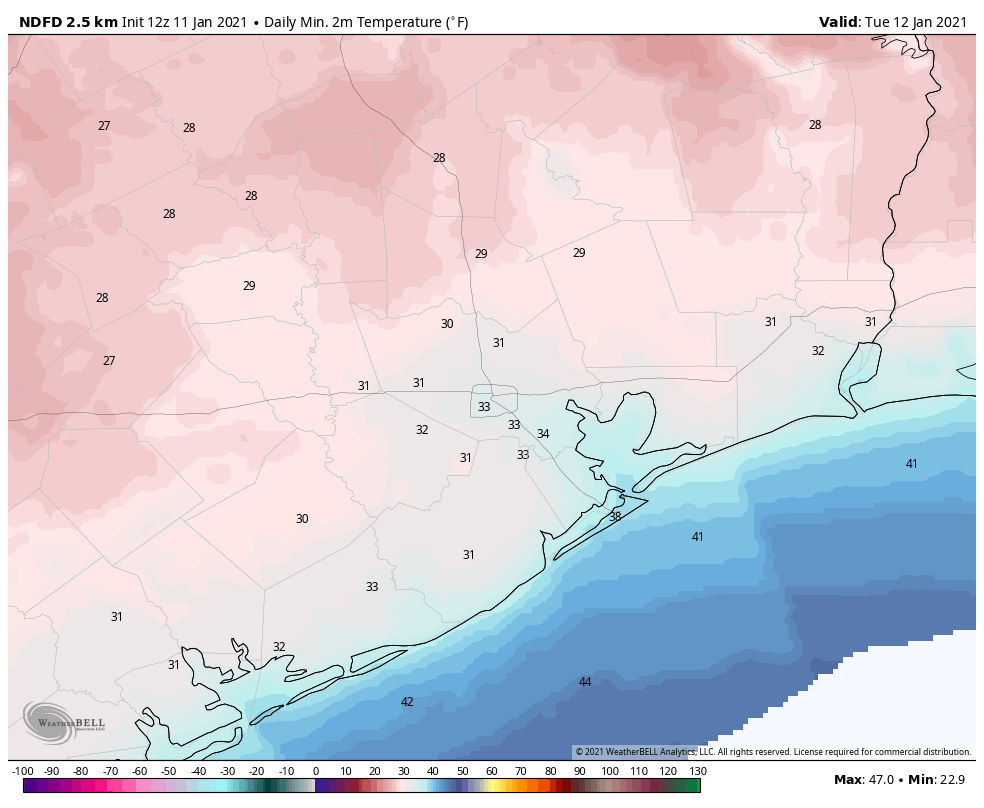
While winds have slackened for inland areas this morning, it remains breezy along the coast with gusts above 20 mph. Temperatures have bottomed out in the low 30s across much of the region and with mostly cloudy skies, high temperatures today probably won’t rise above the mid-40s. Winds will remain out of the north today, at 5 to 10 mph. Skies may break apart a little bit later tonight, but with partly to mostly cloudy skies providing a little bit of insulation most of the city should remain near or just above freezing. Outlying areas will see a freeze.
Low temperature forecast for Tuesday morning. (Weather Bell)
Tuesday, Wednesday, and Thursday
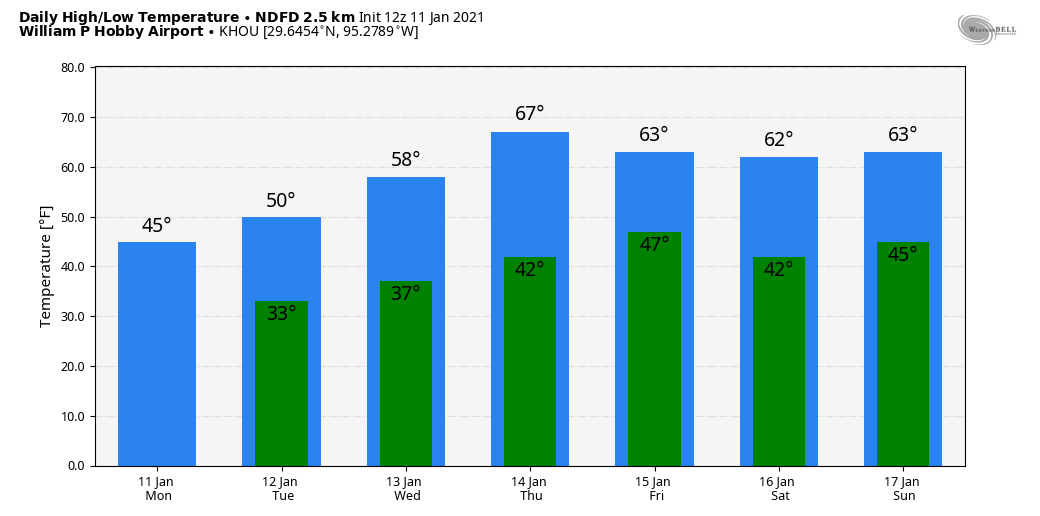
High pressure should more or less keep conditions on the mostly sunny side this week, and after a very cold Monday night a slow warming trend will begin on Tuesday. Look for highs in the low 50s on Tuesday, headed toward the upper 60s by Thursday. Nighttime temperatures, too, should warm from the low- to mid-30s on Tuesday night to mid-40s by Thursday night. All in all this will be a cold, very winter-like week for Houston.
The weekend and beyond
So what does the weekend hold? A cold front appears to be on track to cross the Houston area on Thursday night, or so. Right now this most likely will be a dry passage, with no rain, and bring more clear and cool weather for the weekend. We can probably expect highs in the neighborhood of 60 degrees, with lows down around to around 40 to 45 degrees.
Temperatures will warm up as the week goes on, but a front Thursday will stop the trend. (Weather Bell)
Some clouds may begin to build later on Sunday—at about the same time our confidence in the forecast begins to decrease. Next week looks warmer, with more days in the 60s, and with more clouds. After our soaking and near miss with wintry precipitation this past Sunday, our next real chance for precipitation may not come for awhile. We don’t really need any more rain, so can anyone complain?
We’ve been talking for several days about the collision of a cold air mass, in the form of a strong front, colliding with southerly moisture near Houston this weekend. The question for some time has been how far south the coldest air will get, and therefore where the line between rain, sleet, and snow will fall. As of late Sunday morning, we think that line will be further south than anticipated, possibly all the way down to Interstate 10. We will soon find out for sure—the best chances for a wintry mix will come this afternoon and evening.
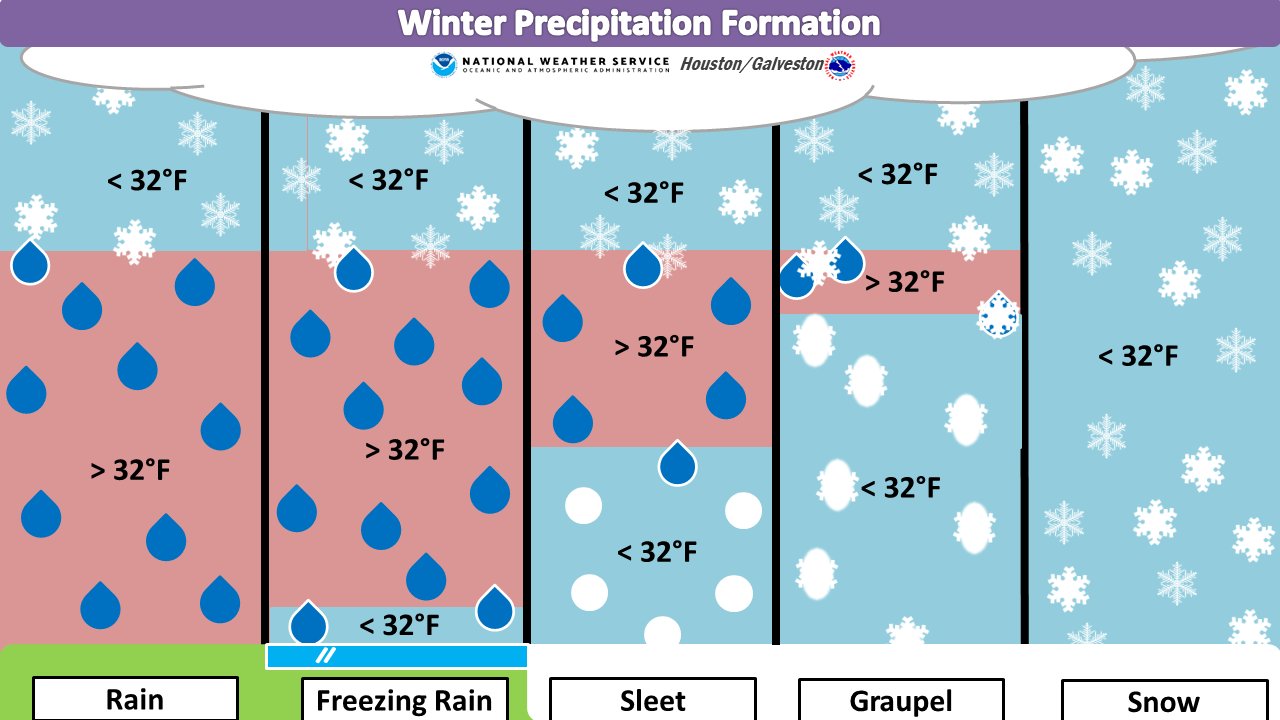
As of 11am, precipitation is now moving into much of the Houston area. Already, rain has turned to snow in College Station, and a few locations in Montgomery County have reported sleet. As a quick reminder, the entire atmospheric column needs to remain at freezing temperatures to form snow, otherwise you can end up with sleet or even freezing rain.
How different types of winter precipitation form. (National Weather Service)
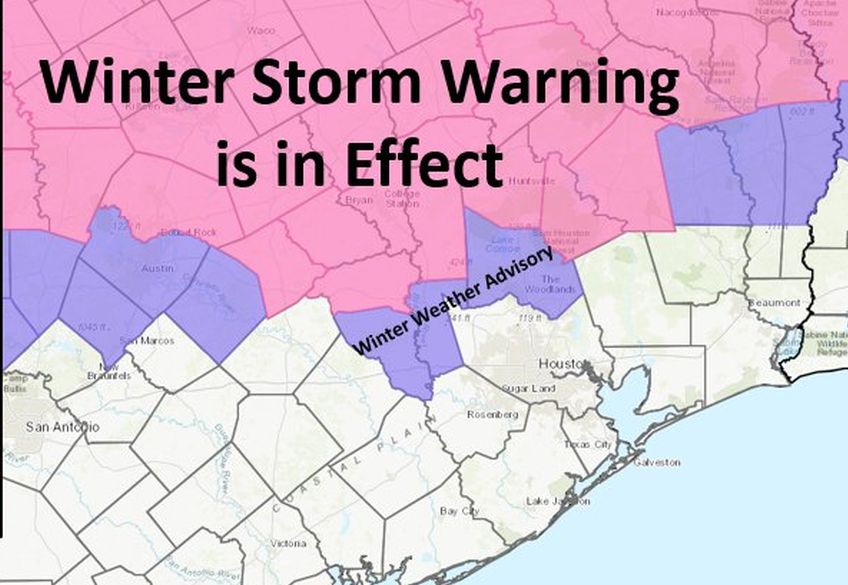
As we get deeper into Sunday and Sunday evening with this storm, we wanted to share some key messages we think it’s important to share. For this, it’s important to know whether you live in an area with a “Winter Storm Warning,” a “Winter Weather Advisory,” or no warnings at all. Most all of Houston is not under a warning, but that doesn’t mean we won’t see any effects.
Winter storm warnings. (National Weather Service)
Areas under a “Winter Storm Warning” face the greatest risk. And although there remain large amounts of uncertainty, it seems likely that much of the region shown in pink, above, will see 2 to 5 inches of snow. This is enough snow to cause significant problems in terms of driving, so travel to these areas later Sunday through Monday morning is not advised.
Areas facing a “Winter Weather Advisory” likely will receive less than 2 inches of snow, and perhaps also some sleet. This is still enough of a wintry mix to cause problems on roadways, but because temperatures this afternoon should remain above freezing at the surface some travel today is OK. However, as temperatures fall to or near freezing tonight, travel may become problematic.
For all other areas, surface temperatures should remain above freezing on Sunday and Sunday night as precipitation comes down. Therefore, while you may see some flakes in the air, or sleet, as far south as Interstate 10, it is unlikely to accumulate. The real question, of course, is, Is it going to snow at your house? For nearly all of Houston there’s a non-zero chance, but if you’re along or south of Interstate 10 the chance is still quite low. We will update later today if this changes.
This mess will come to an end tonight, as drier air filters into the region from the west. Generally, precipitation should taper off from west to east from about 10pm to 2am, or thereabouts. Monday will be a very cold day, with mostly cloudy skies and highs in the 40s for most of Houston.
Good Saturday afternoon. With a bonafide winter storm on the way, we’ll keep you posted on things this weekend. Most of the morning model data is in, and we can discuss some of what is shown and lay out some thoughts for what might actually happen tomorrow.
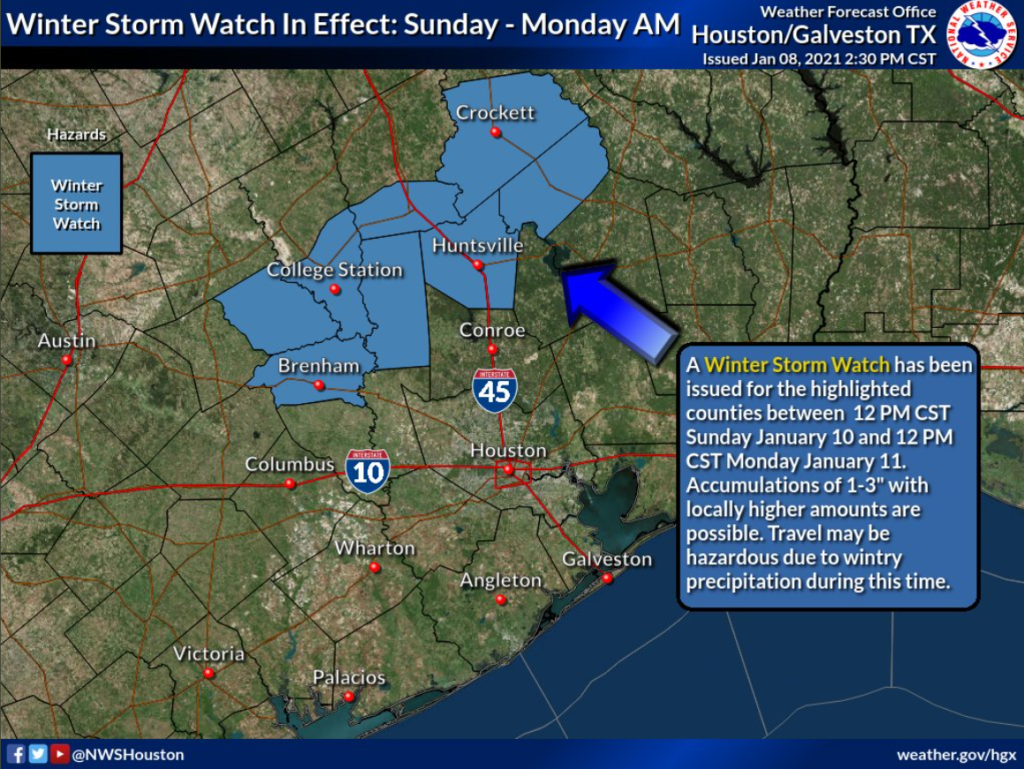
First, the housekeeping: A Winter Storm Watch (as of 2 PM CT Saturday, still a watch) is posted to the north and northwest of Houston for the Brazos Valley, Walker, Trinity, and Houston Counties. We expect this to be upgraded to a warning before this evening, and it’s possible an advisory or watch is expanded south also.
Winter Storm Watches are in effect for Sunday northwest of Houston. These will be upgraded to warnings later today. (NOAA)
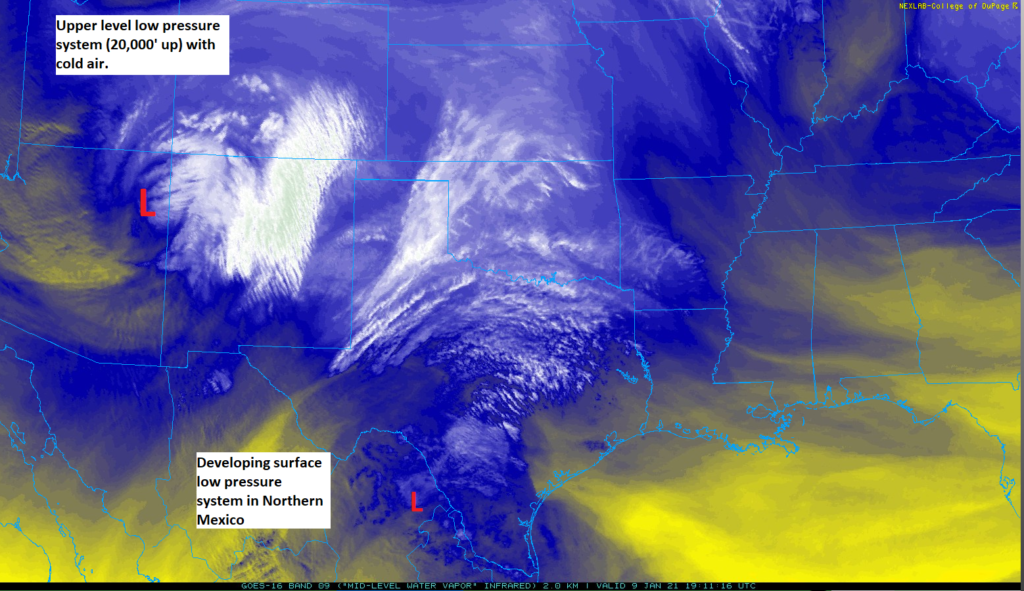
On satellite, the two features we are most interested in stand out nicely this afternoon. We’re looking at the water vapor channel on satellite, which shows us where dry air and moisture are located. Over the Four Corners region, you can see a swirl in the clouds representing low pressure about 20,000 feet up, our upper level storm. Over northern Mexico, you see moisture gathering, which is where low pressure at the surface will begin to develop. The system in Mexico will help deliver moisture and precipitation. The upper low will help deliver cold air behind a front. The combination is why we’re talking about winter weather.
Water vapor satellite imagery shows the upper level storm over Arizona and the surface storm developing over Mexico that will combine to bring snow and sleet to parts of the region tomorrow. (College of DuPage)
We still believe rain will develop tomorrow morning across the entire region. Everyone should begin as rain, as cold enough air for anything else won’t arrive til later. Look for snow and sleet to begin mixing in with the rain well northwest of the city tomorrow by early afternoon. Think: College Station, Madisonville, Crockett. The rain/snow or sleet line will continue to nudge south and east tomorrow afternoon and evening, arriving in places like Brenham, Navasota, and Huntsville by late afternoon. From there, how much farther southeast could the rain/snow line get? Ultimately it will depend on the exact track of the storm, but I expect it will get close to places like The Woodlands, Conroe, Hempstead, or Cleveland before all is said and done.
In addition to that, as discussed earlier this week, we could be talking about dynamic cooling (where the rain falls so hard, it pulls down enough cold air to flip over to snow or sleet for a time) driven snow or sleet virtually anywhere north of I-10 late tomorrow afternoon or evening. It wouldn’t accumulate much, if at all, but if you see snowflakes falling or hear sleet pinging, don’t be shocked.
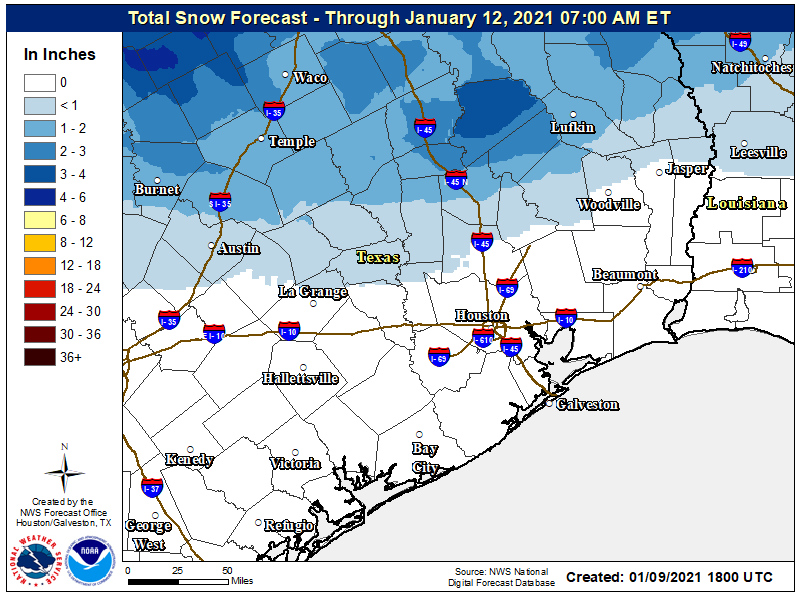
So the question becomes: How much snow for places north of Houston? For The Woodlands or Conroe, right now we don’t expect much. Maybe a slushy coating if things break right (or wrong depending on your viewpoint). However, as you go north of there toward Huntsville west toward College Station or east toward Lufkin, it gets dicey. Here’s the current forecast from the National Weather Service as of early afternoon Saturday:
Snow forecast as of early Saturday afternoon for southeast Texas. (NOAA)You can see about 1 to 2 inches for Huntsville, less as you go south, more as you go north. It is notable that there are some weather models that show considerably higher snowfall amounts up that way, up to 4 to 6 inches of snow or even more in spots.
There are two main problems in determining how much snow will fall. One is the storm track, discussed a bit above. The second is something I made a Twitter thread about earlier today: Sleet. Sleet can destroy a snow forecast. I’ve been burned many times by that. The more the precipitation that is frozen falls as sleet, the less snow accumulation there will be.
Let's look at 7 PM Sunday. Here's the 12km NAM thermal profile for Huntsville. Definitely good for snow with the entire column except the surface below freezing. pic.twitter.com/eqHSdtHUOS
And right now, the temperature profiles north of the Houston region are a mess, with a very, very fine line between a cold rain, sleet, or snow. That could mean the difference between someone seeing a coating or 1 inch or someone seeing closer to 5 inches of snow.
The GFS model at Conroe for that same time shows a very mild temperature profile with above freezing temps from about 7,000' above down to the surface. That's a cold rain. Alternatively, the NAM has a fairly substantial subfreezing layer that allows for sleet instead. pic.twitter.com/Qm0hLlmOid
That’s a big, big deal, and it’s very difficult to pin down. So forecasting how much snow falls will be challenging, but who sees the snow? That should be a little more straightforward.
If you live in the city of Houston, keep hope alive (if you want snow), but the odds are going to be quite low. If we do see snow in the city, I would target the 9 PM Sunday to 2 AM Monday window to catch a fleeting glimpse.
If you want to see legitimate snow and feel comfortable traveling: Huntsville, Crockett, or College Station are as good a bet as any right now, though not quite a full guarantee. Just keep this in mind if you do plan to “snow chase” tomorrow: You will have to come back at night, with temperatures getting colder. While it should be fine in Harris County and most surrounding counties, there may be difficult, slippery travel up north. So just make sure you exercise wise judgment, are prepared in case it gets bad, and please be safe.
Good morning. Today’s post will be fairly brief, as I went in depth rather significantly on weekend snow chances yesterday, and we will be keeping you posted this weekend. To be quite frank, not much has changed since yesterday’s post, although trends overnight were slightly warmer. But still, let’s jump in.
Today & Saturday
Not much weather to speak of over the next 24 to 36 hours. Today will see a bit of low cloud cover in parts of the area this morning give way to mostly sunny skies. Look for highs in the mid-50s. Tonight will see clear to partially cloudy skies with lows in the 30s and 40s. High clouds may dim the sun a bit tomorrow, but otherwise, it will be a mainly nice day with highs once again in the mid-50s.
Sunday
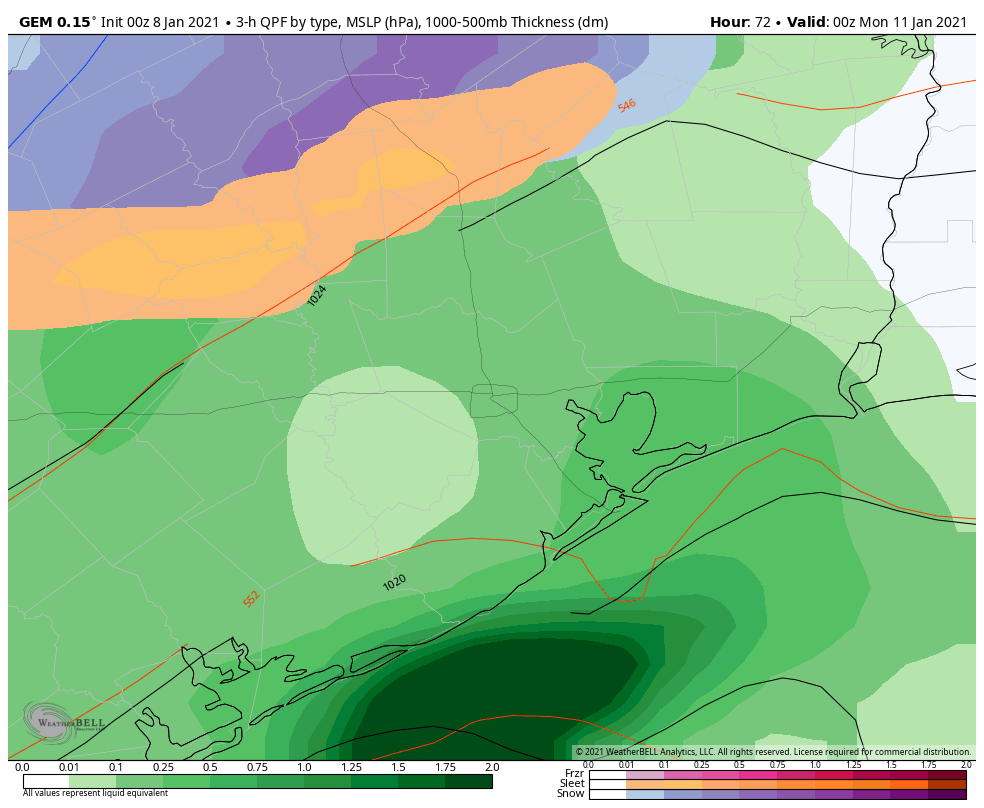
So the forecast for Sunday looks mostly on track with the big picture details being cloudy skies to start with rain developing from west to east through the late morning and afternoon. The thought right now is that basically the entire area from the coast through Conroe (Highway 105) will begin as rain. As the atmosphere cools later Sunday afternoon and evening and the rate of precipitation increases, that’s when we’ll start to likely see some snow reports begin to trickle in from places like Huntsville or Lake Livingston or College Station. It’s possible a few locations farther south closer to Houston see snow mix in if it rains hard enough Sunday afternoon.
One model (Canadian) depiction of what might be falling at 6 PM on Sunday, with rain for most of Harris County and south of I-10, but mixed rain and snow as you go north of Harris County, and mostly snow perhaps north of Highway 105. (Weather Bell)
As we go deeper into Sunday evening, watch for more snow reports to come in from places even farther south, more into Conroe or The Woodlands or Tomball out into Cleveland and Liberty. Rain may turn to mostly snow in some of those places before ending after midnight. And perhaps the rain will end as some light snow in Houston also after midnight.
Will snow accumulate? As of right now that seems very unlikely in the city of Houston and most of Harris County and surrounding counties to the west, south, and east. For Montgomery County and points north from there, yes, snow might accumulate a bit. Right now I wouldn’t expect more than an inch or two, mostly on grassy surfaces and trees, but we could see more in spots depending on how things come together. Slick road conditions are indeed possible up that way Sunday night and Monday morning.
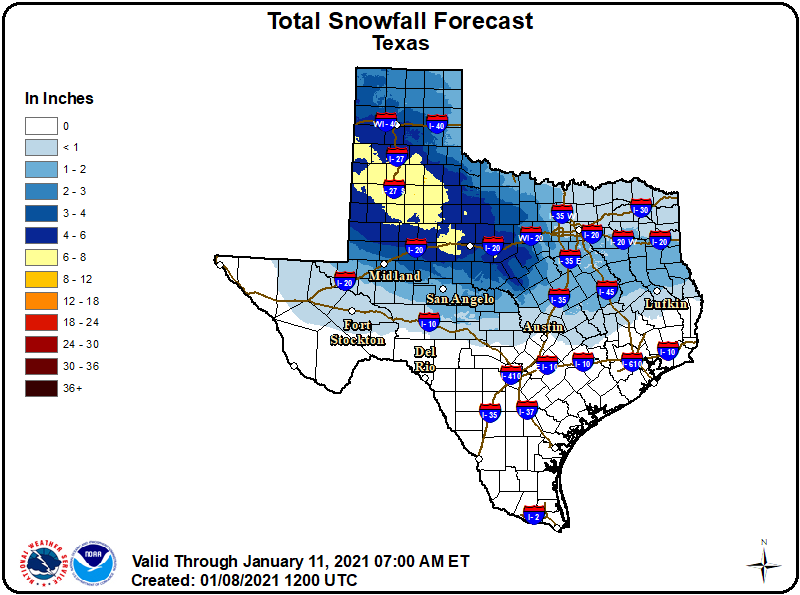
As of Friday morning, the snowfall forecast for Texas shows a wide band of 4 to 8 inches of snow to the north and west of about Waco, with snow totals dropping into the 1 to 3 inch range east of I-35. Again, this too could change.
The current snowfall forecast calls for 4 to 8″ of snow over a wide swath of West Texas, with totals dropping to 1 to 3 inches as you get east of I-35. (NOAA)
Once more, we have to underscore that because storm tracks matter a lot and a few miles can make a world of difference, there is still substantial uncertainty surrounding this forecast. Much may change by Sunday morning. We’ll keep you posted this weekend. I mean, can you tell that I’m excited by this? Has it shown at all?
Again, in addition to the snow aspect of things, there will be locally heavy rain (up to an inch in spots, more perhaps near the coast) but probably no serious flooding. Thunderstorms are possible. And coastal issues, such as rip currents, rough seas, strong winds, and even some tidal flooding will be possible also.
Monday and next week
Look for clouds to hang tough on Monday behind the storm, with cold and windy conditions. Clouds clear for Tuesday, Wednesday, and probably Thursday. Look for temps to rebound into the 50s and eventually 60s. Morning lows in the 30s Monday morning (and perhaps a freeze north of the city) will rebound into the 40s by midweek.