This weekend a reader reminded me of something we published two years ago—an answer to the question of when would be the best time to plan an outdoor wedding in Houston in anticipation of fair weather. After a bit of research we concluded that, “the best time for outdoor weddings in Houston is the last two weeks of March, during the afternoon or evening hours.” Melanie said she had just had a wonderful wedding, and I must admit these two weekends during the last half of March have been pretty pleasant. Forecasts don’t always work out, but it’s nice when they do. Congratulations Melanie!
Monday
We’ll continue to see warm weather to start the week as a southerly flow persists. Winds today will be out of the south at 10 to 15 mph, with higher gusts. As this happens moisture levels will increase in the atmosphere, and we’ll start to see some clouds in the sky. However, I think enough sunshine will break through to allow high temperatures to reach the low- to mid-80s. Winds will slacken a bit tonight as lows drop into the 60s.
Tuesday
This will be even a windier day as the southerly flow deepens. Gusts out of the south may reach 30 mph or even higher, and this will bring more clouds and warmer air into the region. Despite partly to mostly cloudy skies I think highs will again push into the low- to mid-80s. Lows on Tuesday night may drop below 70 for some coastal areas, with sticky dewpoints, and will only be slightly cooler for inland areas.
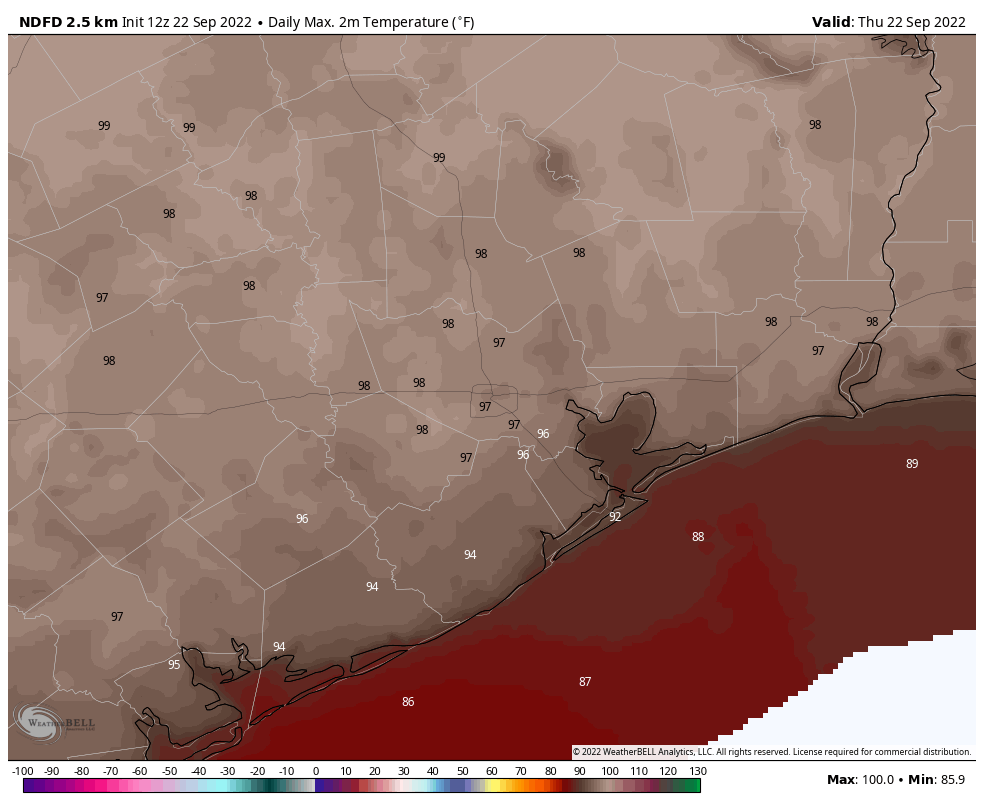
Your forecast for high temperatures on Wednesday. (Weather Bell)
Wednesday
A cold front will move through the region on Wednesday morning. The timing is still uncertain, but for now I’d peg its passage during the pre-dawn hours for College Station, mid-morning in Houston, and off the coast by or before noon. It looks like a line of storms may form with this front, bringing some briefly heavy thunderstorms and straight-line winds. The overall threat of severe weather looks fairly low, however. Highs Wednesday will likely get into the 80s after the front with sunny skies, but the drier air moving in will allow to drop into the 50s overnight.
Thursday
This should be a super nice day, with highs in the 70s, dry air, and lots of sunshine. Winds look fairly light, as well.
Thursday morning will be the coldest of the week. (Weather Bell)
Friday
The onshore flow resumes on Friday, so we’ll probably see some clouds form as highs reach the upper 70s to 80 degrees.
Saturday and Sunday
Some showers are possibly heading into the weekend, as a modest front moves through. At this point it looks like things will clear out by Saturday morning-ish, allowing for mostly sunny weather from thereafter through the weekend. Highs should be around 80 degrees, give or take, with lows in the upper 50s. Winter is long gone, my friends.
We’ll get to all the sun and sneezes in a minute. First, let’s talk drought again. This week’s rainfall came at a good time. Much of the state saw at least some rainfall from the storm. This led to about 3% of state being removed from drought (and about 25% of the Houston area being removed from drought as well).
Drought concerns were eased some across Texas, especially in the Houston area through Austin with this week’s storm. (US Drought Monitor)
We will probably need a storm a week affecting a greater part of Texas to remain with minimal drought concerns and to improve the situation elsewhere in the state. We may see one storm next week, but it looks less widespread and significant than this week’s storm as of today. No one will complain if we can keep the tornadoes away from Texas though.
Weekend
Today, tomorrow, and Sunday look great. Each day will see a little bit of warming, and it will feel solidly like spring. Look for about 80 or so today, and low 80s tomorrow and Sunday. Morning lows will generally be in the 50s both Saturday and Sunday. It will be sunny with low humidity but perhaps just enough to allow for some morning fog in spots. Winds will be light to moderate all weekend, generally about 10 to 15 mph.
Monday should just be an extension of the weekend with a good amount of sunshine. But there will be some changes. As a strong storm wraps up in the central Plains, onshore flow will begin to strengthen on Monday and Tuesday. Winds will likely jump to 15 to 20 mph, with higher gusts at times, especially along the coast.
The forecast map for Tuesday shows strengthening low pressure over Kansas and Nebraska which will help drive up onshore winds across Texas. (NOAA)
The next front will cruise through probably on Wednesday with a chance of showers and storms. At this time, it does not look to be too big a deal, but we’ll keep tabs on things. That should usher in another couple days of fair weather to close out March. Ahead of the front, look for temps in the 80s, with lows in the 60s, and noticeably more humidity than the weekend. Behind the front, we’d probably cool into the 70s with lows perhaps in the 50s.
Good morning. Houston’s forecast continues to hold no concerns weather-wise, with spring-like conditions persisting as far as the eye can see. Of course springtime in Houston also means that our lawns, trees, and flower beds start to emerge from their wintertime slumber. And that means pollen. For now, the major concern comes from our trees—particularly oaks—shedding pollen. According to the City of Houston’s Health Department, tree pollen levels are “extremely heavy” at present, having risen nearly 10-fold over the last week.
(City of Houston Health Department)
This, of course, will pass after a few weeks. But until then expect to feel the effects on your allergies, or in a thin film of yellow-greenish dust on your vehicle or other surfaces outside. This is a small price to pay for summertime shade!
Thursday
Temperatures have generally fallen to about 50 degrees this morning, and we’ll see another sunny day today with highs pushing up to around 70 degrees. You probably won’t notice it too much, but a reinforcing shot of dry air should arrive this afternoon with another moderate front. This will be felt most keenly as winds shift to come from the north-northeast this afternoon. Lows tonight should drop into the 40s with drier air and clear skies.
Friday, Saturday, and Sunday
As high pressure in the wake of this second front dominates our weather, expect fair conditions through the weekend. Each day will see high temperatures of around 80 degrees, with nights mostly in the 50s. Skies will be mostly sunny, with the possible exception of Sunday, which may see a few clouds. Dewpoints will start to rise this weekend as winds turn southerly, but there will be enough dry air both days such that it won’t feel overly humid. So, yeah, this will be a great spring-time weekend.
Here come the 80s! (Weather Bell)
Next week
As the onshore flow gets going, clouds will return next week, along with some modest rain chances by later Tuesday and Wednesday. Highs will remain in the range of 80 degrees, with nights in the 60s. It looks like our next front, a relatively weak one, will arrive later on Wednesday or Thursday, likely dropping lows back into the 50s.
Welcome to a semi-regular series at Space City Weather we’re going to call “SCW Book Club.” Anyone who follows me (Matt) on Twitter knows I almost always share what I am reading with everyone. Often it has to do with Revolutionary Era history, but sometimes I actually read about stuff that is more relevant to my job. The goal of these posts is to share with you books about topics relevant or tangential to weather, specifically here in Houston. Given that I do read about other things (like the history of Ukraine at the moment), this will be an irregular series, but I will make sure to make mention of what relevant read I will be tackling at some point next, hopefully sooner than later.
The first book I want to share with you in this series is Rachel T. Kimbro’s “In Too Deep.” Kimbro is the Dean of the School of Social Sciences at Rice University and a professor of sociology. Her recently published book, “In Too Deep” examines the experiences and decision-making processes of a group of 36 mothers in an upper-middle class neighborhood of Houston. She does not name the flood-prone neighborhood, instead calling it “Bayou Oaks, which is a pseudonym for the area in southwest Houston. If you read the book and are from Houston, it becomes fairly evident which general neighborhood is being discussed. Much of the neighborhood’s identity centers around children and the elementary school, which provides a major focus of the book.
“In Too Deep,” by Rice Dean of Sociology, Rachel T. Kimbro tells the story of Hurricane Harvey through the experiences of upper-middle class mothers in Houston. (University of California Press)
In her introduction, Dr. Kimbro argues that the disaster experiences of more affluent families are an overlooked part of disaster research, which understandably often focuses on those most vulnerable with the fewest resources to call upon. After reading her book, it makes a lot of sense to me why it was a good idea to write, beyond the story it tells. Kimbro details why these families chose to live in this particular neighborhood and why they rejected the suburbs or other neighborhoods in the city. That becomes important in understanding why most of them chose to stay, even after repetitive flooding.
She coins a phrase in the book that I find quite useful: “Flood capital.” In other words, the experiences of these families through repeated flooding, as well as their extremely deep social network in the community provides them access to resources many people in our area can’t find as easily. Some of these families were able to make arrangements for housing and repairs even before the storm hit because of the flood capital they had gained. This of course is in addition to their well-off socioeconomic standing that allows them access to many financial and recovery resources as well. As Kimbro notes, there is disaster research suggesting that those that are well-off before a disaster are often even better off after the disaster and disasters actually increase social inequality. Her research will add to the understanding of how that could be.
The bulk of the story really does focus on the mothers though. They generally raise their families using the principal of “intensive mothering,” which is basically child-centered, expert-guided, labor intensive, and expensive. The book delves into how this parenting technique is practiced specific to these families. You’ll also learn how within these families, there is a large difference between how the fathers and mothers viewed the risks from Harvey, as well as how they managed the recovery. I will just say that the mothers of this story handled the majority of the labor involved in both the preparation and recovery, and they have been through an awful lot.
This topic is not one that’s easy to discuss, and it’s one that is uncomfortable at times. But the story is critical to understanding the Harvey experience, disasters, why buyouts won’t appeal to everyone, and why some people fare so much better than others. This should help shape how community leaders can help less well-off residents improve their reactions and response to disasters. Additionally, it shines a light on why people stay in places they know are disaster-prone, which can offer food for thought for community planning in the future.
Kimbro’s writing is really clear and understandable, and the book makes for a pretty brisk read. She seamlessly weaves in the sociology with first-hand accounts from the mothers she interviewed, and it makes for an informative story — but still a story. This book has valuable academic results, but it does not read as an academic book, which should allow it to appeal to a broader audience. I thought it was excellent, and I would encourage you to consider also giving it a read.
A quick warning: The book does discuss the actual flooding, damage, and impacts, so for some of you, it may trigger unpleasant memories. While still very informative, if you were deeply impacted by Harvey it will be an uncomfortable read at times.